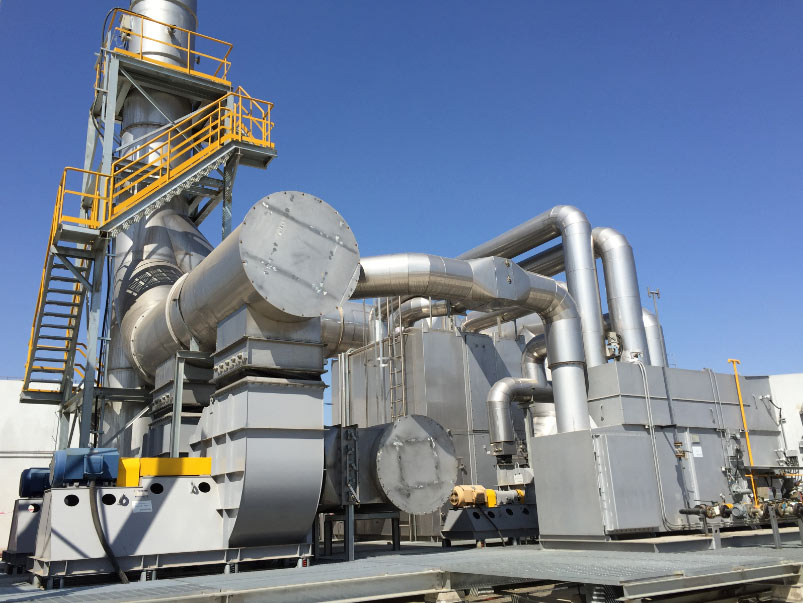

A catalytic oxidizer (CO) destroys volatile organic compounds (VOCs) and hazardous air pollutants (HAPs) at a lower oxidation temperature than direct thermal oxidation. By passing preheated VOC-laden air through a catalyst bed, the system lowers the activation energy required for oxidation, which reduces fuel consumption and operating cost in suitable applications.
Catalytic oxidation converts organic pollutants into water vapor and carbon dioxide. Custom CO, RCO (regenerative catalytic oxidizer) and zeolite rotor combinations are available, engineered around your airflow, solvent chemistry, catalyst protection, heat recovery, safety interlocks and process variability.
How a catalytic oxidizer works
- Preheat – VOC-laden exhaust is heated to the catalyst-bed operating range.
- Catalytic oxidation – The preheated stream passes through the catalyst bed, where organic compounds oxidize at a lower temperature than direct thermal oxidation.
- Heat recovery – Clean hot gas transfers heat to the incoming stream, reducing auxiliary fuel demand.
- Discharge – Treated gas (water vapor and carbon dioxide) is released to the stack through the system controls and interlocks.
Catalytic oxidizer diagram: low-temperature oxidation in one pass
The diagram below shows the main components of a catalytic oxidizer system: preheat, catalyst bed and heat recovery. VOC-laden exhaust is preheated, oxidized over the catalyst at 300-450 C, and the clean hot gas preheats the incoming stream before discharge.
Key performance advantages
- Low-temperature operation – Typical catalyst-bed operating range of 300–450 °C, about half the temperature of direct thermal systems, reducing plant energy overhead.
- High destruction efficiency – 99%+ destruction removal efficiency (DRE) supports stringent regulatory compliance targets.
- Low fuel use – When heat recovery and VOC heat release are suitable, steady-state fuel demand is minimized.
- Automated control – PLC/HMI temperature, LEL, fan and bypass interlocks protect the system and the process.
- Flexible configurations – CO, RCO and zeolite rotor concentration combinations match airflow and concentration profiles.
Typical technical specifications
| Parameter | Typical value |
|---|---|
| Catalyst-bed operating temperature | 300 – 450 °C* |
| Destruction removal efficiency | 99%+* |
| Catalyst composition | Precious metal (Pt/Pd) or base metal oxide |
| Catalyst support | Ceramic honeycomb monolith or structured packing |
| Airflow | Project specific |
| Control system | PLC/HMI with interlocks |
*Actual performance depends on waste-gas composition, operating conditions and final system design.
When is a catalytic oxidizer the right VOC-control choice?
Catalytic oxidation is commonly evaluated for solvent exhaust with moderate VOC concentration, clean gas conditions and compounds that can be oxidized over catalyst without rapid poisoning. Because oxidation occurs at a lower temperature, the system can reduce energy demand compared with direct thermal oxidation. It is not a universal replacement for an RTO – high dust, sticky resin, silicone, sulfur, phosphorus or halogen compounds require careful evaluation and often pretreatment.
Catalytic oxidizer vs. RTO vs. thermal oxidizer
| Technology | Best suited for | Key difference |
|---|---|---|
| Catalytic oxidizer (CO) | Medium-concentration, stable, catalyst-compatible solvent exhaust | Low-temperature oxidation over catalyst, lower energy demand |
| RTO (Regenerative Thermal Oxidizer) | Medium-to-high airflow, continuous duty, variable VOC exhaust | Ceramic-bed heat recovery, up to 97% thermal recovery |
| TO (Thermal Oxidizer) | High-concentration waste gas | High-temperature oxidation without regenerative beds |
Typical applications
- Surface coating and automotive painting – solvent vapors from spray booths and curing ovens;
- Chemical and pharmaceutical production – process emissions from reaction vessels, distillation columns and solvent storage vents;
- Flexographic and rotogravure printing – packaging solvents, alcohols and ink carriers;
- Rubber, plastic and resin process exhaust;
- Solvent exhaust after adsorption concentration (zeolite rotor) systems.
Catalyst protection and design factors
Catalyst activity depends on protecting the bed from poisons. The design review should cover:
- VOC composition – confirm catalyst compatibility and oxidation temperature;
- Catalyst protection – review dust, oil mist, sulfur, halogens, silicon and poisoning compounds, and add pretreatment when needed;
- Airflow and concentration – determine reactor size, residence time and heat balance;
- Safety – LEL control, inlet concentration management and emergency shutdown logic;
- Operating cost – evaluate fuel use, heat recovery and catalyst maintenance interval.
Reference projects
- Case 5 – CO for painting workshop VOCs
- Case 6 – CO for oil tank mixed waste gas
- Case 7 – CO for pharmaceutical VOCs
- Case 8 – CO for acetone gas treatment
Beyond air: catalytic oxidation in water treatment
Catalytic oxidation technology is also applied to wastewater treatment, for example ozone catalytic oxidation and heterogeneous Fenton systems for recalcitrant organics. For air-side VOC abatement, the sections above describe our CO and RCO systems. See our wastewater treatment equipment for liquid-phase applications.
Related catalytic oxidizer resources
- Catalytic oxidizer equipment for industrial VOC treatment
- How does a catalytic oxidizer work
- Compare with regenerative thermal oxidizer
- Compare with thermal oxidizer
- Recuperative catalytic oxidizer
- Regenerative catalytic oxidizer (RCO)
Frequently asked questions
How does a catalytic oxidizer work?
It passes VOC exhaust through a heated catalyst bed, where organic compounds are oxidized at a lower temperature than direct thermal oxidation, converting them into water vapor and carbon dioxide.
What can damage the catalyst?
Dust, oil mist, sulfur, halogens, silicon compounds and some metals can reduce catalyst activity, so pretreatment may be required.
Catalytic oxidizer or RTO?
Catalytic oxidizers can be efficient for stable, catalyst-compatible gas. RTO systems are often used for larger airflow or more variable industrial VOC streams.
What temperature does a catalytic oxidizer operate at?
Typical catalyst-bed operating range is 300–450 °C, about half the temperature of direct thermal systems, depending on the VOC species and design.
What destruction efficiency can a catalytic oxidizer achieve?
Destruction removal efficiency of 99%+ is achievable, depending on gas composition, operating conditions and final system design.
Which applications suit catalytic oxidation?
Surface coating, automotive painting, chemical and pharmaceutical production, printing, and solvent exhaust after concentration systems, where the gas is catalyst-compatible and concentration is moderate.
Does a catalytic oxidizer always require supplemental fuel?
Fuel is typically required for start-up. Steady-state demand depends on VOC heat release, airflow, heat recovery and operating conditions; some applications approach autothermal operation after a project-specific heat balance.
What is the difference between CO and RCO?
A regenerative catalytic oxidizer (RCO) adds ceramic-bed heat recovery, which suits larger airflow or continuous duty. A catalytic oxidizer (CO) is often selected for lower to medium airflow or intermittent duty.
Can a catalytic oxidizer handle variable loads?
Systems are designed around average and peak loading. Turndown, VFD control and bypass strategy are coordinated with the process so the system handles normal variation without compromising compliance.
What does a full project scope include?
Process evaluation, equipment sizing, mechanical and electrical engineering, fabrication, factory inspection, installation guidance, commissioning, operator training and lifecycle service, including catalyst management.
What is included in a catalytic oxidizer system?
A typical catalytic oxidizer system includes the catalyst bed and housing, preheat burner, inlet and outlet heat exchangers, fan, PLC/HMI controls, temperature and LEL interlocks, and safety devices. The scope is engineered around your airflow, concentration and emission target.
How much does a catalytic oxidizer cost?
Catalytic oxidizer cost depends mainly on airflow, VOC concentration, catalyst type and loading, heat recovery, materials of construction and project scope. Send your process parameters – airflow, solvent chemistry, operating hours and emission target – for a preliminary budget estimate.
What is a regenerative catalytic oxidizer (RCO)?
A regenerative catalytic oxidizer (RCO) combines a catalyst bed with regenerative ceramic heat recovery. It suits larger airflow or continuous duty, where high thermal recovery reduces fuel consumption while the catalyst keeps oxidation temperature low.
Can a catalytic oxidizer use electric heating?
Electric or hybrid heating can be considered for smaller catalytic oxidizer systems where gas supply is unavailable or cost-prohibitive. Suitability depends on airflow, concentration and site utilities; our engineers can review the energy balance for your project.
What is a thermal catalytic oxidizer (or catalytic thermal oxidizer)?
Thermal catalytic oxidizer and catalytic thermal oxidizer are terms sometimes used for a catalytic oxidizer – a system that uses a catalyst to oxidize VOCs at lower temperature than direct thermal oxidation. It is a catalytic oxidation system, distinct from a direct thermal oxidizer without catalyst.
What is a recuperative catalytic oxidizer?
A recuperative catalytic oxidizer uses a fixed heat exchanger, rather than regenerative ceramic beds, to recover heat from the clean gas and preheat the incoming stream. It suits lower to medium airflow or intermittent duty, with a simpler footprint than an RCO.
What is a photocatalytic oxidizer?
A photocatalytic oxidizer is a different technology that uses UV light and a photocatalyst to treat low-concentration odors and VOCs, often for air purification. For high-efficiency industrial VOC destruction, catalytic oxidation (CO/RCO) is typically more suitable. See our microwave-UV oxidation equipment for UV-based odor control.
What is a catalytic oxidizer?
A catalytic oxidizer (CO) destroys VOCs and HAPs over a catalyst at a lower temperature (typically 300-450 C) than direct thermal oxidation, reducing fuel use in suitable applications.
What is a VOC catalyst?
A VOC catalyst is the active media in a catalytic oxidizer, typically precious metals (platinum/palladium) or base metal oxides on a ceramic honeycomb, that lowers the oxidation temperature of organic compounds.
Do you offer catalytic oxidizer maintenance and catalyst services?
Yes. Our lifecycle service covers catalyst management and replacement, burner and heat exchanger service, controls and interlocks, plus preventive maintenance programs.
Request a project evaluation
Send the process conditions – VOC composition, airflow, concentration range, operating hours and emission target. Preliminary or estimated data is acceptable for the first review, and we will recommend a practical CO, RCO or combined configuration.
Catalytic Oxidizer Selection Parameters
A catalytic oxidizer uses a catalyst to destroy compatible VOCs at a lower temperature than a direct-fired thermal oxidizer. Final selection requires gas chemistry, catalyst poisons, airflow and operating profile.
| Design item | Typical selection basis |
|---|---|
| Operating temperature | Often approximately 300–450 °C, depending on catalyst and VOC chemistry |
| VOC compatibility | Stable, catalyst-compatible compounds; review sulfur, silicone, particulates and halogens |
| Heat recovery | Recuperative heat exchanger or other recovery option to reduce fuel demand |
| Main components | Catalyst bed, burner or electric heater, heat exchanger, fan, controls and safety interlocks |
| Applications | Coating, printing, pharmaceutical, chemical and solvent exhaust |
Catalytic Oxidizer Cases and Related Products
See our catalytic oxidizer case studies, compare thermal oxidizer systems, or review the RTO option for higher airflow and variable loading.
Request a Catalytic Oxidizer Quote
Provide airflow, VOC composition and concentration, inlet temperature, catalyst concerns and operating hours. Request a custom CO/RCO design and quotation.
Catalytic Oxidizer How It Works and Cost Factors
A catalytic oxidizer destroys compatible VOCs over an oxidizing catalyst at a lower operating temperature than many thermal systems. Catalyst selection, poisoning risk, inlet particulate, heat recovery, burner or electric heating and residence time affect the final design and cost. A reliable catalytic oxidizer manufacturer reviews the complete gas analysis before selecting CO or RCO equipment.
Compare catalytic oxidation with a thermal oxidizer or RTO system when airflow or VOC loading varies.
Project References & Factory Photos
See our pharmaceutical tail-gas catalytic oxidation project and English project portfolio and factory photos.
CO Selection by Industry and VOC Load
A catalytic oxidizer is typically selected for stable VOC streams that can be treated at a lower operating temperature than a thermal oxidizer. Final sizing depends on airflow, VOC concentration, solvent chemistry, inlet temperature, oxygen level, dust, moisture and the required outlet limit.
- Printing and coating: solvent-bearing exhaust from dryers and spray booths.
- Pharmaceutical: mixed VOC and odor streams with strict safety requirements.
- Oil and chemical processing: intermittent vents and hydrocarbon-containing process gases.
Request a catalytic oxidizer proposal with your airflow and VOC data, or review our project case studies.
Related VOC Control Technologies
VOC treatment equipment should be selected according to airflow, VOC composition, concentration range, temperature, explosion risk, recovery value and the required emission limit. Compare the main technology routes below before choosing a system.
- Regenerative Thermal Oxidizer (RTO) for high-volume VOC destruction with heat recovery.
- Thermal Oxidizer (TO) for direct high-temperature VOC oxidation.
- Catalytic Oxidizer (CO) for lower-temperature oxidation when the gas is suitable for catalyst use.
- Oil & Gas Vapor Recovery Unit (VRU) for hydrocarbon vapor recovery from tanks, loading racks and terminals.
For project proof and factory evidence, see our project references and factory photos.
Catalytic Oxidizer System Selection
A catalytic oxidizer can be considered for suitable VOC streams where catalyst compatibility, inlet temperature, concentration, contaminants and operating schedule support stable catalytic oxidation. Dust, silicone, sulfur, halogens and other catalyst poisons must be reviewed before selection.
Catalytic Oxidizer Applications
Potential applications include coating, printing, solvent processing, chemical production and pharmaceutical exhaust. The system may include prefiltration, heat exchange, catalyst modules, burner or preheat equipment, controls and safety interlocks depending on the process.
Send VOC composition, airflow, temperature, humidity, dust loading, operating hours and the emission target for a preliminary review. Compare the process with an industrial thermal oxidizer or RTO system before fixing the treatment route.
Catalytic and Thermal Oxidizer Topics
- Catalyst selection and replacement
- Burner and electric heater packages
- Heat exchanger recovery
- Catalytic oxidizer control system
- Catalytic oxidizer for coating lines
- Catalytic oxidizer for printing VOC
- Catalytic oxidizer for chemical VOC
- Catalytic oxidizer for pharmaceutical VOC
- Catalytic oxidizer equipment overview
- Recuperative catalytic oxidizer
- Regenerative catalytic oxidizer (RCO)
- RTO compared with catalytic oxidizer
- RTO compared with RCO
- Choosing between RTO, catalytic oxidizer and plasma