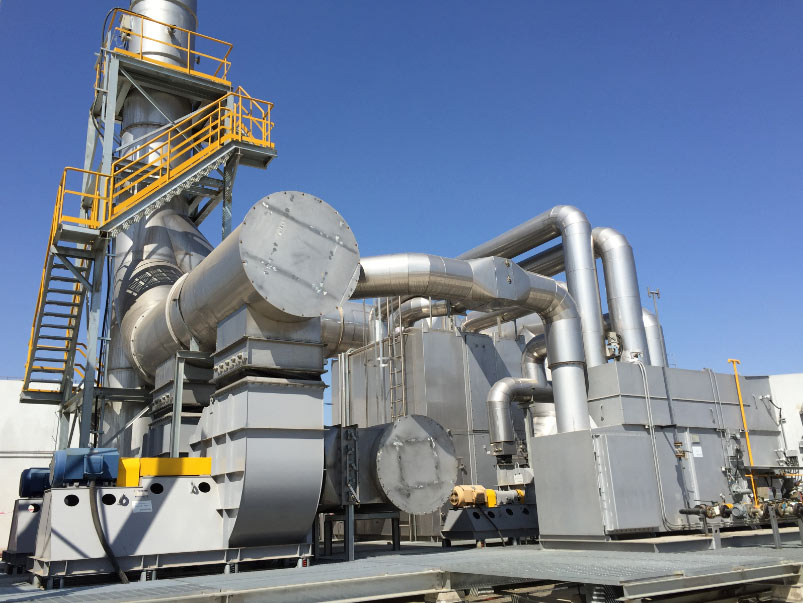

A recuperative catalytic oxidizer combines a catalyst bed with a fixed heat exchanger: the catalyst oxidizes VOCs and HAPs at a lower temperature (typically 300-450 C), and the recuperative heat exchanger recovers energy from the clean gas to preheat the incoming stream. The result is low fuel consumption with a simpler footprint than a regenerative catalytic oxidizer (RCO).
How a recuperative catalytic oxidizer works
- Preheat – VOC-laden exhaust passes through the recuperative heat exchanger.
- Catalytic oxidation – The preheated stream passes over the catalyst bed, where organic compounds oxidize at 300-450 C.
- Heat recovery – Clean hot gas preheats the incoming stream in the heat exchanger, reducing auxiliary fuel demand.
- Discharge – Treated gas (water vapor and carbon dioxide) exits through the system controls and interlocks.
Recuperative catalytic oxidizer vs RCO
A recuperative catalytic oxidizer uses a fixed heat exchanger. A regenerative catalytic oxidizer (RCO) uses ceramic-bed heat recovery for higher thermal efficiency, typically for larger airflow or continuous duty. The recuperative configuration suits lower to medium airflow and intermittent duty, with a simpler layout and lower capital cost.
Typical technical specifications
| Parameter | Typical value |
|---|---|
| Catalyst-bed temperature | 300-450 C* |
| Destruction removal efficiency | 99%+* |
| Heat recovery | Fixed heat exchanger (recuperative) |
| Airflow | Project specific |
| Control system | PLC/HMI with interlocks |
*Actual performance depends on waste-gas composition, operating conditions and final system design.
Typical applications
- Surface coating and automotive painting;
- Printing and packaging solvent exhaust;
- Pharmaceutical and chemical process vents;
- Solvent exhaust after concentration systems.
Frequently asked questions
What is a recuperative catalytic oxidizer?
A recuperative catalytic oxidizer (also written catalytic recuperative oxidizer) uses a catalyst bed plus a fixed heat exchanger, oxidizing VOCs at low temperature while recovering heat to reduce fuel use.
What is the difference between a recuperative and a regenerative catalytic oxidizer?
Regenerative systems (RCO) use ceramic-bed heat recovery for higher thermal efficiency and suit larger airflow. Recuperative systems use a fixed heat exchanger and suit lower to medium airflow with a simpler footprint.
How much does a recuperative catalytic oxidizer cost?
Cost depends on airflow, VOC concentration, catalyst loading, heat exchanger size and scope. Send your process parameters for a preliminary budget estimate.
What can damage the catalyst?
Dust, oil mist, sulfur, halogens, silicon compounds and some metals can reduce catalyst activity, so pretreatment may be required.
When is a recuperative catalytic oxidizer the right choice?
When the gas is catalyst-compatible and the airflow is lower to medium with intermittent operation, a recuperative catalytic oxidizer offers low temperature, low fuel use and a compact layout.
Do you offer catalyst and maintenance services?
Yes. Our lifecycle service covers catalyst management and replacement, heat exchanger and burner service, controls and interlocks, plus preventive maintenance programs.
Request a project evaluation
Send the process conditions – airflow, VOC composition and concentration, operating hours and emission target – for a recuperative catalytic oxidizer recommendation and budget estimate.