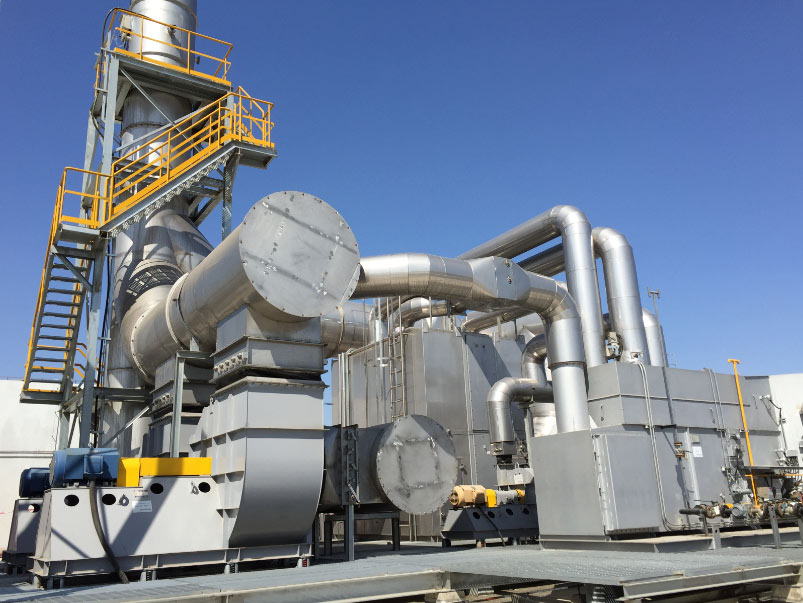

Case-style pages organized by industry, exhaust source, design basis, system configuration and conversion-focused engineering notes.
Catalytic Oxidizer for Coating Line VOC Exhaust
A recuperative catalytic oxidizer configuration for solvent coating exhaust with filtration, heat recovery and catalyst protection.
Catalytic Oxidizer for Printing and Packaging VOC
A zeolite rotor plus catalytic oxidizer concept for large airflow and low-concentration printing VOC exhaust.
Catalytic Oxidizer for Pharmaceutical Solvent VOC
A solvent exhaust review page focused on catalyst compatibility, corrosion, halogen content and safe operating control.
Catalytic Oxidizer for Chemical Plant VOC Exhaust
A chemical VOC treatment page comparing catalytic oxidation, RCO and RTO based on solvent chemistry and catalyst risk.
Send VOC data for catalytic oxidizer sizing
Share airflow, VOC composition, concentration range, temperature, humidity, dust or mist content, operating schedule and required emission limit. We will review whether a catalytic oxidizer, RCO, RTO, zeolite rotor or carbon system is the better fit.
How to read these catalytic oxidizer case studies
These cases share a technology but not a design basis, and that is the point: the parameters below are what change the equipment, and comparing the cases side by side shows how far the duty can vary within the same process family.
| What varies between cases | Why it changes the design |
|---|---|
| Air volume | Sets the equipment size, the ducting and the fan power |
| Inlet concentration | Decides whether the unit runs autothermally or needs supplementary fuel |
| Solvent species | Determines catalyst operating temperature and poisoning risk |
| Pretreatment provided | Dilution, dedusting or dehumidification may be needed before the catalyst |
| Heat recovery | Changes the economics and the downstream equipment |
| Emission limit | Sets the guarantee point and therefore the catalyst volume |
What these cases have in common
- A defined design basis — every case states the airflow and the required outlet concentration, because a catalytic oxidizer cannot be quoted without them.
- Pretreatment matched to the risk — dilution where the stream is flammable, dedusting where the dust would mask the catalyst, dehumidification where condensation would blind it.
- Documented performance — each case reports the measured result against the standard that applied, not a generic efficiency claim.
What to look for when comparing suppliers
- Is the inlet concentration stated, and is it the peak or the average?
- Is the catalyst operating temperature given, and the expected replacement interval?
- Is the pretreatment included in the scope or left to the buyer?
- Is the guarantee written against a measured outlet concentration and a stated standard?
- Are the materials specified for any acidic or wet condition?
Frequently asked questions
Why do the case air volumes vary so much?
Because the airflow is set by the process exhaust, not by the oxidiser. A small coating line and a large chemical plant both use catalytic oxidation, at volumes that differ by an order of magnitude.
Can these designs be scaled down for a smaller line?
Yes, but the pretreatment logic has to be re-derived rather than scaled proportionally, because the fire and dust risks do not scale linearly with airflow.