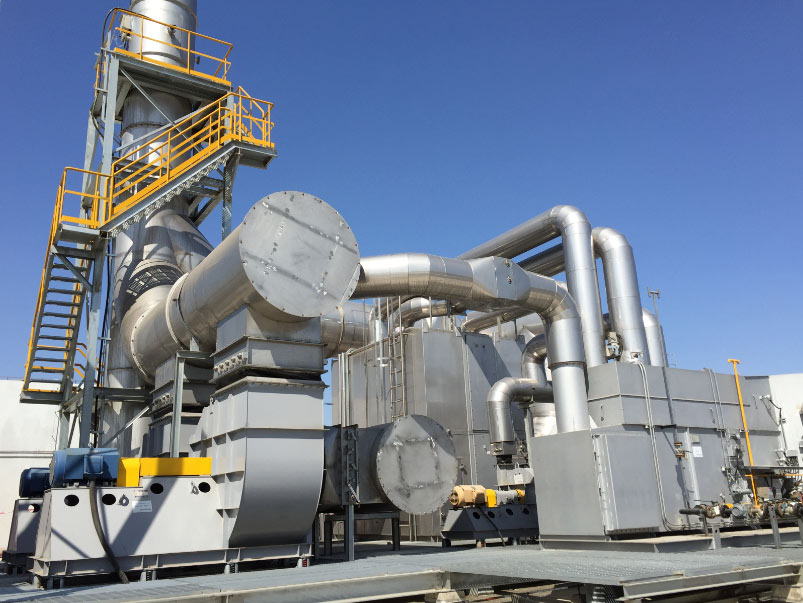

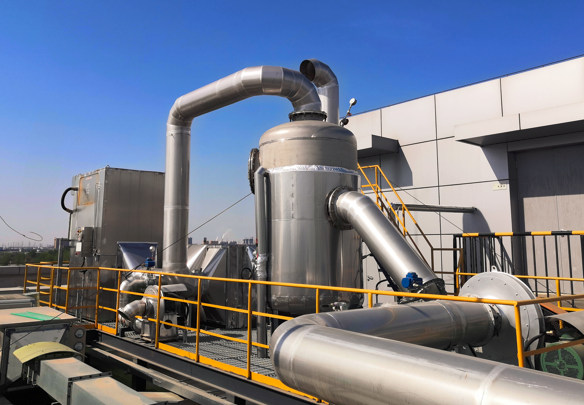
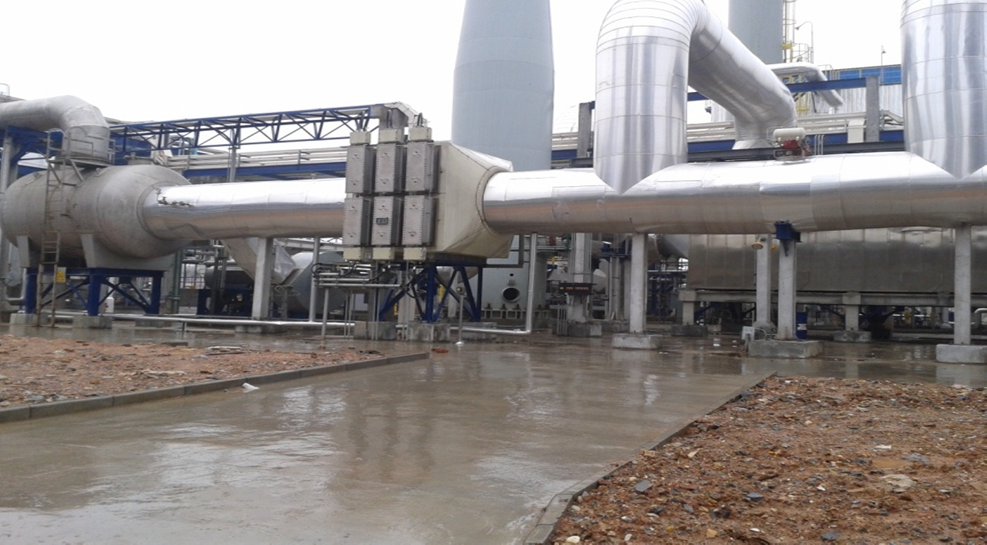
How a catalytic oxidizer works on tank farm vapour
Tank farm vapour is a mixture of hydrocarbon vapours displaced from storage tanks during filling, plus vapour generated by temperature change. Condensation removes the heavier fraction, and the catalytic oxidizer then destroys what remains at a bed temperature far below the flame temperature of thermal oxidation.
The reason a catalytic route suits this duty is autothermal operation: above a certain inlet concentration the oxidation of the VOC itself releases enough heat to hold the bed temperature, so no supplementary fuel is needed. Below that concentration the unit needs external heat, and the economics change.
What decides whether a catalytic route is viable
- Inlet concentration after pretreatment — too low and the unit needs fuel; too high and the temperature must be controlled to protect the catalyst.
- Catalyst poisons in the stream — sulphur compounds, halogens, heavy metals and silicones deactivate the catalyst. Coal tar and naphtha service makes this the first question to answer, not the last.
- Particulate and aerosol carry-over — condensed droplets blind the catalyst surface; the pretreatment has to be reliable, not nominal.
- Duty cycle — continuous operation at stable load is what makes the autothermal saving real; frequent starts erode it.
What to specify for a similar installation
- Total treatment air volume and the range of variation, not only the design point.
- Inlet VOC concentration and composition, including sulphur species.
- Annual operating hours and the expected load profile.
- Required outlet concentration and the applicable emission standard.
- Pretreatment provided upstream, and its guaranteed performance.
- Plot area, utilities and the electrical supply available.
Frequently asked questions
Why does the concentration matter more than the airflow?
Because autothermal operation depends on the heat released per unit of gas, which is a function of concentration. Two streams of the same airflow can sit on opposite sides of the fuel-free operating point.
How is the outlet concentration guaranteed?
By the catalyst volume, the bed temperature and the residence time together, verified by testing at commissioning. A guarantee without those three defined is not a guarantee.