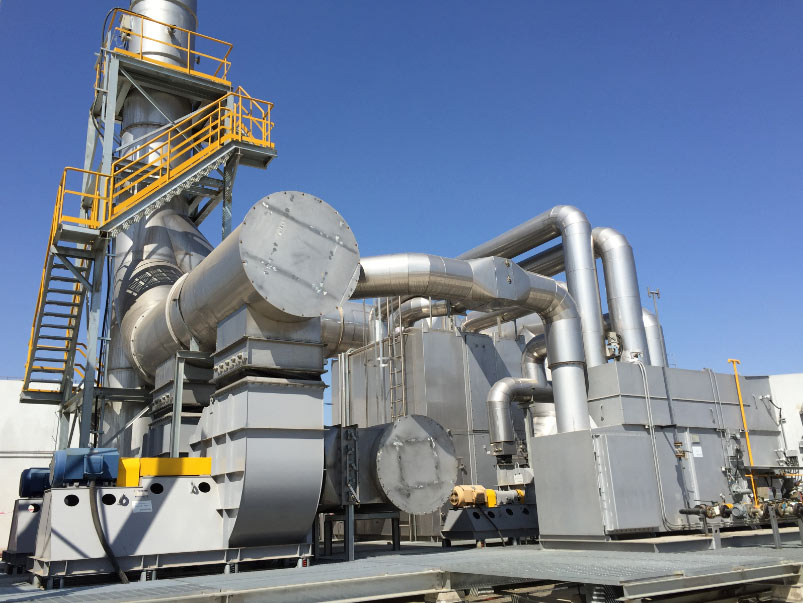

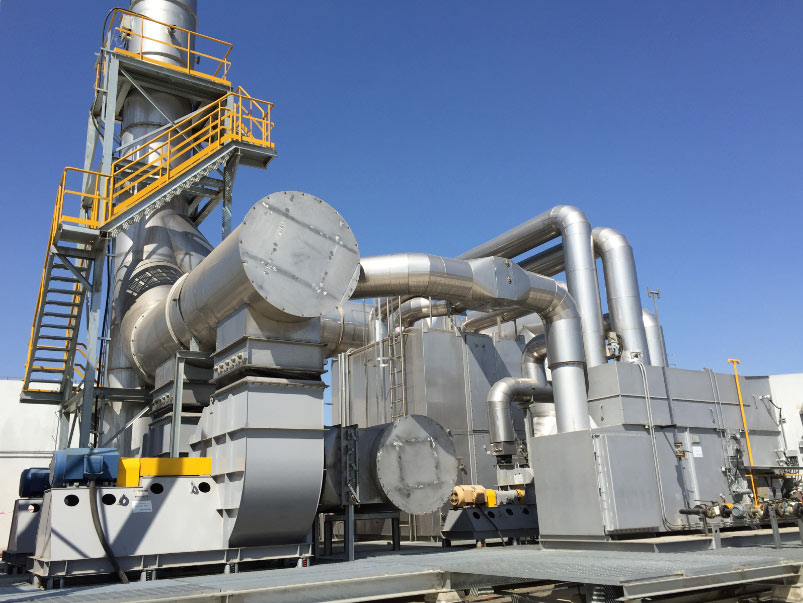
Industrial “incinerator” is a broad term that can describe several combustion systems. For VOC-laden process exhaust, two common choices are the regenerative thermal oxidizer (RTO incinerator) and the direct thermal oxidizer. Both oxidize organic compounds at elevated temperature, but they recover heat differently and suit different gas streams.
This comparison explains working principles, selection criteria, operating temperature considerations and typical applications.
What is an RTO incinerator?
An RTO uses beds of ceramic heat-transfer media. Incoming exhaust passes through a hot media bed, absorbs stored heat and enters the oxidation chamber. After the VOCs are oxidized, the clean hot gas transfers heat to another media bed. Flow direction changes periodically so the beds alternate between heating and cooling.
This regenerative arrangement conserves thermal energy and makes an RTO system attractive for large airflow with low to moderate VOC concentration.
What is a direct thermal oxidizer?
A direct thermal oxidizer mixes process gas, combustion air and fuel in a refractory-lined chamber. The burner raises the gas to the required oxidation condition and sufficient residence time is provided before discharge. Heat recovery can be added, but the basic system does not rely on alternating ceramic beds.
Direct thermal oxidizers can be suitable for smaller airflow, higher VOC concentration, strongly varying composition or streams that may foul regenerative media.
Process comparison
- Heat recovery: RTOs use regenerative ceramic media; direct systems may use no recovery or a separate recuperative exchanger.
- Airflow: RTOs are commonly applied to high-volume dilute exhaust; direct units can be effective for smaller or more concentrated streams.
- Particulate and condensable material: Both require evaluation, but sticky material can plug RTO media and valves.
- Pressure variation: RTO valve switching creates a characteristic pressure cycle that must be compatible with the process.
- Fuel use: The RTO heat-storage cycle can reduce supplemental fuel after stable operation, while direct oxidizer demand depends strongly on inlet temperature and VOC heating value.
Thermal oxidizer temperature and residence time
Destruction performance is not controlled by temperature alone. The oxidizer must provide suitable temperature, residence time, mixing and oxygen for the specific compounds. Required conditions depend on VOC chemistry, concentration, process variability and the applicable emissions requirement.
Operators should use multiple temperature measurements and validated performance testing rather than assuming that one chamber setpoint proves treatment.
When an RTO is usually preferred
- Large, continuous exhaust airflow.
- Low to moderate VOC concentration.
- Clean gas with limited sticky particulate or condensable aerosol.
- Long operating hours that benefit from regenerative heat recovery.
- Processes able to tolerate the pressure pattern associated with valve switching.
For a deeper explanation, read how the thermal oxidizer process works.
When a direct thermal oxidizer may fit better
- Smaller or highly variable flow.
- Higher VOC concentration that contributes useful heat.
- Gas composition that could foul or plug ceramic media.
- Batch operation requiring a simpler flow path.
- Applications needing a high-temperature combustion chamber without regenerative switching.
Safety and concentration control
VOC concentration must be evaluated relative to flammability limits under normal and upset conditions. Systems may require continuous concentration monitoring, dilution air, isolation dampers, purge sequences, explosion relief and emergency shutdown logic. The safety review must include upstream process equipment and ductwork, not only the oxidizer.
RTO inspection and maintenance
Important RTO components include switching valves, ceramic media, burner, chamber refractory, fans, dampers, instruments and the control system. Review our RTO inspection guide and RTO maintenance checklist.
For direct oxidizers, inspect the burner, flame scanner, refractory, mixing section, fan, heat-recovery surfaces and stack. Trend fuel use, pressure, airflow and temperature to identify deterioration early.
Selection checklist
- Airflow and turndown.
- VOC species, normal load and peak concentration.
- Inlet temperature, oxygen and moisture.
- Dust, oil mist, silicon, sulfur, halogens and condensable material.
- Operating schedule and production interruptions.
- Required emissions performance and testing method.
- Fuel, electricity, footprint and maintenance access.
Contact PollutionCtrl to compare an RTO incinerator, direct thermal oxidizer and catalytic oxidizer for your VOC stream.
Quick VOC Control Selection Answer
Which VOC control system should be selected? Use vapor recovery when hydrocarbons have reuse value; consider a catalytic oxidizer for catalyst-compatible VOC gas; consider an RTO for large dilute continuous exhaust; and evaluate direct thermal oxidation for smaller, concentrated or media-fouling streams. Airflow, VOC species, concentration peaks, temperature, contaminants and operating hours determine the final choice.