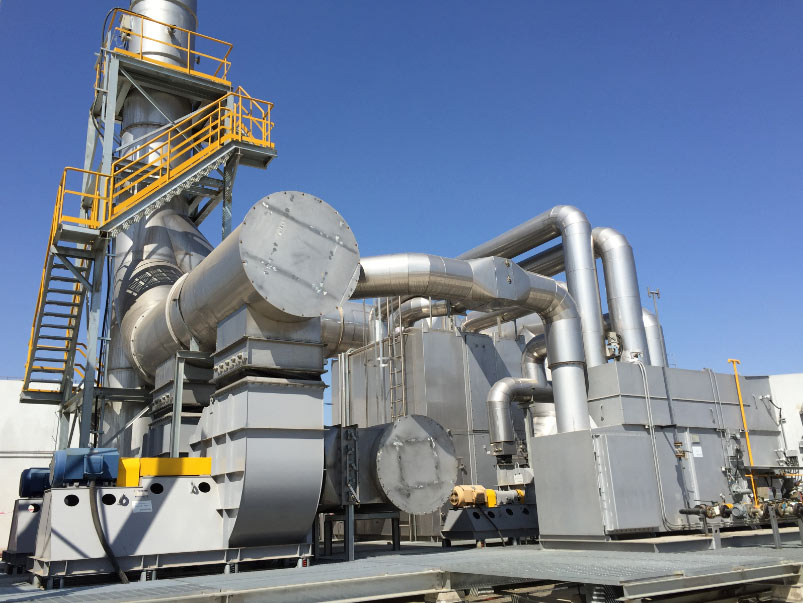

A thermal oxidizer (TO) destroys volatile organic compounds (VOCs), hazardous air pollutants (HAPs) and organic odors from industrial exhaust by high-temperature oxidation. The system elevates contaminated process air to 760-850 C, converting hydrocarbons into water vapor and carbon dioxide before discharge. “Thermal oxidiser” is the British English spelling of the same technology.
Thermal oxidizer units are available in direct-fired, recuperative and regenerative configurations, engineered around your airflow, VOC concentration, operating schedule and emission target.
What does a thermal oxidizer do?
A thermal oxidizer destroys organic pollutants in industrial exhaust rather than collecting or absorbing them. VOC-laden air is heated to oxidation temperature, the organic compounds break down, and the clean gas – water vapor and carbon dioxide – is released to the stack. With a destruction removal efficiency (DRE) of 99%+, thermal oxidation is a compliance-grade technology for chemical, pharmaceutical, coating, printing and similar processes.
Thermal oxidizer working principle
Effective thermal oxidation depends on the three Ts: temperature, residence time and turbulence.
- Temperature – typical oxidation temperature of 760-850 C breaks down organic molecules;
- Residence time – retention of 0.5-1.0 seconds gives the gas enough time to fully oxidize;
- Turbulence – high-turbulence flow ensures thorough mixing of the gas with oxygen and heat.
Oxygen availability is also required for complete combustion, so the burner and combustion chamber are designed to maintain the correct balance under variable loading.
Thermal oxidizer formula
The basic chemistry is complete combustion of hydrocarbons with oxygen:
CxHy + O2 (heat) -> CO2 + H2O
For example, methane oxidizes to carbon dioxide and water. In practice, the system is designed around the specific VOC chemistry, airflow and concentration to maintain complete destruction at the required outlet limit.
Thermal oxidizer diagram: controlled combustion in one pass
The diagram below shows the main components of a thermal oxidizer system: burner, combustion chamber and optional heat recovery. VOC-laden exhaust is heated to 760-850 C, held at temperature for the required residence time, and discharged as clean gas.
Direct-fired, recuperative and regenerative thermal oxidizers
| Configuration | Best suited for | Key difference |
|---|---|---|
| Direct-fired thermal oxidizer | High-concentration waste gas, simple exhaust streams | Burner heats the gas directly; simplest design, no heat recovery |
| Recuperative thermal oxidizer | Lower to medium airflow, intermittent duty | Fixed heat exchanger recovers heat from the clean gas to preheat the incoming stream, reducing fuel use |
| Regenerative thermal oxidizer (RTO) | Medium-to-high airflow, continuous duty | Ceramic beds store and release heat, achieving up to 97% thermal recovery and low fuel demand |
Thermal oxidizer vs flare: which should you use?
A flare burns gas in an open flame at a stack, typically for disposal or emergency relief. A thermal oxidizer is an enclosed combustion device that controls temperature, residence time and turbulence, recovers heat, and achieves a high destruction removal efficiency. For routine VOC compliance with measurable outlet limits, a thermal oxidizer is normally the right choice; a flare may be acceptable only for specific relief or non-routine duties where local regulations allow it.
Thermal oxidizer design considerations
A well-designed thermal oxidizer starts with the process envelope:
- Airflow and concentration – determine unit size, burner duty and heat balance;
- VOC chemistry – composition and calorific value affect temperature and residence time requirements;
- LEL margin – concentration control and dilution strategy protect safety;
- Heat recovery – recuperative or regenerative options reduce fuel consumption;
- Materials – high-temperature alloys and refractory linings withstand thermal cycling and corrosive chemistry;
- Controls and safety – PLC/HMI, interlocks, and monitoring for reliable operation.
Typical technical specifications
| Parameter | Typical value |
|---|---|
| Operating temperature | 760-850 C* |
| Destruction removal efficiency | 99%+* |
| Thermal heat recovery | Up to 97% (RTO configuration) |
| Retention / residence time | 0.5-1.0 seconds |
| Fluid dynamics | High-turbulence configuration |
| Automation and controls | PLC-based with HMI and interlocks |
*Actual performance depends on waste-gas composition, operating conditions and final system design.
Typical applications
- Chemical and petrochemical process emissions;
- Pharmaceutical solvent exhaust;
- Surface coating, painting and curing ovens;
- Printing and flexible packaging;
- High-concentration VOC streams from storage and transfer.
Related systems
- Regenerative thermal oxidizer (RTO)
- Catalytic oxidizer (CO)
- Recuperative thermal oxidizer
- Rotary concentrator thermal oxidizer
Frequently asked questions
What does a thermal oxidizer do?
A thermal oxidizer destroys VOCs, HAPs and organic odors in industrial exhaust by high-temperature oxidation, converting them into water vapor and carbon dioxide before discharge.
What is the thermal oxidizer working principle?
Thermal oxidation uses temperature (760-850 C), residence time (0.5-1.0 seconds) and turbulence to fully oxidize organic compounds, with oxygen available for complete combustion.
What is the thermal oxidizer formula?
The combustion reaction converts hydrocarbons and oxygen into carbon dioxide and water: CxHy + O2 with heat -> CO2 + H2O. The design is based on the specific VOC chemistry and process conditions.
What is a direct-fired thermal oxidizer?
A direct-fired thermal oxidizer heats the waste gas directly with a burner. It is the simplest configuration, commonly used for high-concentration streams where heat recovery is less critical.
What is a recuperative thermal oxidizer?
A recuperative thermal oxidizer (also written thermal recuperative oxidizer) uses a fixed heat exchanger to recover heat from the clean gas and preheat the incoming stream, reducing fuel consumption. It suits lower to medium airflow and intermittent duty.
What is the difference between a thermal oxidizer and a regenerative thermal oxidizer (RTO)?
A thermal oxidizer oxidizes waste gas at high temperature, optionally with a recuperative heat exchanger. An RTO (also written thermal regenerative oxidizer) adds regenerative ceramic beds that store and release heat, achieving up to 97% thermal recovery – typically the better choice for medium-to-high airflow, continuous duty. See our RTO page for details.
Thermal oxidizer vs flare: which should I use?
A thermal oxidizer is an enclosed, controlled combustion device with heat recovery and high destruction efficiency. A flare burns gas in an open flame, usually for disposal or emergency relief. For routine VOC compliance, a thermal oxidizer is normally required.
What is the difference between thermal oxidiser and thermal oxidizer?
There is no technical difference – thermal oxidiser (UK) and thermal oxidizer (US) are regional spellings of the same equipment.
Can a thermal oxidiser use electric heating?
Electric or hybrid heating can be considered for smaller thermal oxidiser units where gas supply is unavailable. Suitability depends on airflow, concentration and site utilities; our engineers can review the energy balance for your project.
What data is needed for thermal oxidizer design?
Airflow, VOC composition and concentration, temperature, operating hours, required outlet limits and site utilities. The design review covers temperature, residence time, turbulence, heat recovery, materials and safety interlocks.
Are you a thermal oxidiser manufacturer for the UK or Middle East?
Yes. PollutionCtrl is an R&D, manufacturing, sales and service company that supplies industrial thermal oxidisers worldwide, including the UK, Europe and the Middle East (for example Oman). Send your process parameters for a preliminary evaluation.
Where can I find a thermal oxidiser PDF?
Download the PollutionCtrl product brochure (PDF) for an overview of thermal oxidizers, RTO, catalytic oxidizer and vapor recovery systems.
What is the difference between a thermal oxidizer and a catalytic oxidizer?
A catalytic oxidizer oxidizes VOCs over a catalyst at lower temperature (300-450 C), which suits stable, catalyst-compatible gas. A thermal oxidizer uses higher temperature without catalyst, and is often chosen for high-concentration or variable streams. See our catalytic oxidizer page.
What destruction efficiency can a thermal oxidizer achieve?
Thermal oxidizers can achieve 99%+ destruction removal efficiency for VOCs and HAPs, depending on gas chemistry, operating conditions and final system design.
How does a thermal oxidizer work?
Exhaust air is drawn into the unit, heated by the burner to 760-850 C, held at temperature for the required residence time with high turbulence, and discharged as clean gas (carbon dioxide and water vapor). Heat recovery reduces fuel consumption.
What is the difference between a thermal oxidizer and an incinerator?
An incinerator burns solid or hazardous waste for disposal. A thermal oxidizer treats a gas stream – VOCs and HAPs in exhaust air – at controlled temperature for compliance-grade destruction. The terms are sometimes confused, but they address different feed streams.
What is a thermal oxidizer package?
A thermal oxidizer package is a skid- or container-mounted unit including the combustion chamber, burner, fan, heat recovery, controls and safety interlocks, ready for site integration. Packaged units simplify transport and installation.
What type of burner does a thermal oxidizer use?
Thermal oxidizers use a combustion burner (gas or dual-fuel) sized for the airflow and VOC heat release, with flame safeguards and temperature control. Burner and combustion-system design is part of the project scope – see our RTO burner and combustion system reference.
Are you a thermal oxidizer manufacturer?
Yes. PollutionCtrl is an R&D, manufacturing, sales and service company that designs and supplies direct-fired, recuperative and regenerative thermal oxidizers worldwide.
How much does a thermal oxidizer cost?
Thermal oxidizer cost depends mainly on airflow, VOC concentration, configuration (direct-fired, recuperative or regenerative), materials of construction, heat recovery and project scope. Send your process parameters – airflow, composition, operating hours and emission target – for a preliminary budget estimate.
What is a thermal oxidizer?
A thermal oxidizer (TO) is an enclosed air pollution control system that destroys VOCs, HAPs and organic odors in industrial exhaust at 760-850 C, converting them into water vapor and carbon dioxide, with optional heat recovery.
What is included in a thermal oxidizer system?
A thermal oxidizer system includes the combustion chamber, burner, fan, heat recovery (recuperative or regenerative), controls and safety interlocks, plus ductwork and instrumentation as required by the project.
Do you offer thermal oxidizer inspection and maintenance?
Yes. Our service covers combustion system checks, heat exchanger and refractory inspection, controls and instrumentation, plus preventive maintenance programs, spare parts and repair support.
What are thermal oxidizer applications?
Thermal oxidizers are used for VOC and HAP destruction in chemical and petrochemical production, pharmaceutical manufacturing, surface coating and painting, printing and flexible packaging, rubber and plastics, and high-concentration storage and transfer vents.
What is thermal oxidizer efficiency?
Thermal oxidizer efficiency is measured as destruction removal efficiency (99%+ for VOCs and HAPs) and thermal heat recovery (up to 97% in regenerative configurations). Both depend on gas chemistry, temperature, residence time and design.
What are the advantages of a thermal oxidizer?
Advantages include high destruction efficiency for complex VOC chemistry, reliability across variable airflow and loading, compliance with strict emission limits, and optional heat recovery that reduces fuel consumption.
Thermal oxidizer vs fired heater: what is the difference?
A fired heater heats a process fluid for production. A thermal oxidizer destroys VOCs and HAPs in an exhaust gas stream at high temperature for emission control. They serve different purposes, although both use combustion.
What types of thermal oxidizers are available?
The main types are direct-fired thermal oxidizers, recuperative thermal oxidizers (fixed heat exchanger) and regenerative thermal oxidizers (RTO, ceramic-bed heat recovery), plus catalytic variants where catalyst-compatible.
What is an acid gas thermal oxidizer?
An acid gas thermal oxidizer is a thermal oxidation system designed for streams containing halogenated or acid-forming compounds; downstream scrubbing is typically added to remove acid gases formed during combustion.
What is a VOC thermal oxidizer?
A VOC thermal oxidizer is a thermal oxidizer applied to VOC abatement – the system destroys volatile organic compounds in industrial exhaust at high temperature, with 99%+ destruction efficiency.
What is a thermal oxidizer fan?
A thermal oxidizer fan moves the process gas through the system, sized for airflow, duct and burner pressure drop. Fan selection is part of the system design, with VFD control where the load varies.
What is a thermal incinerator?
Thermal incinerator is a term sometimes used for a thermal oxidizer – an enclosed combustion device for VOC and odor destruction. It is different from an incinerator that burns solid waste.
Request a project evaluation
Send the process conditions – airflow, VOC composition and concentration, operating hours and emission target – for a preliminary thermal oxidizer recommendation and budget estimate.
Thermal Oxidizer Design Parameters
Thermal oxidizer selection depends on VOC chemistry, airflow, concentration, inlet temperature, required destruction efficiency and heat-recovery goals.
| Design item | Typical selection basis |
|---|---|
| Oxidation temperature | Typically 760–850 °C, finalized by gas chemistry and permit limits |
| Residence time | Commonly 0.5–1.0 seconds for complete VOC oxidation |
| Destruction efficiency | Often 99%+ when correctly designed and operated |
| Configuration | Direct-fired, recuperative or regenerative according to airflow and energy requirements |
| Applications | Chemical, coating, printing, pharmaceutical and petrochemical exhaust |
Related Systems and Case Studies
Compare the RTO system for high-airflow VOC control, the catalytic oxidizer for lower-temperature streams, and our three-chamber RTO case.
Request a Thermal Oxidizer Quote
Send airflow, VOC composition, concentration, inlet temperature, operating hours and emission target for a preliminary thermal oxidizer design and budget estimate. Contact PollutionCtrl for a custom proposal.
Types of Thermal Oxidizers and Heat Recovery
The main types of thermal oxidizers are direct-fired, recuperative and regenerative systems. A direct-fired thermal oxidizer is simple and robust; a recuperative thermal oxidizer uses a fixed heat exchanger; an RTO uses ceramic beds for high thermal recovery. The best option depends on airflow, VOC concentration, gas chemistry, operating hours and fuel cost.
For a technical comparison, review our regenerative thermal oxidizer and catalytic oxidizer pages.
Project References & Factory Photos
See our 20,000 m³/h RTO VOC treatment project and English project portfolio and factory photos.
When to Choose a Thermal Oxidizer
A direct thermal oxidizer is suited to high-temperature VOC and hazardous air pollutant streams where robust destruction, simple process control and broad gas-chemistry tolerance are more important than maximum heat recovery.
- High or variable VOC concentration
- Gas streams containing difficult-to-oxidize compounds
- Applications requiring a high-temperature safety margin
- New installations and retrofit projects with limited process complexity
Share your airflow, VOC composition, inlet temperature and operating schedule through our technical quotation form. We can compare thermal oxidation with RTO, CO and adsorption options.
Related VOC Control Technologies
VOC treatment equipment should be selected according to airflow, VOC composition, concentration range, temperature, explosion risk, recovery value and the required emission limit. Compare the main technology routes below before choosing a system.
- Regenerative Thermal Oxidizer (RTO) for high-volume VOC destruction with heat recovery.
- Thermal Oxidizer (TO) for direct high-temperature VOC oxidation.
- Catalytic Oxidizer (CO) for lower-temperature oxidation when the gas is suitable for catalyst use.
- Oil & Gas Vapor Recovery Unit (VRU) for hydrocarbon vapor recovery from tanks, loading racks and terminals.
For project proof and factory evidence, see our project references and factory photos.
Thermal Oxidizer vs RTO and Catalytic Oxidizer
A direct thermal oxidizer is considered when the process needs high-temperature VOC destruction and the exhaust conditions support that route. An RTO adds regenerative heat recovery, while a catalytic oxidizer uses a catalyst to lower the operating temperature. The right choice depends on VOC concentration, airflow, contaminants, heat recovery, catalyst compatibility, operating hours and emission requirements.
Thermal Oxidizer Applications
Industrial thermal oxidizer projects may serve coating, chemical, pharmaceutical, printing, drying and other process exhaust. The burner, combustion chamber, controls, residence time, insulation, stack and safety interlocks should be selected from actual process data.
For a quotation, send the exhaust volume, VOC composition, concentration, inlet temperature, humidity, dust or mist, operating schedule and required outlet performance. See the industrial RTO system and catalytic oxidizer system pages when heat recovery or catalytic operation is being considered.
Related Thermal Treatment Pages
- Regenerative thermal oxidizer (RTO)
- How industrial VOC destruction works
- Thermal oxidizer maintenance costs
- Recuperative thermal oxidizer
- Incinerator compared with direct thermal oxidizer
- Flue gas treatment
- Thermal oxidation for chemical industry VOC
- Thermal oxidation for printing VOC
- Thermal oxidation for painting lines
- Thermal oxidation for pharmaceutical emissions