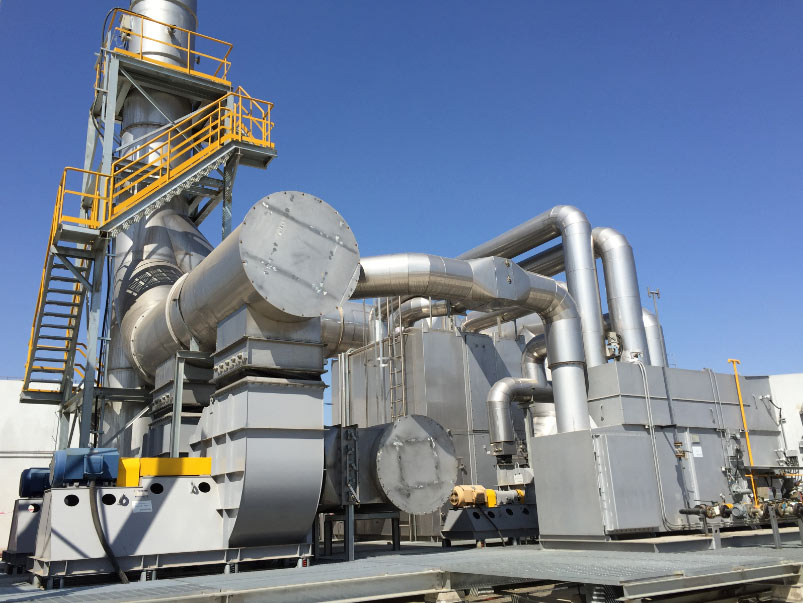

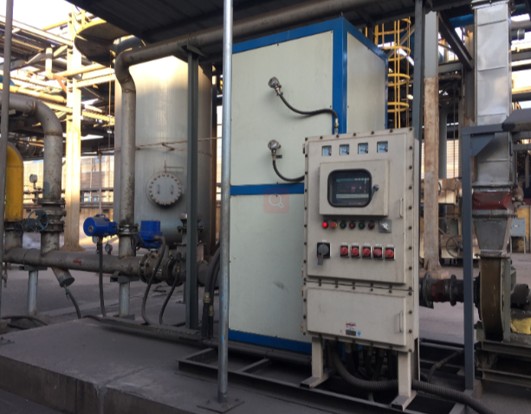
A catalytic oxidizer destroys volatile organic compounds by passing heated exhaust through a catalyst bed. The catalyst promotes oxidation at a lower operating temperature than a comparable non-catalytic thermal oxidizer, which can reduce supplemental fuel demand when the gas is compatible with the catalyst.
This guide explains how catalytic oxidation works, which VOC streams are suitable, how catalysts are selected and what operating problems should be avoided.
Catalytic oxidizer process steps
- Process exhaust is collected and balanced to a stable airflow.
- Filters or separators remove particles, droplets and catalyst poisons where possible.
- A heat exchanger may recover energy from the treated gas.
- A burner or electric heater raises the inlet gas to the catalyst activation range.
- The gas passes through the catalyst, where VOCs react with oxygen.
- Treated gas transfers heat to the incoming stream and then discharges through the stack.
Review our catalytic oxidizer equipment for industrial VOC control.
Why the catalyst matters
The catalyst provides active surface sites that accelerate oxidation. Catalyst formulation and support structure are selected for the expected VOC species, temperature, oxygen, moisture and contaminants. A formulation that performs well for one solvent mixture may not be suitable for another.
The vendor should review a full gas analysis, including trace sulfur, phosphorus, silicon compounds, halogens, heavy metals, oil mist and particulate. These materials can mask or poison active sites and shorten catalyst life.
Suitable applications
- Coating, printing and converting exhaust with consistent solvent composition.
- Chemical and pharmaceutical ventilation after suitable pretreatment.
- Drying and curing processes with moderate VOC concentration.
- Manufacturing exhaust where energy use and compact equipment are priorities.
Streams containing heavy particulate, sticky condensate or strong catalyst poisons may require substantial pretreatment or a different oxidation technology.
Catalytic oxidizer versus RTO
A regenerative thermal oxidizer stores heat in ceramic media and is often selected for large airflow and low VOC concentration. A catalytic oxidizer uses a catalyst to lower the reaction temperature and can be compact, but catalyst compatibility is critical. Read our comparison of RTO versus catalytic oxidizer.
A regenerative catalytic oxidizer combines regenerative heat recovery with a catalyst bed. Selection depends on airflow, concentration, temperature, contaminants, operating schedule and required turndown.
Key design data
- Normal and maximum airflow.
- VOC species and concentration range.
- Gas temperature, humidity and oxygen content.
- Dust, aerosol, sulfur, silicon, phosphorus and halogen compounds.
- Lower explosive limit evaluation and concentration peaks.
- Required destruction performance and stack conditions.
- Operating hours, turndown and available fuel or electricity.
Operating controls
Temperature should be measured before and after the catalyst bed. A rapid temperature rise may indicate a VOC concentration spike, while a gradual loss of performance can indicate fouling or deactivation. Differential pressure helps identify blockage. Flow switches, flame safeguards, high-temperature trips and purge logic are important parts of the control system.
Catalyst inspection and maintenance
Inspect upstream filters and process conditions first. Deposits on the catalyst can sometimes be removed using a method approved for the specific catalyst, but chemical poisoning is not always reversible. Performance testing, temperature profiles and pressure-drop trends help determine whether cleaning, sampling or replacement is required.
Avoid operating below the required catalyst inlet temperature because incomplete oxidation and deposits may result. Also prevent excessive temperature that can damage the catalyst or support.
When to choose thermal oxidation instead
A regenerative thermal oxidizer or direct thermal oxidizer may be more tolerant of changing VOC mixtures when catalyst poisons cannot be controlled. The final decision should compare pretreatment, energy consumption, catalyst replacement, footprint, maintenance and process reliability.
Contact PollutionCtrl with your gas analysis and operating data for a catalytic oxidizer selection review.
Quick VOC Control Selection Answer
Which VOC control system should be selected? Use vapor recovery when hydrocarbons have reuse value; consider a catalytic oxidizer for catalyst-compatible VOC gas; consider an RTO for large dilute continuous exhaust; and evaluate direct thermal oxidation for smaller, concentrated or media-fouling streams. Airflow, VOC species, concentration peaks, temperature, contaminants and operating hours determine the final choice.