
Why this design dilutes before it oxidises
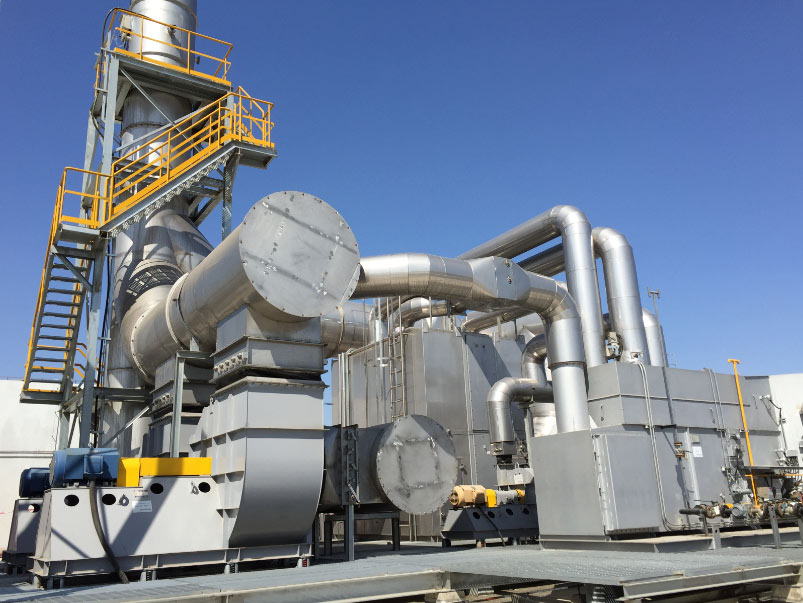
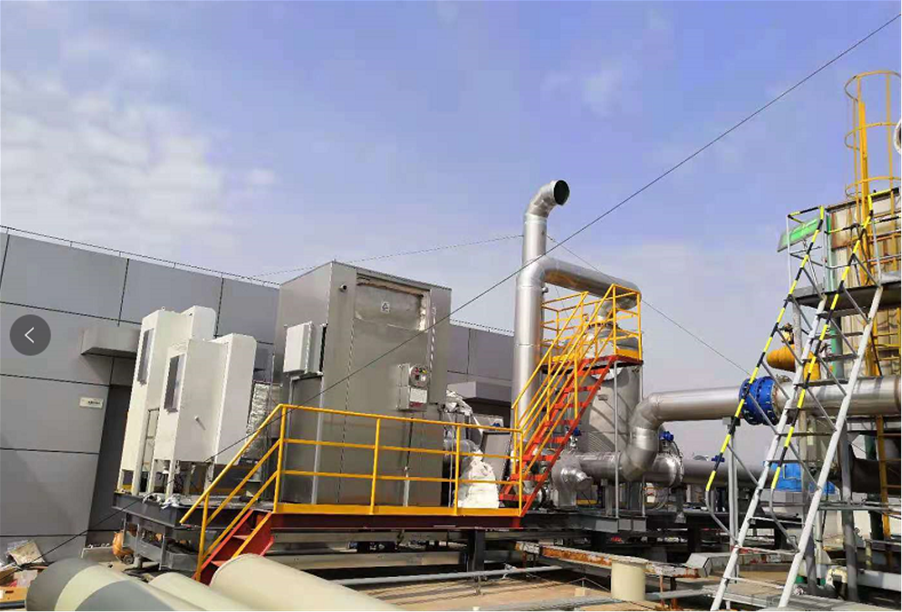
Acetone from vacuum pumps and condensing equipment arrives at a concentration that is both flammable and variable. The design dilutes the raw 200 m³/h stream to 5,000 m³/h, holding the mixture below 25% of the lower explosive limit before it reaches any heated equipment. That is a safety decision first and a process decision second: the flame arrestor and the dilution air are what make the downstream heat exchanger, heater and catalyst permissible.
Dilution has a cost — a larger volumetric flow means a larger oxidiser — but the alternative, concentrating a flammable solvent stream, adds risk that is difficult to justify on a plant handling acetone.
Why catalytic oxidation suits an acetone stream
- Acetone oxidises readily at catalyst temperatures well below thermal oxidation, so the fuel demand is low and the heater is a start-up and trim device rather than the main heat source.
- Clean stream — solvent vapour from a pharmaceutical or food-grade process carries little sulphur or halogen, so catalyst life is governed by temperature and by poisons that are absent here.
- No nitrogen chemistry — catalytic operation avoids the high-temperature NOx formation that a thermal route at higher temperature would need to manage.
What to specify for a similar solvent stream
- Raw flow rate and concentration, including the peak that occurs during vacuum pump operation.
- Lower explosive limit of the solvent and the dilution ratio required to stay below 25% of it.
- Required outlet limit — here non-methane total hydrocarbons at 60 mg/m³.
- Heat exchanger duty and whether steam is available for preheating.
- Start-up and shutdown sequence, since a diluted flammable stream needs a defined purge procedure.
Frequently asked questions
Why not use an RTO for an acetone stream?
An RTO would work, but it operates at a much higher temperature, needs more fuel at low concentration, and requires a larger unit for the same diluted flow. For a clean solvent stream the catalytic route is smaller and cheaper to run.
Why dilute rather than recover the acetone?
Recovery is worth evaluating where the solvent volume justifies it. Where the stream is small and variable, as here, dilution plus destruction is simpler and removes the fire risk that storage and recovery would introduce.