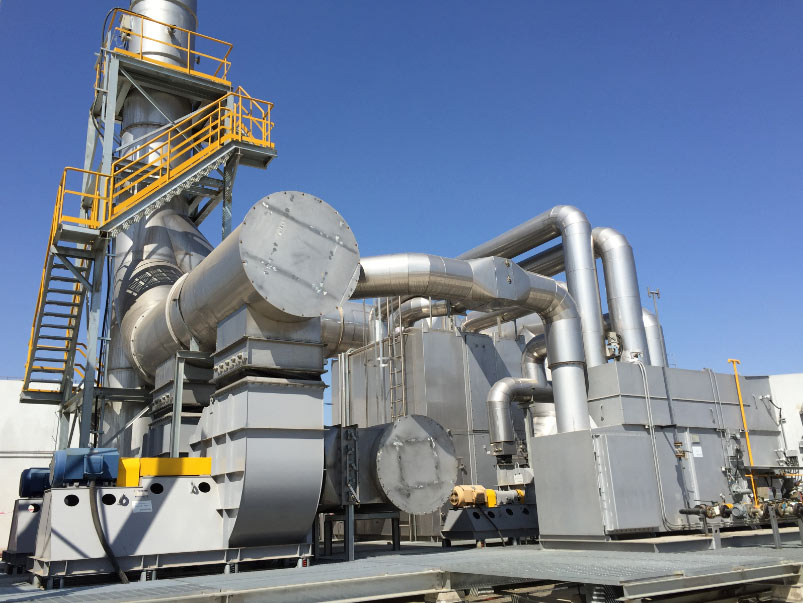

PollutionCtrl supplies industrial wastewater treatment equipment as complete treatment trains rather than isolated tanks: pretreatment, biological treatment, solid-liquid separation, disinfection and sludge handling, all sized from one set of flow and quality data. For the wider project picture – design inputs, scope boundaries and purchasing checks – start with the industrial wastewater treatment equipment selection guide.
The Treatment Chain, Stage by Stage
| Stage | What it is for | Typical equipment | Without it |
|---|---|---|---|
| Pretreatment | Remove gross solids, absorb flow peaks, correct pH | Screens, grit removal, equalisation, pH dosing | Pumps foul; pH excursions kill the biomass |
| Biological treatment | Convert dissolved organic matter and nitrogen | AO, MBR, SBR, MBBR | COD and ammonia reach the outfall |
| Solid-liquid separation | Separate biomass and suspended solids | Clarifier, membrane tank, DAF, filtration | Solids carry-over in the discharge |
| Disinfection and polishing | Inactivate pathogens, remove colour or residual COD | Chemical dosing, UV, filters, activated carbon | Microbiological non-compliance, visible colour |
| Sludge handling | Thicken, dewater and store sludge for removal | Thickener, dewatering unit, holding tank | Sludge backs up the whole train |
Pretreatment – screening, equalisation, neutralisation
Pretreatment does three jobs and is the cheapest place to solve a future problem. Screens remove rags, wipes and fibres before they wrap a pump impeller or blind a diffuser. Equalisation flattens the production cycle so the biology sees steady flow instead of a slug at shift end. Neutralisation corrects pH where acidic or alkaline process solutions arrive in batches. Without these steps, everything downstream is oversized and unpredictable.
Biological treatment – AO, MBR, SBR and MBBR
This is where organic matter and ammonia are removed; process choice follows the outlet limits, the footprint and the attention the site can give the plant.
- AO – an unaerated zone ahead of the aerated tank, so nitrate leaves as nitrogen gas.
- MBR – membranes replace clarification: consistent effluent in the smallest footprint, at higher power and membrane cost.
- SBR – fill, react, settle and decant in one basin; practical for small or intermittent flows.
- MBBR – biomass on moving carriers, so capacity fits a small tank and existing basins can be upgraded.
Aeration is the largest power consumer and the usual source of cost surprises; blower and aerator duty follows oxygen demand, not tank volume.
Solid-liquid separation and sludge
Separation sets the suspended solids in your discharge and the sludge volume you pay to remove. Clarification is the low-energy default where sludge settles well; membranes or dissolved air flotation cover the rest. Confirm the sludge disposal route before the train is fixed.
Disinfection and polishing
Where the outfall needs microbiological control or the water is reused, chlorine dioxide generation, hypochlorite dosing, UV, or membrane and carbon polishing close the train, chosen for the target parameter, the contact time available and the receiving water. Polishing for colour, phosphorus or residual COD is hard to retrofit cheaply, so decide it at design stage.
Packaged System or Civil Concrete Basins?
Civil basins suit a new site with land and a flow large enough to justify design work. Packaged units suit congested sites, retrofits, small to moderate flows, and schedules that cannot absorb formwork and curing.
- Carbon-steel integrated system – lowest capital cost where the coating suits the water and repainting is accessible.
- FRP integrated system – strong corrosion resistance; check resin compatibility against the analysis.
- Stainless steel – for chlorides, acids or temperatures that would shorten a coated unit’s life; higher capital cost.
- Containerised integrated system – built inside a transport frame and delivered complete; site scope is foundations, pipework and power.
Buried installation saves surface space and noise but adds groundwater, buoyancy, loading and access questions – a buried tank that needs repair is a far larger job. Above-ground and containerised units are easier to inspect, drain and extend. Packaged systems avoid formwork and curing and install in weeks; civil construction wins on unit cost at larger flows.
Selection by Wastewater Source
Two plants with the same flowrate can need completely different trains. Composition decides the design.
Textile, dyeing and printing
Ink and printing wastewater brings colour, binders and surfactants. The recurring difficulties are residual colour that biological treatment alone does not reliably remove, high COD from sizing agents, and batch discharge in slugs.
Hospital and laboratory
Hospital wastewater mixes sanitary flow with disinfectants, reagents and pharmaceutical residues, and usually needs microbiological control in a small plant room. Laboratory wastewater is more variable: metals, solvents and acids arrive in small volumes that shock a biological stage. Segregate incompatible streams at the sink.
Landfill and transfer-station leachate
Low volume, very high strength. As a site ages the organic fraction becomes less biodegradable while ammonia stays high, so a design that worked on young leachate can fail on the same site years later. Colour, salinity and inhibitory compounds add difficulty, and concentrate disposal must be settled before equipment is ordered.
Food, beverage and chemical plants
Food plants bring fats, oils and grease, high organic loads, pH swings from cleaning chemicals and seasonal peaks; grease has to come out early or it coats everything downstream. Chemical streams are harder to generalise – solvents, salinity or toxic components can inhibit the biology, so treatability work and segregation come first.
Data We Need Before Anything Is Sized
- Average and peak flow in m3/day or m3/h, with daily and seasonal variation
- Recent inlet analysis: pH, COD, BOD, suspended solids, ammonia and total nitrogen, oil and grease, colour, salinity, metals or inhibitors
- The outlet requirement that applies – discharge standard, sewer limits or reuse specification
- Footprint available, burial feasibility and groundwater level
- Power supply: voltage, spare capacity, standby generation
- Operating hours and staffing – who attends and what maintenance they can carry out
- Sludge and concentrate disposal route
- Temperature range, which sets biological reaction rates and freeze protection
- Existing tanks and tie-in points, plus the destination country
Odour and H2S Control at the Treatment Plant
Screening, equalisation, aeration and sludge handling all release hydrogen sulphide and odorous organics. The problem is not only nuisance: an uncovered tank releases H2S that attacks concrete, cable trays and control panels. Our wastewater odor-control systems cover extraction and treatment for pump stations, covered tanks and sludge handling. Plan covers and duct connections while the water train is laid out – they are far easier to build in than to add later. Water-treatment flow and odour-extraction flow are different specifications, sized from separate inputs.
Frequently Asked Questions
MBR or conventional activated sludge?
MBR gives a tighter, more consistent effluent in a smaller footprint, at the cost of higher power demand and membrane replacement. Conventional activated sludge with clarification is simpler and cheaper where land is available and limits are moderate.
Can a packaged system be installed underground?
Yes, and it is common where surface space is scarce. Burial changes the specification, not the process: structural design for soil and traffic loading, buoyancy checks against groundwater, and watertight covers with maintenance access.
What flow range do integrated units cover?
Packaged units are usually supplied for small to moderate flows, from a few cubic metres per day upward; large flows are normally handled in civil basins or in a combination of civil works and packaged modules.
How much operator time does a small plant need?
It depends on the process. SBR and MBBR plants with automatic controls need routine attendance for checks, dosing and sludge removal rather than continuous staffing, while MBR demands more membrane attention.
More Wastewater Treatment Equipment
- UASB and IC anaerobic reactors
- Inclined tube sedimentation tank
- Dissolved air flotation unit
- Ultrafiltration system
- Ozone disinfection unit
- Sodium hypochlorite generator
- Plate and frame filter press
- Integrated water purifier
- Submersible aerator for wastewater treatment
- Sewage lagoon aerator
- Filter bed sewage treatment
- Wastewater treatment screens
- Wastewater treatment blowers
- Industrial wastewater treatment equipment
- Flow meters for scrubber and wastewater systems
- Wastewater odor control systems
Talk to an Engineer
Send average and peak water flow in m3/day or m3/h, a recent inlet analysis, the outlet limits you must meet, operating hours, site drawings and the destination country. Include the equipment you already have and the items you want quoted, and flag any missing measurements so the proposal can state its assumptions. Send your project details and we will return a configuration proposal with indicative pricing.