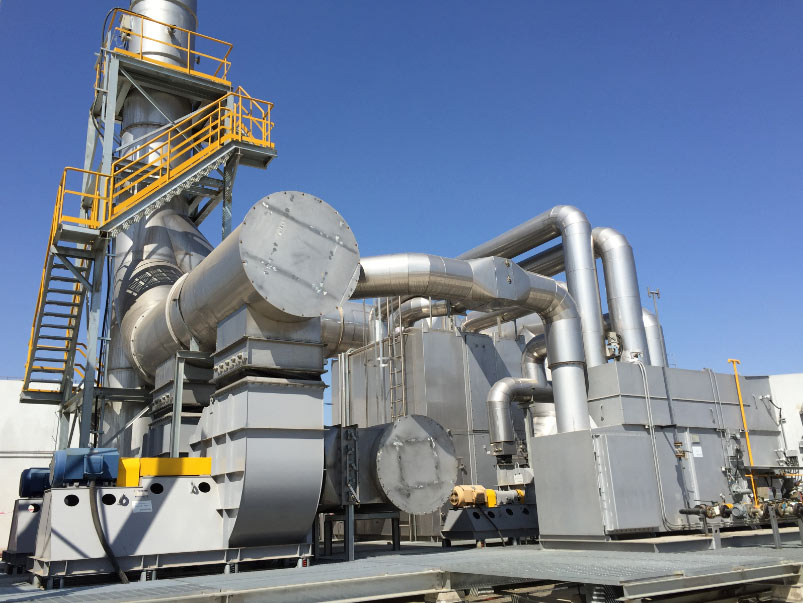

Wastewater treatment blowers supply air for aeration, mixing and scouring in activated sludge and biological treatment systems. Roots-type positive displacement blowers are widely used for their constant airflow and reliable operation, sized to the oxygen demand of the process.
How a wastewater blower works
- Air intake – Ambient air is drawn into the blower.
- Displacement – Roots or rotary lobe rotors trap and discharge air at process pressure.
- Air distribution – Pressurized air is delivered through pipework to diffusers in aeration tanks.
- Aeration – Fine or coarse bubbles transfer oxygen to the biomass for aerobic treatment.
Blower types for wastewater treatment
| Type | Best suited for |
|---|---|
| Roots / rotary lobe blower | Constant airflow at low to medium pressure, common in aeration duty |
| Centrifugal blower | Higher airflow at moderate pressure, energy-efficient at scale |
| Screw / rotary vane blower | Quieter, energy-efficient options for continuous duty |
Typical applications
- Aeration of activated sludge tanks;
- Diffused air in biological treatment;
- Membrane scouring in MBR systems;
- Air supply for equalization and mixing basins;
- Digester and odor control air systems.
Frequently asked questions
What is a wastewater treatment blower?
A wastewater treatment blower supplies air at pressure for aeration, mixing and scouring in biological wastewater treatment, delivering oxygen to the biomass through diffusers.
What is a Roots blower?
A Roots blower (rotary lobe blower) is a positive displacement blower that delivers constant airflow, widely used for wastewater aeration at low to medium pressure.
What blower is used in a sewage treatment plant?
Sewage treatment plants commonly use Roots/rotary lobe blowers, centrifugal blowers or screw blowers for aeration, selected by airflow and pressure requirements.
How do I size a blower for a wastewater treatment plant?
Sizing is based on oxygen demand, airflow (m3/h or cfm), discharge pressure (diffuser depth and piping loss) and operating profile.
What is the difference between a blower and an air compressor for wastewater?
A blower delivers large volumes at low to medium pressure for aeration; an air compressor delivers higher pressure for other duties such as digester gas or pneumatic systems.
How much does a wastewater treatment blower cost?
Cost depends on blower type, airflow, pressure and control scope. Send your process parameters for a preliminary budget estimate.
Are blowers energy-efficient for aeration?
Yes, when sized and controlled correctly; VFD control and dissolved oxygen trimming can significantly reduce aeration energy use.
Do you supply wastewater treatment blowers?
Yes. PollutionCtrl supplies Roots and rotary lobe blowers for wastewater aeration, integrated with controls and aeration systems.
Request a project evaluation
Send your tank dimensions, oxygen demand, diffuser depth and operating hours for a blower recommendation.
Related Wastewater Treatment Equipment
This equipment is part of a complete wastewater treatment process. For system selection, product comparison and quotation requirements, see our industrial wastewater treatment equipment and waste water treatment systems page.