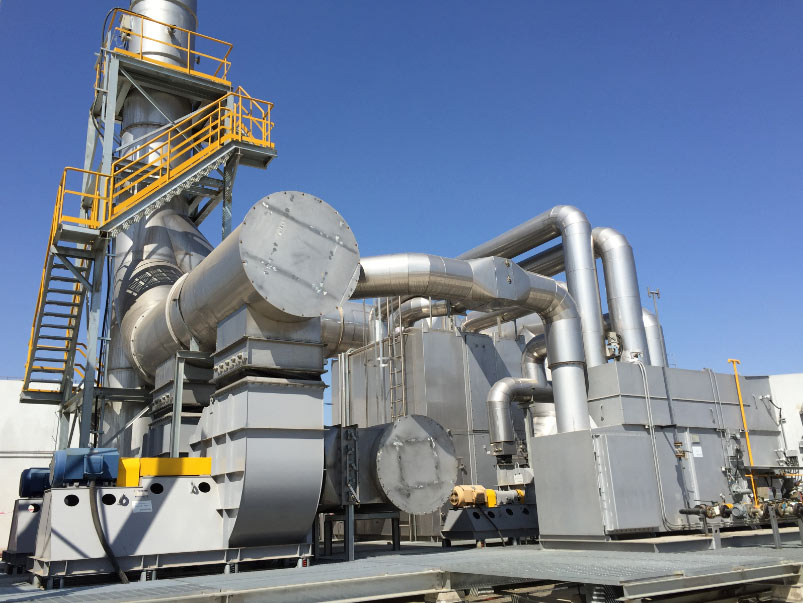

A wastewater odor control system captures contaminated air from enclosed wastewater sources and treats it before discharge. The package combines covers or hoods, ductwork, an extraction fan, treatment equipment and controls. Selecting the reactor is only one part of the job: the air must first reach it without escaping through doors, hatches or leaking covers.
PollutionCtrl supplies equipment for wastewater and industrial odor-control projects. Use this guide to define the source, compare treatment routes and prepare a quotation that includes the connections and maintenance requirements of your plant.
Which wastewater sources need odor control?
| Source | Typical operating issue | Start the design review here |
|---|---|---|
| Pump station and wet well | Intermittent odor peaks during pumping | Cover leakage, headspace and pump-cycle measurements |
| Sewage plant inlet works | Odor release at screening and turbulent transfers | Local hoods and access openings |
| Sludge storage | Load changes during filling, mixing and emptying | Headspace extraction and condensate drainage |
| Sludge dewatering | Multiple releases from presses, centrifuges and conveyors | Capture at the individual release points |
| Industrial wastewater tanks | Changing production batches and gas composition | Process schedule, source segregation and gas sampling |
Water treatment and air treatment have different duties
Water treatment removes pollutants from the liquid stream. Odor control treats gas released around tanks, pump stations and solids handling. An odor-control unit does not replace the process required to meet wastewater discharge limits. For water-side equipment, use the industrial wastewater treatment equipment guide.
The word odour is the British spelling of odor. A specification headed “wastewater odour control” still needs the same source, airflow, gas and acceptance data.
Start with the capture arrangement
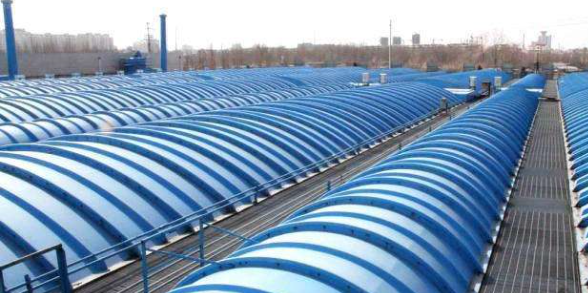
List each enclosed source and trace its duct connection to the treatment unit. Separate concentrated headspace air from general room ventilation where the site design allows it. Mixing a small, concentrated stream with large volumes of clean air can increase equipment size without improving source capture.
Check covers, maintenance hatches, duct low points and condensate drains. The fan must deliver the design airflow against the combined resistance of ducts, fittings and treatment stages. A quoted fan rating alone does not show the airflow available at the furthest branch.
Design inputs for a comparable quotation
| Input | What to provide | Why it changes the equipment |
|---|---|---|
| Source and capture | Cover drawings, open points, extraction branches | Defines leakage, access and the air that actually needs treatment |
| Airflow | Normal and peak m³/h; identify actual or reference conditions | Sets duct, fan and reactor duty |
| Gas analysis | H₂S, ammonia and relevant VOCs; units and peak readings | Defines contaminant load and treatment stages |
| Moisture and temperature | Relative humidity, condensate and operating range | Determines drainage, corrosion protection and pretreatment |
| Operating cycle | Hours per day, filling, mixing and startup events | Shows when peak loads and standby duty occur |
| Acceptance limits | Inlet envelope, outlet concentration and test method | Makes the performance requirement measurable |
Record both normal operation and the event that causes the strongest release. A daily average can hide a short loading or mixing peak. Keep gas measurements and airflow readings on a consistent basis so that the calculated treatment load is meaningful.
Compare wastewater odor-control methods
| Route | Design question | Items to include in the comparison |
|---|---|---|
| Wet scrubbing | Can the contaminants be transferred and treated in the selected liquid chemistry? | Reagents, dosing controls, mist removal, blowdown and corrosion resistance |
| Adsorption | Is the selected media suitable for the measured gas and moisture? | Breakthrough monitoring, pressure loss, media replacement and disposal |
| Biological treatment | Can the biological process remain stable through the load cycle? | Start-up, moisture, nutrients, footprint and upset recovery |
| Low-temperature plasma | Does testing support treatment of the actual contaminant mixture? | Pretreatment, discharge modules, electrical interlocks and residual oxidants |
| Microwave UV oxidation | Can sufficient UV exposure be maintained in the selected reactor? | Lamp arrangement, fouling, microwave shielding and downstream polishing |
There is no single treatment method that is best for every wastewater source. Compare the complete package at the same inlet conditions and outlet requirement. Purchase price, electrical consumption, consumables, access and waste handling all belong in the evaluation.
Where plasma and microwave UV fit
Low-temperature plasma equipment and microwave ultraviolet oxidation equipment are oxidation routes to evaluate for captured odor streams. Suitability depends on the measured gas mixture, moisture, flow and required outlet condition.
Specify pretreatment where droplets or solids could foul the reactor. Ask how residual ozone and reaction by-products will be checked, and whether downstream polishing is included. A model name or nominal power rating is not a substitute for an application-specific performance basis.
How to move from a site survey to an equipment order
- Identify the odor sources and document operating events that change the load.
- Measure the gas and check source enclosure and extraction.
- Set the normal and peak duty, outlet limits and available utilities.
- Compare treatment routes with the same supply boundaries.
- Review layout, cleaning access, drains, controls and replacement parts.
- Agree commissioning measurements and acceptance conditions before the final order.
What should be included in the supply scope?
Confirm whether the offer includes the reactor, pretreatment, fan, control panel, instruments, duct transitions, supports and polishing stage. Covers, site ductwork, civil works, field wiring and installation may be separate items; the quotation should identify the boundary for each.
For an overseas order, request shipping dimensions and weights, connection drawings, the electrical specification and the proposed spare-parts list. Agree how installation support and commissioning will be delivered instead of assuming that they are included in equipment pricing.
Questions before ordering
Can one unit serve several wastewater sources?
Sometimes. Review simultaneous peak loads, branch balancing and the effect of taking one source out of service. Sources with very different gas composition may need separate treatment.
Can equipment be sized from wastewater flow alone?
No. Liquid flow does not define extraction airflow or gas concentration. Provide enclosure details and representative gas measurements.
How is performance checked?
Confirm source capture and actual airflow, then test inlet and outlet conditions during agreed operating scenarios. Set the sampling locations and test method before commissioning.
Related equipment and application guides
Odor Control by Emission Point
- Sewage treatment plant odor control
- Lift station odor control
- Wet well odor control
- Sludge odor control
- Sludge dewatering odor control
- Sludge drying room odor control
- Pump station odor, H2S and ammonia control
- Waste transfer station odor control design
- Hydrogen sulfide removal from wastewater
- Low-temperature plasma for wastewater plants
- Microwave UV oxidation for wastewater odor
- Chemical wastewater station odor control
- UV lamps for wastewater odor control systems
- Industrial odor control FAQ