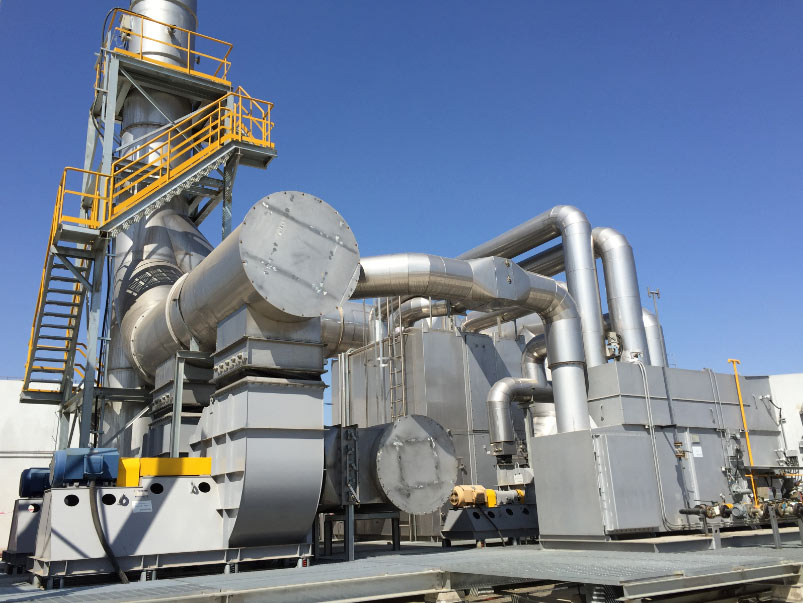

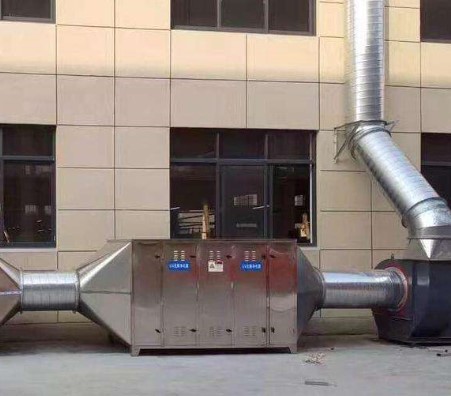
Wastewater odor is not one problem. Hydrogen sulfide from a wet well, ammonia off a dewatering centrifuge and solvent vapor from an industrial equalization tank each behave differently. Treating plant odor as one issue usually produces a scrubber sized for the wrong load and a headworks that still draws complaints.
Where Wastewater Odor Comes From, Area by Area
Hydrogen sulfide dominates anaerobic zones; ammonia appears where nitrogen-rich sludge is dewatered or dried; mercaptans sit at low concentration but are detected at trace level; VOC takes over where industrial wastewater carries solvents.
| Area | Dominant compounds | Release pattern |
|---|---|---|
| Inlet works, screens and grit | H2S, mercaptans, VOC | Peaks with flow |
| Equalization tanks | H2S, VOC, solvent carry-over | Continuous; worse after mixing |
| Sludge thickening | H2S rising to ammonia | Worse with sludge age |
| Sludge dewatering | Ammonia, H2S, mercaptans | At the machine; humid |
| Sludge drying | Ammonia, water vapor | Hot and saturated |
| Storage barn and loading | Ammonia, organic sulfur, VOC | High volume, low concentration |
| Lift station wet well | H2S at high concentration | Quiescent; release on pump start |
Concentrated sources must be covered and extracted separately from general ventilation, because diluting them multiplies the airflow every downstream device handles. The highest-concentration areas are also rarely the largest-volume areas, so our wastewater odor control system designs separate the two.
Hydrogen Sulfide: Corrosion and Personnel Safety
H2S in moist air oxidizes to sulfuric acid and attacks concrete, steel, ductwork and electrical gear. Damage is worst above the water line and in covered-tank headspace, in places that are expensive to repair: wet-well crowns, sludge-room structural steel, terminal boxes and instruments. Extracting the gas protects the structure, but the hydrogen sulfide odor control package and its ductwork carry the same exposure and must be built for wet, acidic service.
Smell is not a reliable indicator. H2S is heavier than air, collects in wet wells, pits and below-grade galleries, and deadens the sense of smell after brief exposure. Entry into a wet well, sludge tank or pit belongs in the plant’s confined-space program, with metering, respiratory protection and a standby person.
Monitoring Practice
Portable meters serve pre-entry testing and locating the load area; they depend on calibration and bump testing more than on the specification sheet. Fixed detectors at the headworks, wet well headspace, dewatering room and upstream duct catch a drift overnight; setpoints come from your EHS program, usually two stages. Logged trends reveal whether the system is losing capacity or the load has changed.
How to Choose a Control Technology
Sizing by floor area is the most common mistake we see: floor area tells you how large a cover must be, not how much odor has to be destroyed. The system is set by the extracted gas volume and the concentration of H2S, ammonia and VOC in it; together they give the mass load that drives contact time, media or chemical volume, footprint and cost.
| Technology | Best fit | Limits | Cost structure |
|---|---|---|---|
| Chemical scrubbing | H2S-dominant gas, including peaky headworks | Compact, good on peaks; needs dosing control and spent-liquid handling | Chemical and pumping cost dominate |
| Biofilter / biotrickling filter | Large, steady, dilute flows, already humid | Poor on shock loads and cold weather; needs moisture, nutrients and land | Low consumables, high area and labour |
| Activated carbon | Polishing, intermittent sources, low outlet limits | Media life collapses on saturated or dusty gas; H2S needs impregnated carbon | Consumable-driven; replacement dominates |
| Plasma and UV oxidation | Compact units at moderate concentration | Needs mist and dust removal upstream; ozone must be handled | Power plus lamp or module replacement |
| Terminal oxidation | Streams with real VOC content, or combined streams on one stack | Careful materials; pre-treatment for particulates or poisons | Fuel or electrical heat plus media service |
Most plants end up with more than one: capture and scrubbing at the headworks and wet wells, biological treatment on the large dilute flows, and a carbon stage as a final barrier before the stack. The carbon stage absorbs peaks and compounds the upstream stage does not target. Media choice is covered under granular activated carbon for sewage treatment.
Covering and Extraction: The Details That Decide Performance
Capture sets the ceiling on everything downstream.
- Cover form – flat or domed covers over tanks and channels, hoods over screens and loading points, full enclosures around dewatering machines and sludge bays; every opening is a leak path.
- Air changes and negative pressure – extraction from a covered tank is calculated from the headspace volume above the liquid, not the plan area, and expressed as air changes per hour; an enclosure room or sludge bay needs a much higher rate. The enclosure stays under negative pressure even with a hatch open, so the fan is sized against the worst-case opening and make-up air enters close to the work.
- Condensate, materials and hazardous areas – ducts need slope, low-point drains and velocities that keep droplets out of the treatment unit; wetted parts are stainless, FRP or plastic, and fans and ducting are specified for the classified zone wherever methane or solvent vapor can accumulate.
Matching the Approach to the Site
Small lift station
Small flow, intermittent operation, high peak concentration and nobody on site to tend it. A sealed wet well, modest extraction and a compact stage with a long service interval are normally right; power, remote alarms and service access decide more than the process choice. See lift station odor control system.
Municipal treatment plant
Many sources at different concentrations, a train that cannot be interrupted, and a community that judges the site by smell. The work is source separation: capture at the headworks, biological or scrubbing duty on the main flow, polishing before discharge. See sewage treatment plant odor control.
Industrial wastewater station and sludge handling
Industrial wastewater brings VOC and solvent content a municipal design never sees, and sometimes dust or mist that must come out before adsorption or biological treatment. Sludge is where ammonia joins H2S, so dewatering rooms and dryers need capture at the machine, not the room. See sludge odor control and sludge dewatering odor control.
Waste transfer station
Large enclosures, heavy dust, low to moderate concentration and loading traffic that makes ventilation hard to control, so capture is dominated by door management and negative pressure through the tipping hall. See waste transfer station odor control system design.
What We Need to Size a System
- Odor sources with covered volumes
- Extraction airflow per source, normal and peak
- H2S, ammonia and VOC concentrations, or a compound list
- Humidity, temperature, dust and mist
- Operating schedule of the extracted processes
- Required outlet performance, discharge point, footprint and utilities
We would rather have rough numbers for the right variables than precise numbers for the wrong ones; if you have only measured H2S, say so, and say what you have not measured. A wider comparison is in the industrial odor control systems guide, and hydrogen sulfide removal from wastewater covers the liquid-side options that reduce the load reaching the air.
Frequently Asked Questions
Should we treat the air or treat the water?
Both, usually. Dosing the liquid stream lowers the sulfide that can later be stripped out, but it rarely removes the need for capture and extraction, because release is driven by turbulence and surface area as well as concentration.
Can one system treat the whole plant?
Possible, but the airflow is then dominated by general ventilation, so the equipment moves a large volume of air to destroy a small mass of odor. Separate capture on concentrated sources is cheaper to buy and run; streams sharing a discharge point can be combined after treatment.
Why does the odor get worse at night or at low flow?
Low flow means longer residence time and less oxygen in the collection system, so more sulfide forms upstream and is released as the flow arrives, and pump starts disturb a quiescent wet well. That is why sizing includes a peak case.
What makes activated carbon lose capacity early?
Moisture first, then dust, then compounds the upstream stage does not remove. Carbon works best on cool, dry, pre-cleaned gas, and this gas is usually warm and saturated, so a demister upstream and drained ductwork protect the media.
Talk to an Engineer
Send the source list, covered volumes, extraction airflows and the concentration range you have measured, with your discharge point and site constraints. Contact us with the project details and we will take it from there.