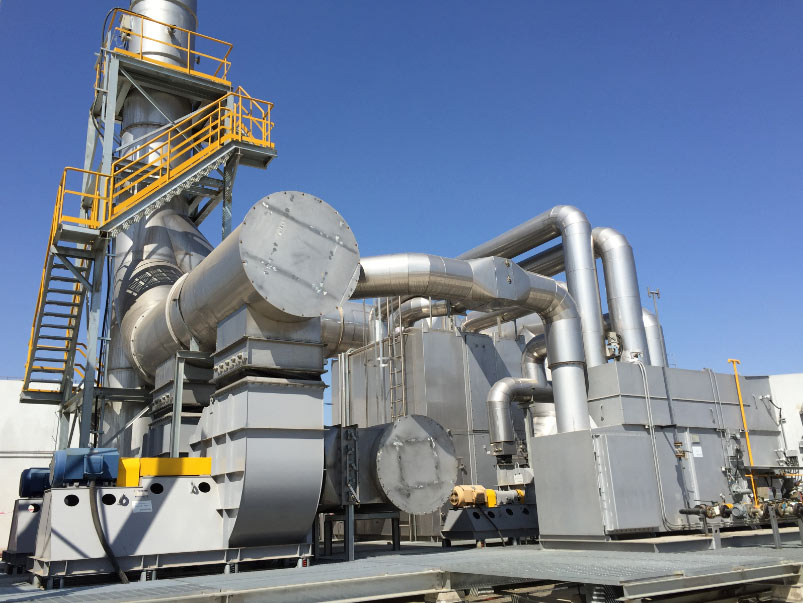

Sewage treatment plant odor control starts by locating the release points: incoming sewage, screens, turbulent channels, covered tanks and solids handling. Each source has its own load and operating cycle. A plant-wide system should collect the air where it is released, then treat the combined load under defined operating conditions.
For an existing works, first establish whether the complaint comes from an untreated source, a capture problem or a treatment stage that is no longer meeting its duty. Adding a larger reactor does not resolve every one of those problems.
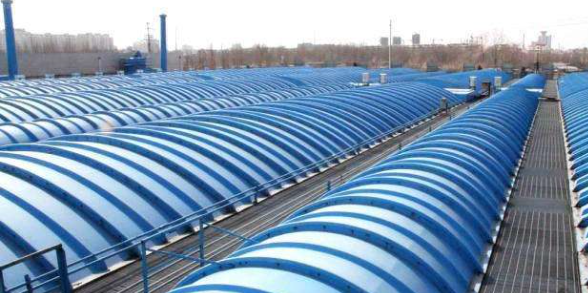
Map the inlet works and process areas
Mark the screens, grit handling, inlet channels, flow splits, tanks and sludge equipment on a plan. Record which areas are enclosed, where operators open access panels and when tank levels change. Follow the extraction path from each source to the discharge point.
Keep room ventilation requirements and process-headspace extraction visible as separate duties. The room air needed for an occupied space should not be assumed to have the same concentration as air drawn directly from a covered tank.
Define the gas and airflow basis
| Input | What to provide | Why it changes the equipment |
|---|---|---|
| Source and capture | Cover drawings, open points, extraction branches | Defines leakage, access and the air that actually needs treatment |
| Airflow | Normal and peak m³/h; identify actual or reference conditions | Sets duct, fan and reactor duty |
| Gas analysis | H₂S, ammonia and relevant VOCs; units and peak readings | Defines contaminant load and treatment stages |
| Moisture and temperature | Relative humidity, condensate and operating range | Determines drainage, corrosion protection and pretreatment |
| Operating cycle | Hours per day, filling, mixing and startup events | Shows when peak loads and standby duty occur |
| Acceptance limits | Inlet envelope, outlet concentration and test method | Makes the performance requirement measurable |
Select treatment around the operating envelope
Municipal wastewater odor control may need to accommodate wet gas, intermittent peaks and several odor compounds. Compare scrubbing, adsorption, biological treatment and oxidation using the same inlet range, required outlet condition and operating schedule.
Low-temperature plasma and microwave UV oxidation can be evaluated as equipment options when the gas data support them. Request a clear pretreatment and polishing scope, including how fouling, condensate and residual oxidants are handled.
Commission one branch at a time
- Confirm the source covers, hatch seals and branch connections.
- Measure airflow and balance extraction branches at the agreed operating condition.
- Record treatment inlet and outlet measurements with plant operating data.
- Check fan-failure response, process alarms and the agreed restart sequence.
- Record the baseline pressure loss and cleaning condition for later maintenance.
A single measurement at the stack cannot show whether air is escaping from an uncovered upstream source. Include source capture in the acceptance review.
Maintain access while containing the source
Hatches, sampling points and equipment doors should remain accessible. Define how operators isolate equipment and maintain temporary extraction when a treatment section is unavailable. Include drains at the appropriate duct low points and a clear condensate destination.
For retrofit work, provide the existing duct sizes, fan curves if available, inspection history and changes in wastewater loading. These details help distinguish a new process requirement from a maintenance issue.
Questions before ordering
Do all tanks need one shared system?
Not necessarily. The layout, contaminant mixture, simultaneous loads and maintenance strategy determine whether to combine or separate sources.
Can this also treat the water?
This scope concerns captured air. Liquid wastewater treatment requires its own process specification.
What should an enquiry include?
Send the plant plan, source list, extraction data, gas measurements, discharge requirement and photographs of the main release points.