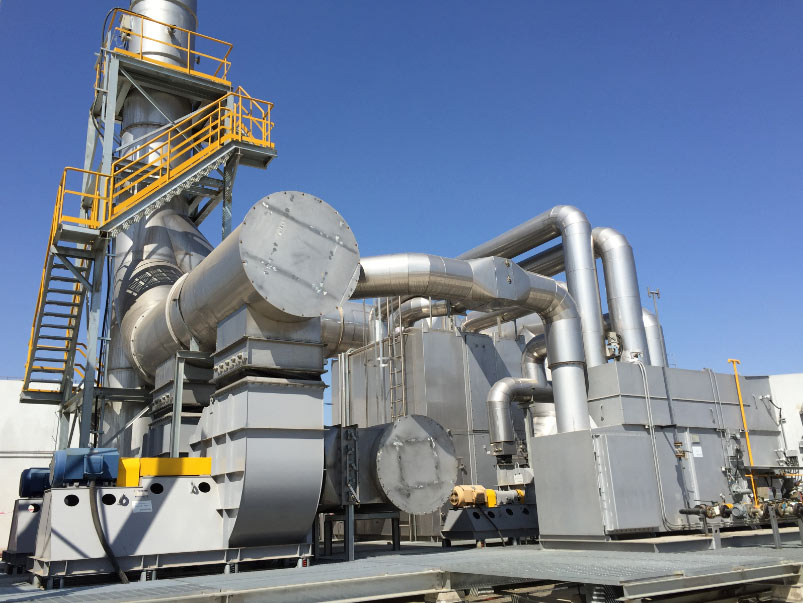

RTO operating cost is driven by airflow, VOC heat release, thermal recovery, startup frequency, heat loss and the supplemental fuel the burner must add. Thermal recovery is the largest single term but only one part of the balance: a unit with good media and a poorly tuned purge can still burn more gas than a simpler unit matched to the stream.
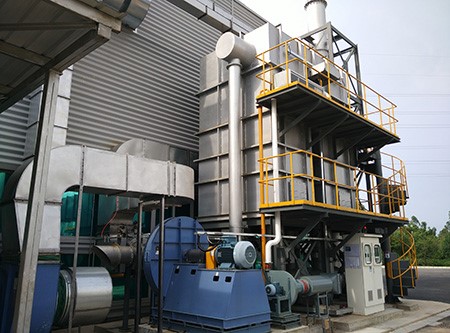
How an RTO Reduces Fuel Demand
During each cycle, ceramic media stores heat from the treated gas. The airflow path then switches, allowing incoming exhaust to pass through the hot media before entering the oxidation chamber, so the burner supplies only the remaining difference.
Without regeneration the stream would be heated from ambient in a single pass, which is why a direct-fired oxidizer uses far more fuel on a dilute stream and why RTO and thermal oxidizer selection is a fuel-cost decision.
What Determines RTO Energy Consumption
Six factors account for most of the variation in fuel demand between units serving similar streams.
Thermal recovery efficiency
Regenerative thermal oxidizers are normally supplied with thermal recovery in the 90 to 95 percent range. Three-bed and rotary units with structured media sit at the upper end; two-bed units with random media sit lower.
Ceramic media type and bed depth
Structured media gives more surface area and lower pressure drop than random packing, which is cheaper up front but pays in fan power. Depth and geometry trade pressure drop against recovery – see our notes on RTO ceramic media and media pressure drop.
Bed count and valve arrangement
A two-bed unit reverses flow and clears untreated gas with a short purge. Three-bed designs add a purge chamber and hold higher recovery. A rotary valve RTO distributes flow continuously, smoothing outlet temperature and pressure.
Switching time and purge volume
The interval sets how much of each bed’s heat capacity is used. Long cycles let the thermal front travel too far and heat escapes; short cycles raise valve wear and transition time. Purge volume must clear dead volume without pushing untreated gas back through the media. This is covered under RTO switching valves.
VOC concentration and the autothermal point
Fuel demand falls as inlet concentration rises, because heat of combustion offsets the sensible heat needed to reach oxidation temperature. Many solvent streams approach autothermal operation around 1.5 to 2 g/m3 of VOC in the inlet; the actual point depends on the compounds present, moisture, inlet temperature and recovery rate held in service. Below it the burner and combustion system makes up the difference; above it excess heat must be absorbed or diluted.
Standby and low-load operation
An idling unit holds the chamber above its minimum operating temperature, and every restart carries a warm-up penalty. Minimum airflow sets a floor on heat loss, and cold inlet air or high humidity raises the sensible heat demand. On intermittent processes we weigh holding the unit hot at reduced flow against shutting down. Insulation and duct leakage belong in the same review, handled under maintenance and troubleshooting.
Heat Recovery Options and Where They Apply
Regenerative recovery inside the oxidizer is the first and usually the best use of the heat. Heat can also be taken from the cleaned gas for site use, in packages that differ in temperature level, hours and pressure drop.
Primary heat recovery
Primary recovery extracts heat immediately downstream of the oxidation chamber, to hot oil, steam or hot air for a process oven, dryer or building. It fits sites with continuous thermal demand running as many hours as the oxidizer.
Secondary heat recovery
Secondary recovery takes lower-grade heat from the stack, for make-up air, boiler feedwater or process water. The level is lower, so the same duty needs more surface, but it disturbs the oxidizer less and retrofits more easily.
Waste heat boilers and the limits of recovery
A waste heat boiler only pays back with a real steam demand and many operating hours a year. Three constraints decide the case: the acid dew point of the gas, which sets a floor on stack temperature and causes low-temperature corrosion if heat is pulled out too far; the added pressure drop the fan must overcome permanently; and the operating hours profile, since a package sized for continuous duty sits idle during shutdowns. Halogenated streams tighten the dew point limit further.
| Recovery option | Where it fits | Limits |
|---|---|---|
| Regenerative media | Every RTO | Pressure drop, media condition |
| Primary recovery | Continuous heat demand | Materials, corrosion |
| Secondary recovery | Preheat or water heating | More surface, lower grade |
| Waste heat boiler | Steady demand, high hours | Dew point, backpressure |
Practical Measures to Cut RTO Fuel Consumption
Most fuel savings on an existing unit come from a combination of the following.
- Raise the recovery rate – add media depth, change media type, or move to a three-bed or rotary arrangement.
- Tune switching and purge – set the interval from the actual thermal profile and purge volume from measured dead volume.
- Reduce dilution and tramp air – sealing the collection system cuts demand more than most hardware changes.
- Segregate high-concentration streams – routing rich sources separately from large dilute volumes shifts the autothermal balance.
- Concentrate before oxidizing – a zeolite wheel or carbon concentrator upstream reduces the flow the oxidizer sees. Check particulate and condensables first.
- Match fan output to demand – variable frequency drives and a controlled oxygen setpoint avoid over-aerating the unit.
- Fix insulation and leakage – insulation, expansion joints, damper seals and valve seating affect short-circuiting.
Estimating Fuel Consumption Before Equipment Selection
A preliminary estimate does not need a detailed model, only the right inputs and a visible structure:
- Sensible heat to raise the stream – design airflow times the specific heat of the mixture times the temperature rise from inlet to oxidation temperature. That is the gross demand.
- Plus system losses – heat lost through the housing, ductwork and stack, plus heat carried out by purge or leakage.
- Less regenerated heat – the share of gross demand the media returns at the recovery rate the configuration holds in service.
- Less VOC oxidation heat release – inlet VOC mass rate times the heat of combustion, adjusted for combustion efficiency.
- Less external recovery – heat removed for steam or hot air is useful output, not burner fuel.
- The balance – the residue is the supplemental fuel the burner must supply. Run it at minimum, average and peak conditions and report the range.
The inputs are total and minimum airflow, VOC composition, average and peak concentration, inlet temperature, humidity, operating hours, startup frequency, recovery target and emission limits. Our RTO sizing guide covers how these are handled in selection.
Frequently Asked Questions
How much natural gas does an RTO use?
It depends on airflow, VOC concentration and recovery rate, so there is no single figure. A dilute stream well below autothermal needs continuous firing; a stream near autothermal operation may need fuel only at startup and low load. Report a range, not one number.
What VOC concentration makes an RTO self-sustaining?
As a general industry figure, autothermal operation is often reached around 1.5 to 2 g/m3 of VOC in the inlet. That is a planning range, not a guarantee, since the point moves with the compounds, moisture, inlet temperature and recovery rate in service. Below it, supplemental fuel; above it, dilution or a heat sink.
Is heat recovery worth it on a small RTO?
Usually not as external recovery, and always as internal recovery. External packages carry capital cost, extra pressure drop and control complexity, and pay back only where demand is continuous and the oxidizer runs most of the year.
Does a higher recovery rate always lower operating cost?
Not automatically. Recovery is bought with media depth and surface area, and both raise the pressure drop the fan overcomes every hour of operation. Compare total operating cost – fuel and fan together – over the real profile.
Can an RTO use electricity instead of natural gas?
Yes. Electric-heated designs remove the gas train and simplify the combustion package, and they fit where electricity is cheap or gas is unavailable. The heat balance is unchanged.
Talk to an Engineer
Send your stream data and site constraints – airflow range, VOC composition and concentration, operating hours, inlet conditions and any recovery demand. We will return a configuration proposal and an energy estimate within one business day. Send your process data for review.