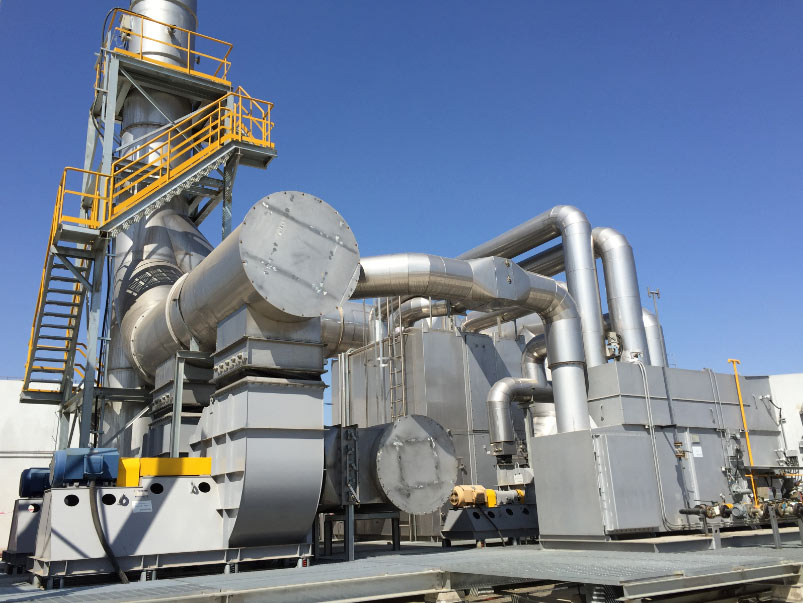

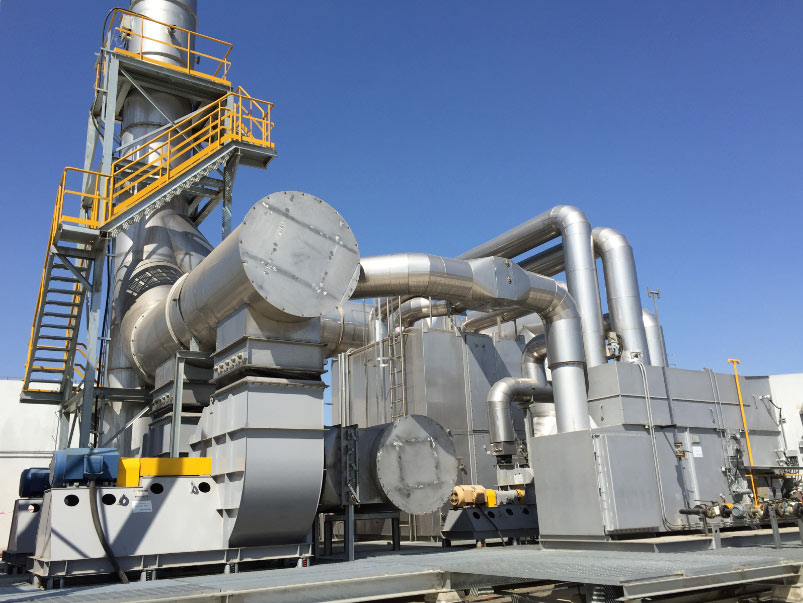
Electric regenerative thermal oxidizer demand is growing: plants want VOC control with less direct fuel combustion, easier electrification planning, and a cleaner path under tight site limits. An electric-heated RTO is not right for every exhaust stream, but it can be the stronger option when process conditions, electrical capacity and energy pricing support it. Core product reference: regenerative thermal oxidizer.
What an Electric-Heated RTO Is
An electric regenerative thermal oxidizer uses electric heating elements, or electric-assisted heating, to hold the oxidation chamber at temperature. Like a conventional RTO it recovers heat through ceramic media beds and destroys VOCs by high-temperature oxidation, meeting the same destruction and removal efficiency target a permit would set for a gas-fired unit. What changes is the source of supplemental heat: resistance elements and power control instead of a burner, gas train and combustion air system.
Heating Elements and Power Control
- Watt density and surface temperature – watt density is set so element surface temperature stays compatible with the stream and any condensable or particulate carryover; excessive temperature shortens element life and encourages deposits.
- Zoned power control – the chamber is divided into zones, each driven by a power unit that modulates output rather than switching on and off, holding a steady temperature profile and avoiding hard cycling.
- Diagnostics and replacement – current monitoring and per-zone alarms expose a failed element before it becomes a temperature deviation. Elements are a wear item whose life depends on temperature, atmosphere, cycling and contamination, so design for maintenance with accessible mounting and a defined spare set. This logic belongs to the PLC control and safety interlock package.
Temperature Uniformity, Startup and Site Conditions
Electric heating is inherently uniform: energy enters the chamber across many elements with no flame to mix out, so holding the profile the oxidation reaction needs is easier and hot spots or cold paths around the media beds are less likely. Startup is different too – there is no burner purge and light-off sequence, and heat can be added gradually, which suits duty-cycled processes and short shifts. At high elevation, thinner air changes velocities, fan performance and media pressure drop with no combustion air to compensate; in low-oxygen or inerted environments, electric heating also avoids putting a flame in a stream whose oxygen content cannot be guaranteed.
When an Electric-Heated RTO Makes Sense
The strongest cases combine several of these conditions:
- No natural gas at the site – no gas service, or extending a main is slow or disproportionately costly.
- Low-cost or low-carbon electricity – power that is cheap by contract, generated on site or bought on a renewable tariff.
- Small to moderate flow with a steady VOC load – supplemental heat demand scales with exhaust volume.
- Intermittent or shift-based operation – gradual heat-up and clean shutdown reduce the stop-start penalty.
- Only non-combustion sources permitted – removing the gas train removes much of that hurdle.
- Electrification and carbon targets – the oxidizer is one of the easier loads to electrify.
When a Gas-Fired RTO Still Wins
- Very large airflows – heat demand scales roughly with flow, and the electrical service a large electric unit needs can become the deciding constraint. A thermal oxidizer with a burner and combustion system may be the practical route.
- Limited electrical capacity – if the service, transformer or switchgear cannot absorb the load without a major upgrade, that upgrade belongs in the electric option’s cost.
- Streams that already self-sustain – where VOC heat release alone holds chamber temperature after warm-up, no supplemental heat is needed and an electrically heated design can be entirely unnecessary. There the decision is driven by heat recovery, not by the heat source.
- Inexpensive fuel against tariff-priced power – where gas is cheap and electricity is bought at published rates, the operating cost gap is wide.
Comparing Energy and Operating Cost: Structure, Not Numbers
Total cost is site-specific; build the comparison from variables, not one quoted figure:
| Variable | Why it matters |
|---|---|
| Airflow and heat duty | Sizes both the gas train and the electrical load |
| Media heat recovery effectiveness | Determines how much supplemental heat is needed at all – see fuel consumption and thermal recovery |
| VOC concentration and heat value | Higher loading cuts supplemental heat; past self-sustaining it disappears |
| Operating hours and duty cycle | Favours the heat source with the smaller start-stop penalty |
| Tariffs, maintenance and connections | Electricity may carry demand charges and time-of-use bands that fuel does not; service extensions and upgrades belong here too |
Run it over a realistic annual operating profile, not at design flow.
Combining with Concentration and Heat Recovery
The heat source is only one lever. Where flow is large and concentration low, a rotor concentrator cuts the volume reaching the oxidizer, shrinking both electrical load and footprint – see the zeolite rotor and RTO case study. Media selection and bed design set how much heat is recovered per pass (ceramic media), which is what determines the top-up power. On a tight site, a rotary valve RTO can be combined with electric heating to keep the package compact, and catalytic routes suit clean, halogen-free streams. Primary sizing inputs are in the RTO sizing guide.
Engineering and Delivery Considerations
- Electrical supply and distribution – confirm available capacity, voltage, fault level and space for switchgear and power control cabinets early; the load is continuous and interacts with the site demand profile.
- Skid packaging – no gas train to route and commission on site, though transport limits, lifting points and tie-ins still govern the split.
- Control and safety interlocks – element overtemperature, airflow proving, valve position and shutdown sequencing sit in the interlock system; loss of airflow must remove power before elements overheat.
- Hazard review – where the stream or surroundings are classified, element enclosures, purging and shutdown logic are reviewed against it; seismic or wind loading, coastal corrosion and ambient extremes drive material and structural choices.
- Documentation – an electric design removes combustion fuel requirements but not the need to authorize VOC emissions; equipment data and duty cases are prepared for the application.
Suitable and Unsuitable Applications
Good fit: coating, printing and laminating lines with moderate solvent load; chemical and specialty manufacturing with stable emissions; battery and specialty material handling; sites with on-site generation and no gas supply.
Poor fit: very large airflow with high heat demand; sites without the electrical capacity; streams rich enough to self-sustain without supplemental heat; cheap fuel against tariff-priced power with no carbon driver; and any stream that will foul the elements quickly.
Frequently Asked Questions
Is an electric RTO always cheaper to run?
No. It can reduce direct fuel combustion at the site, but total cost depends on electricity price and tariff structure, operating hours, VOC heat value, heat recovery and system size. Build the comparison on your own operating profile.
Can an electric-heated RTO meet high VOC destruction efficiency?
Yes, when chamber temperature, residence time, mixing and controls are designed correctly. The target is set by the permit and the unit is sized to meet it with margin; the heat source does not change the oxidation chemistry.
How long do heating elements last, and how are they replaced?
Element life depends on operating temperature, duty cycle, atmosphere and contamination, so treat it as a range rather than a fixed number. Design for maintenance instead: accessible mounting, per-zone isolation and a defined spare set.
What data do you need for a quotation?
Airflow, VOC composition and concentration range, inlet temperature, moisture and particulate content, operating schedule, required emission target, site elevation and available electrical supply. Send them through the contact form and you will receive a configuration proposal.
Talk to an Engineer
Send your stream data, operating profile and site constraints – including the electrical capacity you actually have available – and we will return a configuration proposal and indicative pricing within one business day. Contact us.