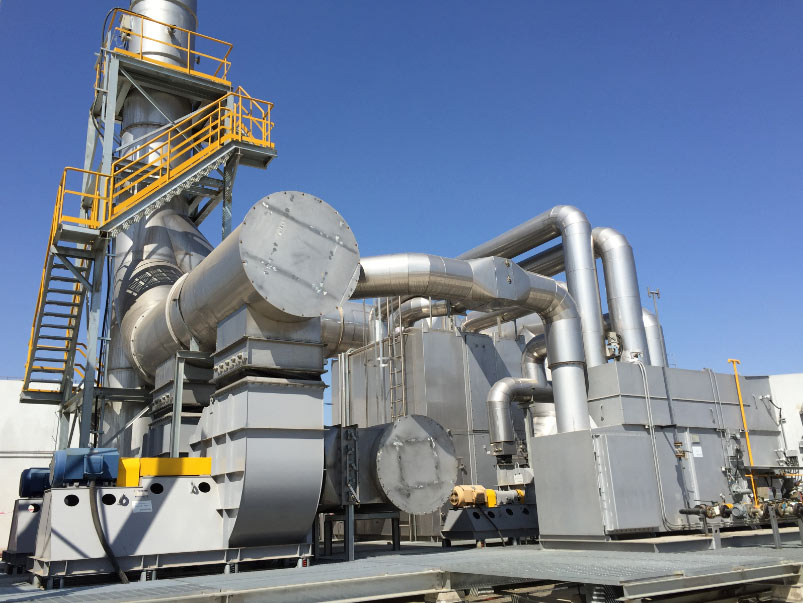

Owning an oxidizer is a decade-long commitment: budgets should plan for scheduled service from day one. This page summarizes what owners typically spend on thermal oxidizer and RTO maintenance over time, and how service intervals drive those costs. Figures are planning ranges based on common industry practice – request a quote for equipment-specific numbers.
Typical Service Intervals
| Task | Interval | Relative Cost |
|---|---|---|
| Burner tune-up and combustion check | Annual | $ |
| Safety interlock and shutdown testing | Annual | $ |
| Switching valve inspection/seal check | 1-2 years | $$ |
| Ceramic media inspection/top-up | 3-5 years | $$$ |
| Media replacement | 7-10+ years | $$$$ |
| Catalyst replacement (CO/RCO units) | 3-6 years | $$$$ |
What Drives Cost Up
- Silicone contamination – destroys catalysts early; screen all sealants and lubricants upstream
- Particulate carryover – plugs ceramic media, raising pressure drop and fan power draw
- Neglected annual combustion tuning – excess fuel use silently adds thousands per year
- Unplanned shutdowns – emergency service plus lost production dwarfs scheduled work
Planning Approach
Track chamber temperature uniformity, valve cycle times and pressure drop trend lines. Rising pressure drop signals media fouling months before failure; drifting temperatures flag damper or burner issues. A modest annual inspection contract consistently beats reactive repair economics.
Maintenance Support
We supply replacement ceramic media, burner components, switching valves, catalyst modules and PT100 sensor sets for most major RTO brands, with engineering support for turnaround planning.