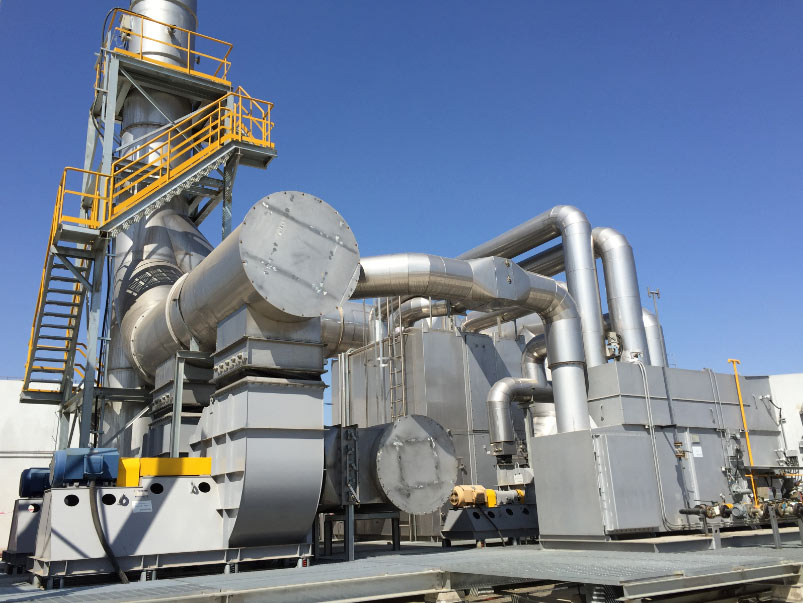

Tennessee manufacturers face the same federal VOC emission limits as the rest of the United States — NSPS and NESHAP subparts depending on the source category — administered locally through the Tennessee Department of Environment and Conservation (TDEC). For plants in the Memphis, Nashville, Chattanooga and Knoxville industrial corridors, a regenerative thermal oxidizer remains the default choice for high-flow, dilute VOC streams where thermal destruction efficiency in the 95-99 percent range is required.
Tennessee’s Industrial Base and Where VOC Emissions Come From
The state’s emitting base is broad rather than concentrated in one sector, so a single specification has to cover a paint shop in middle Tennessee, a panel coater in the east and a printer in Memphis. Four groups drive most oxidizer inquiries:
- Automotive assembly and the parts supply chain — paint and topcoat booths, primer and sealer lines, trim and plastic coating. High volume, solvent load that swings with model mix and shift, often light particulate from overspray.
- Wood products, furniture and panel finishing — stain and clearcoat lines, particleboard and MDF coating, laminate finishing. High flow at low concentration — the profile where RTO heat recovery pays back best.
- Printing, packaging and converting — flexographic and rotogravure presses, laminating and coating lines. Press exhaust is dilute; many plants pair the oxidizer with a concentrator upstream so less volume is heated.
- Chemical, coatings and pharmaceutical operations — batch reactors, mixing and blending, tablet coating and solvent-recovery tails. Lower flow, longer species list, stricter limit; uptime matters more than first cost.
Regional Corridors and What They Mean for a Project
The corridor a plant sits in changes shipping, erection and, at the margin, the fuel decision.
| Corridor | Typical operations | Character of the exhaust stream | Project logistics |
|---|---|---|---|
| Memphis and the western river corridor | Automotive parts, distribution, printing, chemical blending | Press and coating exhaust, mixed solvents | Rail and river freight access |
| Nashville basin and middle Tennessee | Automotive supply, food and beverage, coatings | High-volume paint exhaust with shift-driven swings | Congested parks; indoor layouts common |
| Chattanooga and the southeast | Metal working, automotive components, chemical conversion | Mixed solvents, some particulate | Good interstate access; hilly terrain |
| Knoxville and the eastern corridor | Wood and panel products, furniture, packaging | High flow, low concentration coating and press exhaust | Longer hauls; plan module size |
We ask for the site city at the outset: it settles whether a module ships intact or must be split for the route, and which utilities are available at the fence line.
The Permit Ring Around a Tennessee VOC Project
TDEC administers air permitting in Tennessee, with federal NSPS and NESHAP requirements layered on top for many source categories. Three practical authorization paths cover most projects — and the most valuable hour is the one spent deciding which applies before equipment is specified.
- Small projects on a registration or exemption route — a defined activity, or an increase small enough to fit a registration category. Lighter documentation, but the eligibility conditions still have to be met and recorded.
- Moderate projects on a standard permit — a defined equipment train authorized with emission calculations and control-device specifications submitted for review.
- Projects needing case-by-case review — larger increases, siting considerations, or streams where the federal category requirement adds a layer of analysis. Longest timeline, most rounds of questions.
The methodology that avoids rework: estimate the emission increase first, confirm the authorization path second, specify equipment third. Plants that buy the oxidizer first regularly re-engineer the stack, the monitoring package or the destruction requirement — far more expensive than the week spent up front.
Engineering and Selection Considerations in Tennessee
Humidity, seasonal swing and freeze protection
Tennessee gives you humid summers and cold winter mornings, so a unit sized on a mild design day is usually wrong. Summer moisture lowers the heat available from a given VOC load and pushes the autothermal point — the concentration at which the oxidizer holds temperature without supplemental fuel — upward. Winter cold raises duct and shell losses and lengthens morning warm-up. That translates into moisture content in the sizing calculation, heat tracing on condensable lines, drain provisions ahead of the media bed, and a startup sequence that cannot strand a cold unit waiting on a hot process line.
Indoor and tight-site installation
Most Tennessee plants we quote are fitting an oxidizer into an existing building or fenceline, not onto open acreage. Settle three constraints before the layout is frozen: space, where a rotary valve design shortens duct runs and cuts footprint in a congested park; noise, where property-line limits may require an enclosure that is cheaper to specify than to retrofit; and heat and access, since an indoor hot shell radiates into the building, so clearance, ventilation and access belong in the layout. Setting those limits at the inquiry stage is cheap; discovering them at structural design is not.
Fuel and power availability
Natural gas is broadly available across the state’s main corridors, so a gas-fired RTO is the default starting point; that flips for remote eastern sites, constrained gas service, or a plant with large electrical capacity. Where electricity is inexpensive or already contracted, an electric-heated RTO removes the gas train, the fuel piping and the combustion source from the permit package, and eliminates freeze protection. We compare gas and electric on lifecycle rather than capital cost, because on most streams the answer turns on annual operating hours.
Configurations We Supply
Two-bed and three-bed regenerative thermal oxidizers, rotary valve RTO designs for space-constrained sites, and direct-fired thermal oxidizers for rich or heavily loaded streams. Packages include ceramic media, switching valves, burner and combustion systems, optional heat recovery, and PLC control systems with safety interlocks for high temperature, flame failure, low flow and valve-position feedback. Documentation is prepared to support TDEC permit submittals.
Data We Need to Size a Unit
Send what you have — a complete sizing data set shortens the quotation cycle; a partial one still returns a preliminary configuration and budget range.
- Design exhaust flow at the oxidizer inlet — normal, peak and minimum cases
- VOC species and concentration — full list where available, otherwise dominant solvents
- Required destruction efficiency, or the permit limit to meet
- Halogens, silicon, phosphorus or heavy metals that drive media selection
- Particulate loading, moisture content and condensable components
- Turndown range and operating pattern (continuous, batch, shift-based)
- Site ambient conditions, elevation, noise or footprint limits
- Available fuel, electrical supply and utility tie-in points
Frequently Asked Questions
Does a VOC control project in Tennessee need a TDEC permit?
Usually yes, unless the project fits a registration or exemption category, and federal NSPS or NESHAP requirements may apply on top of the state review. The practical question is which path the emission increase falls into — a front-end determination, not something to settle after the order.
What destruction efficiency should be specified?
Regenerative thermal oxidizers are commonly specified in the 95-99 percent destruction and removal range on solvent streams, and thermal designs can go higher with adequate residence time. The number that matters is the limit in your authorization, and the unit is sized to meet it with margin.
RTO, direct-fired thermal oxidizer, or an electric-heated RTO?
A regenerative unit is normally the lower operating-cost choice on high-flow, dilute streams because the ceramic media recovers most of the heat. A direct-fired thermal oxidizer suits rich streams, small flows, or service where media would foul quickly. An electric-heated RTO suits low-cost power, constrained gas service, or removing combustion from the permit package.
How do Tennessee’s humidity and seasonal range affect sizing?
Both shift the autothermal point. Summer moisture reduces the heat released per unit of VOC, and winter ambient temperatures increase shell and duct losses during warm-up and standby. Sizing on annual averages understates winter fuel and overstates summer margin, so moisture, heat tracing and drain provisions belong in the specification.
Can an oxidizer be installed inside an existing building?
Often yes — in congested industrial parks it is frequently the only option. Indoor installation puts space, ventilation, noise, radiant heat and maintenance access into the layout discussion early, and rotary valve designs help where footprint and duct routing are binding.
Talk to an Engineer
Send your airflow, temperature, VOC list and target destruction efficiency, along with the site city and any footprint or noise limits. We respond within one business day with a preliminary configuration and budget figure — contact our engineering team to start.