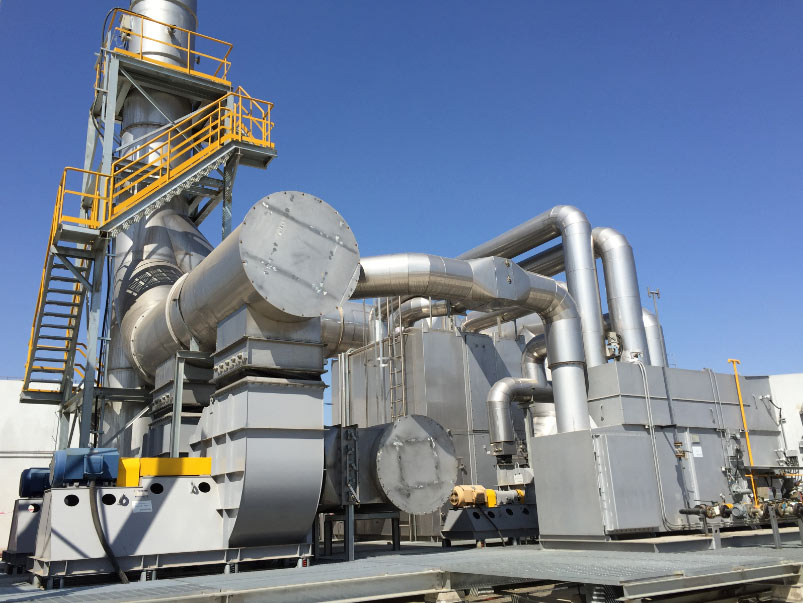

Flue-Gas Baghouse
A baghouse configured for boiler and industrial flue gas, engineered around temperature, moisture, corrosion and the required outlet emission limit.
Key features

Click image to enlarge
Frequently asked questions
What is a flue-gas baghouse used for?
Filtration of boiler and industrial flue gas, where temperature, moisture and corrosion must be managed to protect the collector and meet emission limits.
What gas-conditioning is needed?
Depending on the source, cooling, and possibly pre-treatment for moisture or corrosive components, before the flue gas enters the baghouse.
How is the right media selected?
Media is selected from inlet temperature, moisture, dew point, gas chemistry and particulate characteristics.
What is the difference between a flue-gas baghouse and a normal baghouse?
A flue-gas baghouse is engineered for the specific challenges of combustion exhaust: higher and varying temperature, moisture, dew point, corrosion and continuous duty. Materials, media, insulation and protection are selected accordingly.
Can it be retrofitted to an existing boiler?
Yes. Existing flue-gas baghouses are commonly installed as new builds or retrofits, sized to the existing fan, stack and space constraints.
What is a Flue-Gas Baghouse?
A flue-gas baghouse is a filtration system configured specifically for boiler and industrial flue gas. It is engineered around the temperature, moisture and corrosive character of combustion exhaust, with materials and media chosen to protect the collector and achieve the required emission limit reliably over continuous operation.
How it works
Flue gas is cooled and conditioned where necessary, then enters the baghouse where filter bags remove particulate matter. A pulse-jet cleaning system keeps the bags free of dust during continuous operation, and collected ash is discharged through hoppers and airlocks. The design accounts for gas dew point, corrosion risk and load variation so that the collector performs across the operating envelope of the boiler or process.
Typical applications
- Coal-, biomass- and gas-fired boiler flue gas
- Process heaters and thermal oil boilers
- Incinerators with upstream gas treatment
- Lime and cement kiln exhaust
- Metallurgical process off-gas
Key selection parameters
- Flue gas flow, temperature and moisture profile
- Dust concentration and ash characteristics
- SOx, HCl and other corrosive components
- Required outlet dust concentration
- Start-up, shutdown and bypass conditions
- Integration with existing fans and stacks
Related dust collection equipment
Need this dust collector sized for your process?
Send your dust source, airflow, temperature, dust load and operating conditions. We will recommend a practical system and filter configuration.
← Back to dust collection guide
Flue-Gas Baghouse Selection Notes
Application: Used for boiler, kiln, furnace and incineration flue gas dust removal where temperature, corrosion and ash properties affect baghouse design.
Key sizing data: Please provide flue gas volume, temperature range, dust load, moisture, acid gas, ash characteristics, emission target and cleaning method.
System context: This product can be used as part of a complete industrial dust collection system. For comparison, see High-Temperature Pulse-Jet Baghouse.
Request a quotation: Send dust source, airflow, temperature, humidity, dust concentration, particle size, emission limit, site layout and project country so our engineers can recommend the right dust collector configuration.