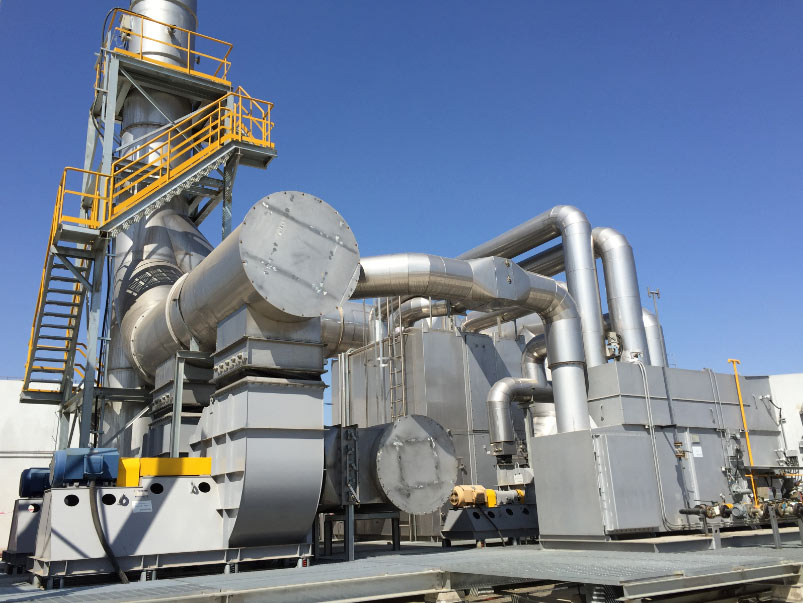

Texas hosts one of the densest concentrations of VOC-emitting industry in the United States: petrochemical complexes along the Gulf Coast, oil and gas production in the Permian and Eagle Ford, and large manufacturing bases around Dallas-Fort Worth and Houston. Emission control in Texas falls under TCEQ jurisdiction, with additional federal NSPS/NESHAP requirements for many source categories.
Where RTOs Fit in the Texas Market
- Oil and gas processing – tank battery vapors and flash emissions often pair VRUs with oxidizers for residual control
- Petrochemical and refining – process vents and fugitive collection headers routed to thermal oxidation
- Composites, coating and fiberglass – styrene and solvent streams at high flow rates
- Data-center backup generation and RNG facilities – emerging applications for electric-heated and standard RTOs
Texas Regions and the Streams They Produce
| Region | Typical operations | Character of the exhaust stream |
|---|---|---|
| Houston Ship Channel and Gulf Coast | Refining, petrochemical, tank farms, marine and barge loading | High-volume vents, tank breathing and loading vapors; halogen and sulfur species in some service |
| Permian Basin and Eagle Ford | Crude and condensate tank batteries, gas processing, oil and produced-water transfer | Intermittent, rich hydrocarbon streams from flash and breathing losses |
| Dallas-Fort Worth | Composites, fiberglass, coatings, metal finishing, food and packaging | Solvent and styrene streams at moderate flow with wide turndown |
| San Antonio and Austin corridor | Manufacturing, electronics support, pharmaceutical operations | Cleaner, more dilute solvent streams |
| Panhandle and West Texas | Gas processing, ethanol and renewable natural gas projects | Richer streams, remote sites, limited utility infrastructure |
Permitting Path in Texas
VOC control equipment in Texas is authorized through TCEQ. Depending on the size of the emission increase and the source category, the route is normally one of three: a permit by rule (PBR) claimed on form PI-7 for smaller, defined activities; a standard permit; or a case-by-case new source review (NSR) authorization for larger or more complex projects. TCEQ publishes NSR guidance written specifically for vapor oxidizer projects, listing the authorization types and fees that apply.
Permitting is frequently the critical path on Texas projects, so the schedule matters as much as the equipment. TCEQ’s air permitting fact sheet (RG-616) sets target review time frames of about 45 days for a permit by rule, 150 days for a standard permit with public notice, 285 days for a new NSR permit and 365 days for federal NSR. Complete emission calculations, performance data and equipment specifications submitted up front are what keep a project inside those targets.
We prepare equipment data sheets, performance guarantee values, emission calculations and dimensional drawings in the format a TCEQ application expects, and we stay available to the permitting engineer through the review.
Engineering Approach for Gulf Coast Conditions
Gulf Coast projects demand corrosion-aware design: salt-laden coastal air, high summer ambient temperatures and hurricane-rated structural requirements all influence the package. We evaluate each stream for halogen and silicone content before recommending catalyst-based alternatives, since these poisons shorten catalyst life dramatically. Ambient above 40 C, high humidity and long duct runs also change fan sizing and insulation thickness, so site conditions are reviewed alongside the process data rather than after equipment selection.
Where electricity is cheap or on-site generation is available – data-center backup power, renewable natural gas and some West Texas sites – electric-heated RTO designs remove the need for a gas train and simplify permitting of combustion sources.
Configurations We Supply
Two-bed and three-bed regenerative thermal oxidizers, rotary valve RTOs for space-constrained sites, direct-fired thermal oxidizers for rich streams, and catalytic oxidizer systems where halogen-free streams and lower operating temperature make catalyst the better economic case. Packages include ceramic media, switching valves, burner and combustion systems, heat recovery, and PLC control systems with safety interlocks. Documentation packages are prepared to support TCEQ permit submittals.
Data We Need to Size a Unit
- Design exhaust flow, including peak and normal cases, at the oxidizer inlet
- VOC species and concentration – a full list where available, otherwise the dominant solvents
- Required destruction efficiency, or the permit limit the unit has to meet
- Presence of halogens, silicon, phosphorus or heavy metals that rule out catalyst
- Particulate loading and moisture content
- Turndown range and the operating pattern (continuous, batch, shift-based)
- Site ambient conditions, elevation and any noise or footprint limits
- Available fuel, electrical supply and existing utility tie-in points
Service, Retrofit and Turnaround Support
Existing Texas installations are supported with troubleshooting and parts replacement, switching valve maintenance, media pressure-drop evaluation, burner components and control upgrades, plus the temperature sensors and pressure transmitters the control loop depends on. For capital projects, representative references are listed under project case studies.
Frequently Asked Questions
What destruction efficiency can an RTO achieve on a Texas VOC stream?
Regenerative thermal oxidizers are routinely specified for 98 to 99 percent destruction and removal efficiency on solvent streams, and thermal designs can go higher with adequate residence time and temperature. The number that matters is the limit in your authorization – the applicable NSPS or NESHAP subpart and any state condition – and the unit is sized to meet it with margin rather than to a generic figure.
Does a new oxidizer need a TCEQ permit in Texas?
Yes, unless the project qualifies for a permit by rule or is below the de minimis threshold. TCEQ publishes NSR guidance specifically for vapor oxidizer projects that sets out the available authorization types and the associated fees, which is the fastest way to confirm the path for a specific project.
How long does Texas air permitting take?
TCEQ’s published target time frames are roughly 45 days for a permit by rule, 150 days for a standard permit with public notice, 285 days for a new NSR permit and 365 days for federal NSR. Applications with complete emission calculations and equipment data move through review faster than those that need follow-up requests.
RTO or catalytic oxidizer for a Texas stream?
Catalyst is usually the lower operating-cost choice on clean, halogen-free solvent streams with low particulate. Any silicone, halogen, phosphorus or heavy-metal content shifts the decision toward thermal, because those compounds poison or mask the catalyst and change the replacement interval dramatically.
What site conditions in Texas change the equipment package?
Coastal salt exposure, hurricane and wind loading requirements, ambient temperatures above 40 C, high humidity and remote West Texas locations with limited utilities all change materials, structural design, insulation and the electrical package. Sending site conditions together with the process data avoids rework later in the project.
Talk to an Engineer
Send your stream data and site constraints – we will return a configuration proposal and indicative pricing within one business day.