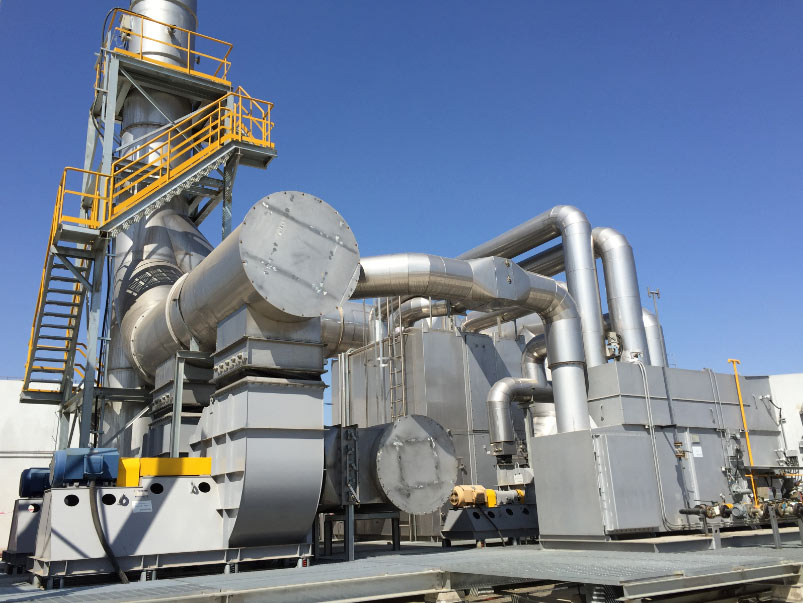

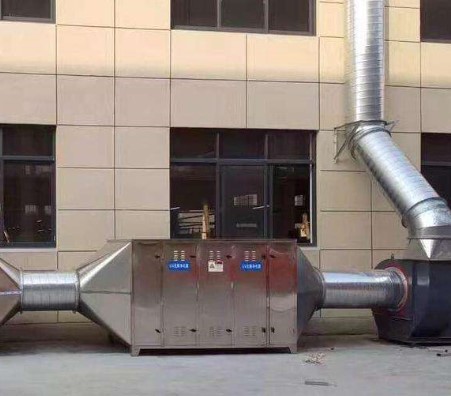
Reactors, distillation columns and stripping units are the heart of a chemical plant — and often the source of its worst odors. Reaction by-products, uncondensed light ends, vacuum pump exhaust and safety valve releases carry a complex mixture of solvents, mercaptans, amines and intermediate compounds. Unlike steady-state tank farm emissions, reactor and distillation odors are intermittent, composition-shifting and often hot. Low-temperature plasma oxidation handles this variability better than fixed-chemistry scrubbers, which is why it is increasingly specified for reactor vent and distillation column exhaust treatment.
The Emission Profile of Reactors and Distillation Columns
Three groups of odor sources dominate this part of the plant:
- Reactor vents: purge gas, inert gas sweep and pressure relief during exothermic reactions carry unreacted monomers, catalyst decomposition products and side-reaction volatiles.
- Distillation overheads: non-condensable light ends vented from the reflux drum are rich in low-boiling odor compounds that bypass the condenser.
- Vacuum system exhaust: steam ejectors and liquid ring vacuum pumps discharge water vapor mixed with volatile organics and reduced sulfur species.
The odor compounds are frequently sulfur- and nitrogen-based: methyl mercaptan, dimethyl sulfide, trimethylamine and ammonia, alongside aromatic and chlorinated hydrocarbons. Their odor thresholds are extremely low, so intermittent releases can cause complaints even when the mass emission rate is small.
Why Fixed Scrubbers Struggle with This Duty
Wet scrubbers work well when the pollutant chemistry is constant. But reactor vents change composition between batches, and a caustic scrubber tuned for H2S does little for toluene or methyl ethyl ketone. Activated carbon saturates quickly at high concentration and needs frequent regeneration, and thermal oxidation is oversized and fuel-hungry for intermittent, low-calorific vents. Low-temperature plasma is chemistry-independent: the same reactor oxidizes reduced sulfur, amines and hydrocarbons because the active species attack molecular bonds rather than specific functional groups.
How the Plasma Reactor Is Configured for Process Vents
A process-vent plasma skid typically includes:
- Condenser/knock-out pot: drops condensed solvent back to the process and protects the plasma cell from liquid carryover.
- Particulate filter or demister: protects electrodes from catalyst dust and polymer fines.
- Plasma oxidation cell: a dielectric barrier discharge chamber sized for the maximum vent flow, often 0.8–1.5 s residence time.
- Post-oxidation section: ozone generated in the plasma reacts with residual odor in a short mixing duct before final discharge.
- Optional catalytic polishing bed: for chlorinated compounds, a downstream catalyst stage raises destruction efficiency above 95%.
For batch processes, the power supply follows the emission curve — the system idles at low load between batches and ramps up automatically when a reaction or distillation cycle starts. This modulation cuts energy use dramatically compared with always-on equipment.
Safety and Interlocking for Process Areas
Reactor and distillation areas are typically Zone 1 or Zone 2 hazardous locations. Plasma skids for these duties are supplied with:
- Explosion-proof fan and motor (Exd / flameproof or Ex e increased safety)
- Flame arresters on the inlet and outlet
- LEL monitoring with automatic system bypass or shutdown
- Interlock with the reactor vent valve so the treatment unit is always running before venting begins
These safeguards make cold plasma a practical alternative in process areas where an open-flame oxidizer would require extensive permitting.
Case-Style Performance Data
On a pharmaceutical intermediate plant treating a 3,000 m³/h reactor/distillation vent stream at 200–800 mg/m³ VOC, a two-stage plasma system achieved 92% total VOC removal, with trimethylamine reduced from 35 mg/m³ to below 2 mg/m³ and odor concentration falling from 8,000 OU to 650 OU. The system has run for three years with electrode cleaning twice a year.
FAQs for Process Vent Treatment
Q: Can plasma treat chlorinated solvents? A: Yes, but chlorine-containing streams are best routed through a downstream catalytic stage to capture HCl by-product and prevent corrosion. Always tell us the solvent inventory when requesting a design.
Q: What happens during a batch upset? A: The LEL monitor detects high concentration and either throttles the fan or bypasses to the flare/vent header per your site procedure. The interlock design is agreed during engineering.
Q: Is a scrubber still needed? A: Many plants keep a small water/caustic scrubber upstream for the highest-loading streams and use plasma downstream for the remaining mixture. We engineer the combined scheme from your emission data.
Request an Engineering Review
Tell us your reactor and distillation vent conditions — compounds, concentrations, flow range and batch cycle — and we will propose a plasma-based solution with a defensible removal estimate. Contact s18301170098@gmail.com or WhatsApp +86 19833770783.
See the equipment options on our low-temperature plasma equipment page.
Related Articles
- Tank Farm Odor Control for Chemical Plants with Low-Temperature Plasma
- Hazardous Waste Warehouse and Storage Room Odor Control Guide
- Sludge Drying Room Odor Control with Low-Temperature Plasma
Compare with Incinerator Leachate Regulation Tank Odor Control with Microwave UV Oxidation for your application.