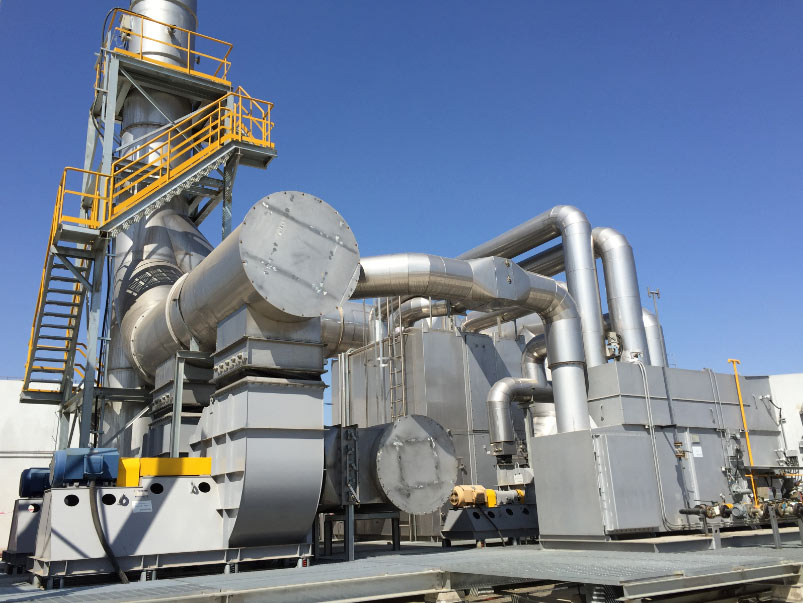

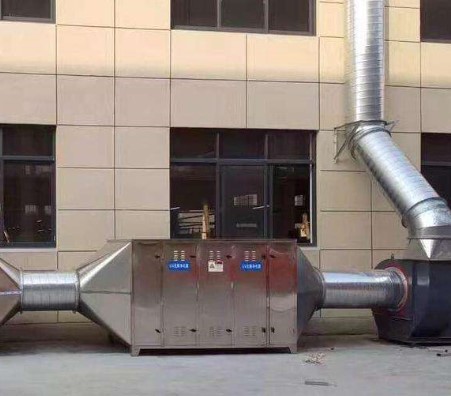
Hazardous waste warehouses and hazardous waste temporary storage rooms are a special odor challenge: the emissions are slow, variable, and often toxic, and the facility operates under strict safety and environmental regulation. Leaking drums, open containers of spent solvents, reactive waste residues and biodegrading organic waste all contribute. Because the space is enclosed and ventilated for safety, the collected exhaust must be treated before discharge. Low-temperature plasma oxidation is well suited to hazardous waste storage ventilation because it destroys odor and VOC molecules in one pass with no water discharge, no consumable chemicals, and no flame in a waste-handling environment.
Typical Odor Compounds in Hazardous Waste Storage
Depending on the waste stream, the odor profile can include:
- Solvent vapors: toluene, xylene, acetone, MEK, ethyl acetate
- Reduced sulfur: hydrogen sulfide, methyl mercaptan, dimethyl disulfide
- Nitrogen compounds: ammonia, amines from pesticide and pharmaceutical waste
- Organic acids and aldehydes from partially decomposed organic waste
Concentrations are usually low — tens to a few hundred mg/m³ — but the exhaust volume is large because warehouses are ventilated at 6–12 air changes per hour. This combination of large air volume and low concentration is exactly the operating window where plasma oxidation is most cost-effective compared with thermal or catalytic oxidation.
Ventilation Design for a Waste Warehouse
The treatment system must work with the warehouse ventilation strategy:
- Source extraction: local exhaust hoods above drum storage and decanting areas capture the highest concentration at the source, minimizing dilution.
- General ventilation: the remaining room air is exhausted at a rate set by the hazardous area classification and odor dispersion model.
- Combined header: source and general exhaust are blended in a manifold before the treatment skid to smooth concentration peaks.
- Plasma treatment: the blended stream passes through the DBD reactor, where active species oxidize odor molecules to CO2 and H2O.
- Final polishing: a thin carbon bed removes residual ozone and trace by-products before the stack.
Because the plasma unit has no liquid circuit, it can be installed indoors or on a roof without freeze protection or wastewater collection — a real advantage for retrofit projects.
Safety in a Hazardous Waste Environment
Waste storage areas demand conservative safety engineering:
- Explosion-proof classification of the fan, motor and control panel in line with the warehouse zone
- LEL monitoring at the manifold inlet with automatic dilution or bypass
- Corrosion-resistant construction: FRP or stainless steel housing where acid gases are expected
- Interlock with fire alarm and smoke detection so the fan stops or switches mode on fire events
All electrical equipment can be supplied to IECEx/ATEX or China GB 3836 hazardous area standards depending on the project location.
Performance and Regulatory Fit
A typical installation on a 15,000 m³/h warehouse exhaust reduces odor concentration from 3,000–6,000 OU to below 500 OU and cuts total VOC below the local emission limit, while treating the sulfur and amine compounds that cause the actual complaints. The system provides continuous documented operation data for the environmental inspection record.
FAQs for Waste Storage Odor Control
Q: Can plasma handle unknown waste mixtures? A: Yes, within the design concentration envelope. Because oxidation is chemistry-independent, changes in the waste mix are handled without retuning, provided the total concentration stays in range.
Q: Does the system produce wastewater? A: No liquid discharge at all. Oxidation products are CO2 and water vapor. This simplifies permitting in waste facilities where any new wastewater stream would be difficult to manage.
Q: What air volume can be treated? A: Plasma skids are modular and can be paralleled. We have supplied units from 2,000 to 100,000 m³/h for warehouse and workshop odor duties.
Get a Warehouse Odor Treatment Proposal
Send us your warehouse dimensions, ventilation rate and a list of stored waste categories, and we will size a plasma system with an accurate removal guarantee. Contact s18301170098@gmail.com or WhatsApp +86 19833770783.
Explore the technology on our low-temperature plasma equipment page.
Related Articles
- Tank Farm Odor Control for Chemical Plants with Low-Temperature Plasma
- Reactor and Distillation Column Odor Control in Petrochemical Plants
- Sludge Drying Room Odor Control with Low-Temperature Plasma
Compare with Incinerator Leachate Regulation Tank Odor Control with Microwave UV Oxidation for your application.