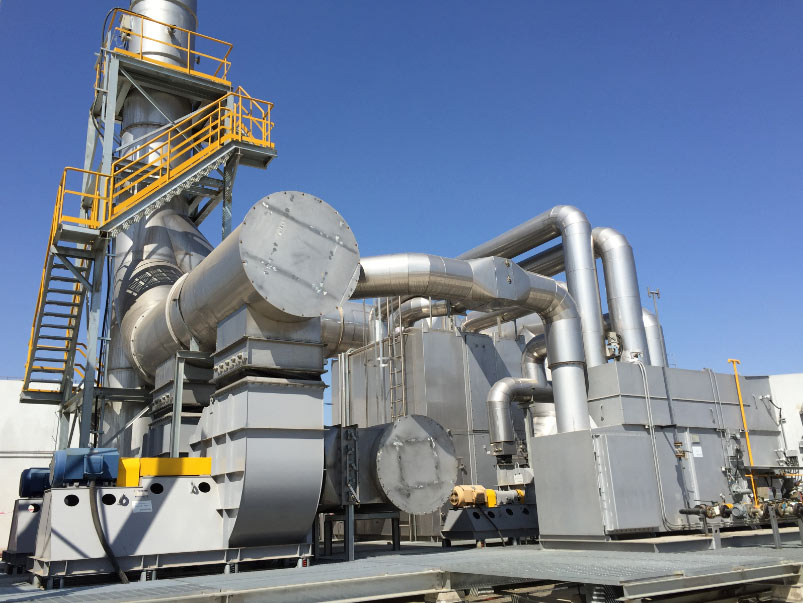

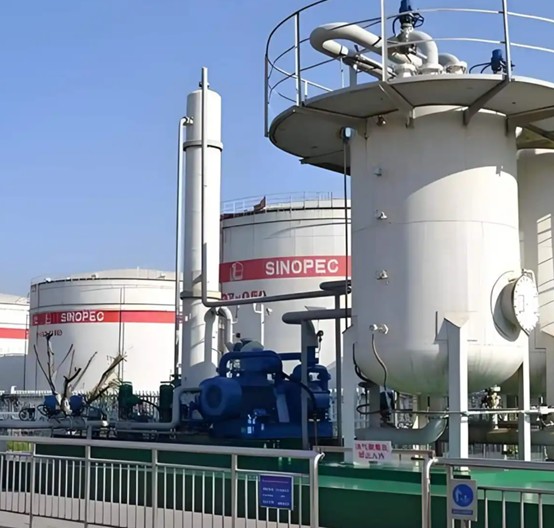
Chemical storage tank farms are among the most persistent odor sources in the petrochemical and fine chemical industries. Breathing losses from fixed-roof tanks, working losses during loading and unloading, and fugitive emissions from seals and vents release solvent vapor and sulfide compounds around the clock. For plant managers and EHS teams, the challenge is not only compliance with odor emission standards but also neighborhood complaints, worker comfort and product loss. Low-temperature plasma (LTP) odor control has become a proven solution for tank farm exhaust because it decomposes odor molecules directly at ambient temperature, without the safety risks of open flames or the maintenance burden of chemical scrubbing.
Where Tank Farm Odor Actually Comes From
An API-style tank farm generates odor through four main routes:
- Breathing losses: thermal expansion and contraction of the vapor space push solvent-laden air out through the breather valve, most noticeably on hot afternoons.
- Working losses: every pump-in and pump-out displaces saturated vapor; a 1,000 m³ tank cycle can release kilograms of VOC vapor.
- Loading rack emissions: truck and rail car loading without submerged filling creates splash filling losses and strong transient odor peaks.
- Fugitive emissions: flange, pump seal and valve packing leaks contribute a low but continuous background smell.
The odor profile is typically a mixture of aromatics (benzene, toluene, xylene), light paraffins, sulfur compounds and oxygenated solvents. Because most of these compounds have very low odor thresholds — hydrogen sulfide can be smelled at 0.4 ppb — a small mass flow can produce a large nuisance footprint.
Why Low-Temperature Plasma Works for Tank Farm Exhaust
Low-temperature plasma technology generates a non-thermal plasma field through dielectric barrier discharge (DBD). Inside the reactor, high-energy electrons collide with gas molecules and produce reactive species such as ·OH, O3 and O radicals. These species attack the C–H, C=C and S–H bonds of odor molecules within milliseconds, converting them into CO2, H2O and trace inorganic salts.
For tank farm applications this offers three decisive advantages:
- Cold oxidation: destruction happens at 30–60 °C outlet temperature, so there is no ignition source near flammable vapor zones. The plasma reactor can be sited with explosion-proof motor and control designs where required.
- Broad-spectrum removal: one unit handles aromatics, alkanes and sulfur compounds simultaneously, unlike a single scrubber chemistry that targets only one pollutant class.
- Low operating cost: typical energy consumption is 3–8 Wh/m³ at moderate concentrations, far below thermal oxidation fuel costs for the same air volume.
System Design Considerations for a Tank Farm
A reliable tank farm odor system is designed around the actual emission profile, not a generic equipment size:
- Air volume calculation: sum of breather valve capacity, working loss displacement and loading rack exhaust. A common rule is to size for 1.2–1.5× the maximum instantaneous flow.
- Pretreatment: a demister or water wash removes droplets and particulate before the plasma reactor, protecting the discharge electrodes and keeping removal efficiency stable.
- Plasma residence time: 0.5–2.0 s in the active discharge zone depending on pollutant concentration; higher loadings may use a two-stage plasma arrangement.
- Explosion safety: for tanks handling flash-point materials, the system should include LEL monitoring, inerting interlocks and ATEX/GB-style hazardous area classification of the fan and electricals.
- Discharge treatment: a small activated carbon polishing bed downstream removes any residual ozone and low-concentration by-products.
Measured Results and Compliance
In practice, a well-designed LTP system on a solvent tank farm reduces the odor concentration (measured by the three-bag olfactometry method, GB/T 14675 or EN 13725) from 5,000–20,000 OU to below 500–1,000 OU, with a 90–98% removal of toluene, xylene and ethyl acetate at inlet concentrations of 200–1,500 mg/m³. Sulfur odor such as methyl mercaptan is reduced by more than 85% in the same pass.
Every project should begin with on-site sampling and a source-by-source emission inventory. This data determines the correct combination of plasma stages, air volume and pretreatment, and it gives the EHS manager a defensible basis for the environmental permit application.
Frequently Asked Questions
Q: Is plasma safe for flammable tank vapor? A: The plasma reactor operates at low temperature and can be supplied with explosion-proof fans, LEL interlocks and flame arresters. For very low flash-point streams, vapor recovery or inert blanketing upstream is recommended first.
Q: What maintenance does a plasma system need? A: The main tasks are periodic cleaning of the discharge electrodes, checking the high-voltage transformer and replacing the polishing carbon bed. Typical intervals are 1–3 months for electrode cleaning and 6–12 months for carbon.
Q: Can plasma handle fluctuating concentrations? A: Yes. The power supply can be modulated to match the emission peak, and the wide treatment window handles both the low background and the high peaks during tank transfer operations.
Get a Tank Farm Odor Assessment
If your chemical or petrochemical facility is facing tank farm odor complaints or tightening emission limits, a professional emission survey is the first step. We supply low-temperature plasma odor control equipment with full engineering support, from air volume design to installation and commissioning. Contact us at s18301170098@gmail.com or WhatsApp +86 19833770783 for a free preliminary assessment.
Learn more about the technology on our low-temperature plasma equipment page.
Related Articles
- Reactor and Distillation Column Odor Control in Petrochemical Plants
- Hazardous Waste Warehouse and Storage Room Odor Control Guide
- Sludge Drying Room Odor Control with Low-Temperature Plasma
Compare with Incinerator Leachate Regulation Tank Odor Control with Microwave UV Oxidation for your application.