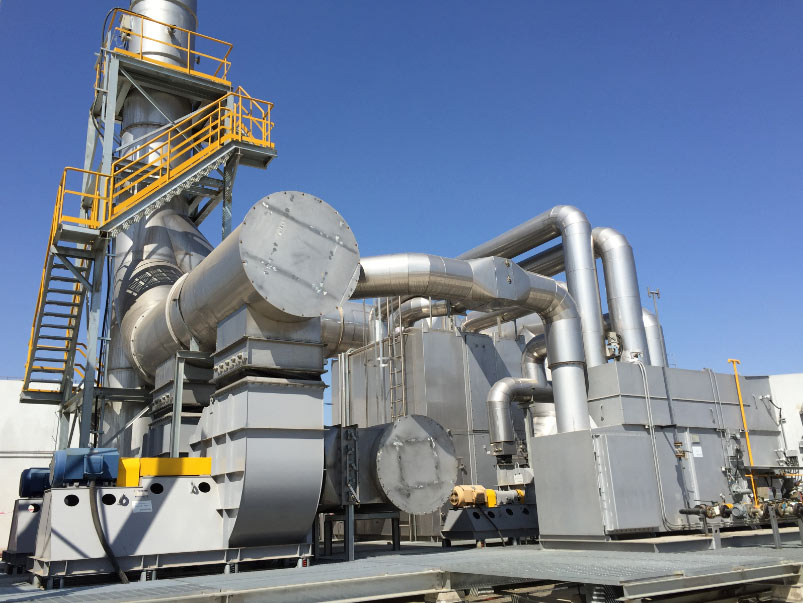

Cyclone dust collectors use centrifugal separation to remove the coarse fraction of a dust stream ahead of downstream filtration. Typical duties are bulk material handling, mineral dust, powder transfer, crushing, screening and conveying. A cyclone is rarely the whole answer: how it is sized and protected decides whether the filter downstream lasts years or blinds off in weeks.
How a Cyclone Separates Dust
Dirty gas enters tangentially and is forced into a descending spiral. Centrifugal force throws heavier particles to the outer wall, down the cone and out through the discharge, while cleaned gas reverses and exits upward through the outlet tube (vortex finder). With no filter media or moving parts in the separation zone, a cyclone tolerates heat, heavy loading and abrasive dust.
The trade-off is cut point. Centrifugal force scales with particle mass, so coarse particles separate well and finer ones progressively less. The usable range depends on size distribution, gas velocity, bulk density and geometry.
- Coarse, dry, free-flowing dust — may suit the cyclone alone.
- Mixed coarse and fine dust — the normal case; cyclone first, filter second.
- Fume, smoke and sub-micron dust — filtration, not cyclonic separation, is what matters.
Pre-Separator or Final Collector?
Decide the role before sizing, or a pre-separator gets specified at a cut point it will never reach.
| Role | Typical duty | What the design must get right |
|---|---|---|
| Pre-separator before a baghouse or cartridge collector | High loading, abrasive or hot gas | Low re-entrainment; a discharge that seals against in-leakage |
| Pre-separator before a silo vent filter | Filling and transfer, material returned to process | Product recovery and wear allowance |
| Final collector | Coarse, dry dust, generous outlet allowance | Confirming the exhaust limit is met on the cyclone alone |
| Product recovery stage | Saleable powder, classification duty | Abrasion protection; leakage is product loss |
Where fine-particle control is required, the cyclone does not replace final filtration; it is paired with a downstream filter so the system handles both fractions — a cartridge dust collector for moderate-load finishing duty, or a low-temperature pulse-jet baghouse at higher volume.
Sizing Parameters
Provide airflow, temperature, dust bulk density, particle-size distribution, inlet concentration, pressure-drop allowance and required outlet performance; diameter and arrangement follow.
| Parameter | Why it matters | Typical practice |
|---|---|---|
| Airflow, normal and peak | Sets body diameter, unit count and inlet velocity | Size on peak; confirm normal flow stays in a stable band |
| Inlet velocity | Too low and particles drop out of the spiral; too high and wear and pressure drop climb | Commonly around 15 to 20 m/s; confirm per geometry |
| Pressure drop | Fan energy cost and the first sign of trouble | Often about 0.5 to 1.5 kPa clean to dirty; record both |
| Body diameter and unit count | Smaller diameter cuts finer but carries less flow | Parallel units (multiclones) for a tighter cut at volume |
| Series staging | Improves coarse recovery at extra pressure drop | Only where recovery justifies the fan energy |
| Discharge arrangement | The air seal, and the most common failure point | Rotary valve or airlock for continuous metered discharge; double flap valve for intermittent duty |
On a silo application the hopper often interfaces with a silo vent filter and its vent protection.
Design Details That Decide Performance
Inlet configuration
Tangential inlets meet the body square-on and let the cylinder wall start the spin. Volute or involute inlets wrap around the body first — lower pressure loss and less re-entrainment, at the cost of footprint.
Outlet tube and body proportions
How far the outlet tube reaches below the inlet sets how much dust re-enters the exit spiral; too short and incoming gas short-circuits upward. A long, gradual cone gives dust a clean path down.
Abrasion protection and wear points
Wear concentrates where velocity peaks: the inlet throat, the upper cone and the underside of the outlet tube. Abrasive dusts justify a wear allowance, replaceable plates or ceramic lining, plus inspection access.
Condensation and insulation
If gas dew point sits near ambient, the cyclone becomes a cold surface and wet dust bridges at the discharge. Insulation and heat tracing hold the body above dew point through start-up and shutdown; sticky dust belongs in a wet dust collector.
Explosion Protection and Safety
A cyclone is a confined vessel where combustible dust is driest and coarsest. Combustion needs five conditions together: fuel, oxygen, an ignition source, dispersion into a cloud, and confinement. The vessel supplies the last two.
- Characterize the dust first. Combustibility screening, and explosibility data where relevant, sets the design basis under recognized combustible-dust standards such as NFPA 652 and 654.
- Deflagration venting. Vent panels relieve to a safe outdoor area clear of people and air intakes; indoors, or without a safe vent path, flameless venting keeps relief inside the envelope.
- Isolation between stages. A cyclone in series with a baghouse or cartridge collector needs isolation so an event cannot propagate down the duct; a correctly specified rotary valve can act as seal and isolation device.
- Bonding and grounding. Bond duct, body, hopper, valves and covers, then ground the assembly and re-verify — a new gasket or duct spool is how bonding gets lost.
- Series layout does not remove the risk. The inlet duct, cyclone, hopper and ductwork stay in the hazardous envelope; treat the train as one explosion-proof dust collector system.
Common Problems and What Causes Them
Complaints usually trace to the discharge, the airflow or the wear surfaces.
| Symptom | Likely causes | Check first |
|---|---|---|
| Pressure drop climbing | Hopper buildup, a discharge valve that stopped cycling, air in-leakage | Valve cycling, then hopper level against the clean baseline |
| Dust carryover at the outlet | Airflow above design, worn outlet tube, over-full hopper, eroded cone | Fan damper and current draw, then internals |
| Abrasion and perforation | High inlet velocity, hard or sharp particles, no liner at the throat | Inlet throat and upper cone |
| Discharge plugging | Condensation, sticky dust, undersized opening, valve leakage | Dew point against body temperature; insulation |
For metalworking and food-processing dusts, duct velocities, cleanable surfaces and filtration staging matter as much as the cyclone — see metalworking and food processing notes.
Frequently Asked Questions
How small a particle can a cyclone dust collector remove?
It depends on geometry, gas velocity, particle density and the size distribution; no single figure applies across units. Cyclones are described by a cut-point range, not a percentage, and lose effectiveness on finer particles.
Is a cyclone enough on its own, or do I need a baghouse?
That is a question about your outlet requirement. Coarse, dry dust, an unrestricted exhaust and a recovered product can suit a cyclone alone; a significant fine fraction calls for a downstream filter.
How do I explosion-protect a cyclone dust collector?
Screen the dust for combustibility and establish the explosibility data that sets the design basis. Then address venting or flameless venting, isolation from any downstream filter, bonding and grounding of every conductive part, and ignition control.
What is the best way to discharge dust from a cyclone?
It depends on whether the material is product or waste and whether flow is continuous. A rotary airlock gives metered discharge while holding the air seal; a double flap valve suits lighter duty. Avoid open manual dumping on combustible or respirable dust.
Why is my cyclone’s pressure drop higher than at commissioning?
Usually the discharge rather than the cyclone: a bridged hopper, a valve that stopped cycling, or in-leakage around a worn valve all change internal flow. Then check the inlet for blockage and the cone for wear.
Talk to an Engineer
Send the dust type, particle-size distribution, air volume, temperature, humidity, inlet concentration, operating hours, available space and any combustible-dust requirements. We will confirm whether the cyclone is a pre-separator or the final collector and recommend a configuration — contact our engineering team for a proposal and indicative pricing.