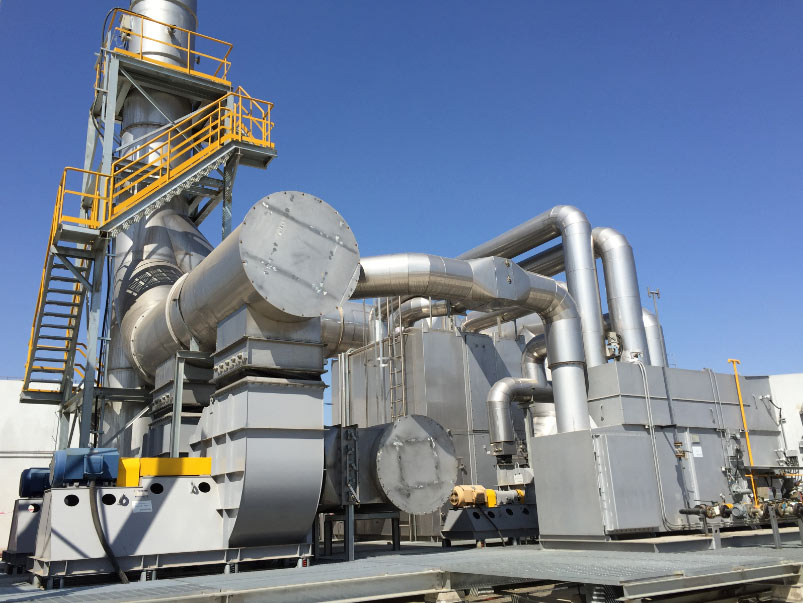

A wet dust collector uses water or another liquid to capture dust and particulate from process exhaust. Wet scrubbing is well suited to fine, sticky, hygroscopic or explosive dust, and to streams where dry filter media would clog or where combined gas and particulate removal is needed.
How a wet dust collector works
- Contact – Dust-laden air contacts a water spray, wet wall or venturi section inside the collector.
- Capture – Particles are wetted and captured into the liquid phase.
- Separation – The wetted dust and liquid are separated from the cleaned gas.
- Slurry handling – Collected slurry is discharged for treatment or disposal.
Wet vs dry dust collection
| Technology | Best suited for |
|---|---|
| Wet dust collector | Fine, sticky, hygroscopic or explosive dust; combined gas and particulate removal; no fire risk from dry media |
| Dry dust collector (baghouse, cartridge) | General dry dust with high efficiency and dry byproduct |
| Cyclone | Coarse or heavy dust as a pre-separator |
Typical applications
- Metal polishing, grinding and buffing dust;
- Chemical and pharmaceutical processes with sticky or soluble dust;
- Explosion-hazard dust where wet collection reduces ignition risk;
- Combined dust and gas or odor treatment streams.
Frequently asked questions
What is a wet dust collector?
A wet dust collector captures dust and particulate using water or another liquid, through spray, wet-wall or venturi contact, separating the cleaned gas from the liquid slurry.
How does a wet dust collector work?
Dust-laden air contacts water in the collector, particles are wetted and captured into the liquid, and the cleaned gas exits while slurry is discharged for treatment.
What is a venturi dust collector?
A venturi dust collector uses a high-velocity venturi throat to atomize water into fine droplets, capturing fine particles; it is one of the most efficient wet collection designs.
Wet dust collector vs dry dust collector: which is better?
Wet collectors suit sticky, hygroscopic, fine or explosive dust and can remove gases too, but produce slurry. Dry collectors (baghouse, cartridge) provide dry byproduct and suit general dry dust.
Can a wet scrubber remove gases as well as dust?
Yes. Wet scrubbers can simultaneously capture particulate and soluble gases or odors, which is why they are used for combined gas and dust treatment.
What is a wet scrubber dust collector used for?
It is used for fine, sticky or moisture-sensitive dust, metal polishing and grinding, chemical processes, and explosion-hazard dust where dry media would be a risk.
How much does a wet dust collector cost?
Cost depends on airflow, dust type, removal efficiency and slurry handling requirements. Send your process parameters for a preliminary budget estimate.
Do you supply wet dust collectors?
Yes. PollutionCtrl supplies wet dust collection and wet scrubbing systems as standalone collectors and within complete air pollution control trains, combined with dry collectors, thermal oxidation and activated carbon.
Request a project evaluation
Send the process conditions – airflow, dust type, particle size, moisture and emission target – for a wet dust collector recommendation.
Wet Dust Collector Selection Notes
Application: Wet dust collectors are used where water scrubbing helps capture dust, reduce sparks or handle humid gas streams, subject to wastewater and corrosion considerations.
Key sizing data: Please provide airflow, dust type, water availability, corrosion risk, slurry discharge, pressure drop, droplet removal and target emission concentration.
System context: This product can be used as part of a complete industrial dust collection system. For comparison, see Cyclone Dust Collector.
Request a quotation: Send dust source, airflow, temperature, humidity, dust concentration, particle size, emission limit, site layout and project country so our engineers can recommend the right dust collector configuration.