
Honeycomb activated carbon (HAC) is a structured gas-phase adsorption medium whose parallel flow channels let process air pass through with relatively low pressure loss. It is supplied as rigid square or round blocks stacked in frames inside an adsorption housing, and it is chosen when airflow volume and system resistance drive the design rather than mass per unit volume.
Product Overview
Raw materials: coal-based carbon powder, coconut shell carbon powder, or wood-based carbon powder. Applications: VOC adsorption, industrial air treatment, solvent recovery, odor control, catalyst support.
The powder is blended with a binder and formed into a monolithic block, so the channel walls carry the pore surface. Unlike granular activated carbon for air purification, honeycomb carbon is a fixed structure whose channel geometry and cell density become part of the system design. It is available on a coal based activated carbon base as well as coconut shell and wood bases.
Why the Honeycomb Form Changes the System Design
Low Airflow Resistance
Straight channels let air cross the media with reduced pressure drop compared with many packed-bed carbon systems. Fan power scales with pressure drop, so on large air volumes this usually justifies the higher media cost.
Stackable Modular Beds
Blocks stack in a frame to build the required face area and bed depth, so capacity is added in modules rather than by replacing a vessel, and nothing settles or channels through the bed.
Adsorption and Desorption Duty
The structure holds its shape through thermal cycling, so it suits solvent recovery and adsorption-desorption systems where the bed is heated to strip solvent and cooled for the next cycle.
Pore Structure, Strength and Impregnation
Depending on the raw material and activation process, the carbon contains micropores and mesopores suited to many organic compounds in industrial exhaust, and the monolithic design provides strength for installation in adsorption units and filters. Selected grades can be impregnated for sulfur compounds, acid gases and aldehydes.
Honeycomb, Granular and Pelletized Carbon: Where Each Fits
| Design factor | Honeycomb | Granular | Pelletized / columnar |
|---|---|---|---|
| Pressure drop | Lowest at a given face velocity | Higher; set by mesh size and bed depth | Between the two |
| Mass per unit volume | Lower; more volume is open channel | Generally the highest | Intermediate, low dust |
| Face velocity | High, keeping the footprint small | Limited by fluidisation | Moderate |
| Replacement | Modules lifted out; short outage | Vacuum or manual unload; longer outage | Handled like granular |
Replacement economics follow the same split: a honeycomb adsorber holds less carbon per cubic metre, so change-out timing is set by mass balance against inlet loading, but blocks are exchanged in a short shutdown while reloading a granular bed is slower and may need confined-space work. On high-volume dilute streams the fan energy saved usually exceeds the media premium.
Typical Applications
Painting, Printing and Coating Exhaust
Solvent-bearing exhaust from painting, printing and coating, where ductwork is large and the stream is dilute.
Spray Booth Recirculation Air
Recirculated booth air returns to the working space, so the adsorber must remove solvent vapor continuously without adding large resistance to the booth fan.
Electronics and Light Solvent Manufacturing
Clean-room and assembly exhaust with low particulate and moderate solvent concentration, where pressure drop and housing size matter most.
Wastewater Treatment and Waste Transfer Odor Control
Odor treatment at wastewater plants, food processing and waste handling sites. Impregnated grades are used where reduced sulfur species dominate; a mixed VOC load may point instead to an adsorption and catalytic combustion combination. Vapor-phase carbon is a separate line from granular activated carbon for sewage treatment.
Air Purification and Catalyst Support
Air treatment equipment where airflow capacity and pressure drop matter, including make-up air and return air handling, and as a substrate for catalytic oxidation and SCR systems.
Specification Categories to Review Before Ordering
| Parameter | Typical range |
|---|---|
| Appearance | Honeycomb block, square or round |
| Standard dimensions | 100 x 100 x 100 mm, 50 x 50 x 100 mm |
| Cell density | 100-200 CPSI |
| Iodine number | 600-950 mg/g |
| CTC (carbon tetrachloride) activity | 45-55% |
| Compressive strength | at or above 0.8 MPa |
| Bulk density | 380-450 kg/m3 |
| Dynamic benzene adsorption | at or above 25% |
| Moisture, as supplied | Grade dependent; specified at order |
| Flame-retardant treatment | Available on selected grades where required |
Actual specifications vary according to product grade and application. Iodine number and CTC activity describe capacity against different probe molecules and do not translate directly into service life; compressive strength governs handling and stacking limits; moisture affects shipping mass and early bed performance; cell density trades pressure drop against adsorption wall.
System Design Points
Face Velocity and Residence Time
Face velocity is fixed first: it sets the required face area, and with it the pressure drop and module count. Residence time then follows from bed depth and velocity and governs how much of the carbon wall is used; a high velocity with too shallow a bed leaves capacity unused at change-out.
Bed Depth and Number of Stages
Two or more stages let a lead stage work toward saturation while the trailing stage polishes the exhaust, improving utilisation and giving a pressure-drop signal for change-out.
Pre-treatment: Dehumidification and Dust Removal
High humidity competes for adsorption sites, and condensed water can displace what has already been captured, so pre-cooling, a mist eliminator or dehumidification protects the bed. Particulate and overspray must be removed upstream: once on the channel walls they block the internal surface.
Differential Pressure Monitoring and Replacement Triggers
A pressure transmitter across the bed tracks gradual blockage; a rise not explained by flow calls for inspection. Replacement is decided on evidence rather than a calendar: outlet measurement against the permit limit, solvent breakthrough, or a mass balance against cumulative inlet loading.
Combining Honeycomb Carbon with Concentrators and Thermal Oxidizers
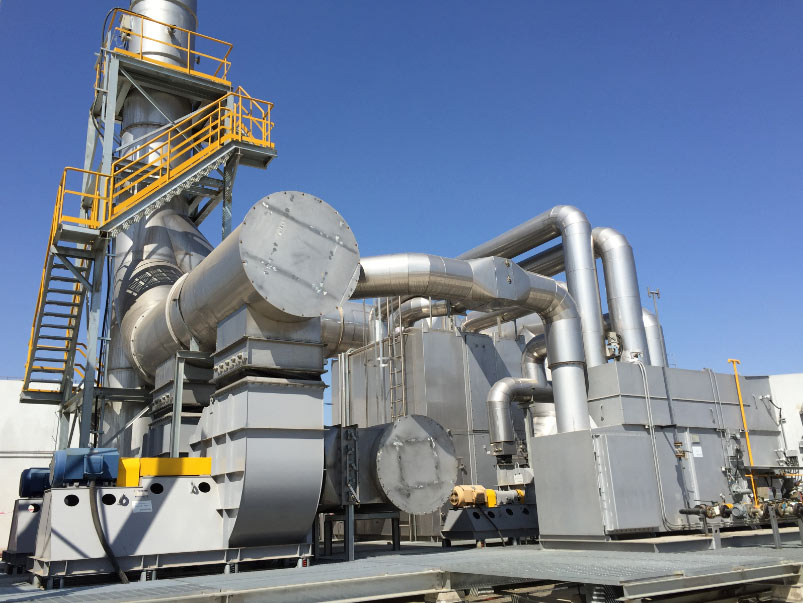
On high-flow, low-concentration exhaust the economics usually point to concentrating the pollutant before destroying it. A rotary concentrator followed by a thermal oxidizer strips solvent from a large dilute stream into a small concentrated one, so a much smaller oxidizer handles the same emission load. A honeycomb adsorber does the same job, capturing solvent and desorbing it into the oxidizer feed. Where a whole system is assembled rather than selected, the scope is quoted as a complete VOC treatment system.
Packaging and Storage
Available with palletized packaging, protective wrapping and customized options. Store in a dry, ventilated area and protect from moisture exposure and physical impact during transportation and handling.
Engineering and Technical Support
Support may include cell density selection, airflow and pressure drop evaluation, grade selection, adsorption system design assistance, replacement planning and regeneration recommendations, based on airflow, VOC composition, concentration, humidity and service life expectations. The wider range covers powdered activated carbon for liquid and injection duties, coconut shell carbon where greater hardness or a microporous structure is required, and industrial wastewater grades for effluent polishing.
Frequently Asked Questions
What is honeycomb activated carbon used for?
Gas-phase adsorption where airflow is large and pressure drop matters: solvent and VOC adsorption on painting, printing, coating and electronics exhaust, spray booth recirculation air, odor control at wastewater and waste handling plants, air purification, and catalytic substrates.
Should I use honeycomb or granular carbon for my VOC stream?
Judge it on flow and loading. Honeycomb suits large air volumes at low to medium concentration, cyclic adsorption-desorption duty and equipment where fan energy and footprint are constrained. A packed granular bed suits smaller streams with higher loading.
Which cell density should I specify?
Cell density balances pressure drop against available adsorption wall: higher density means more carbon wall per unit of face area but higher resistance. It follows from face velocity, allowable pressure drop and the required service interval, together with bed depth.
How do I know when the carbon needs replacing?
On measured evidence: outlet concentration against your limit, solvent breakthrough, a rise in differential pressure that flow alone does not explain, or a mass balance against cumulative inlet loading.
Can honeycomb carbon be regenerated?
Grades used in adsorption-desorption systems are built to be cycled with heat or steam, recovering the solvent; service life depends on the contaminant mix and the number of cycles. High-boiling compounds and particulate loading reduce the number of cycles.
Talk to an Engineer
Send your airflow, VOC species and concentration, humidity, allowable pressure drop, temperature and site constraints, and we will return a media and housing recommendation with indicative pricing through our contact page.