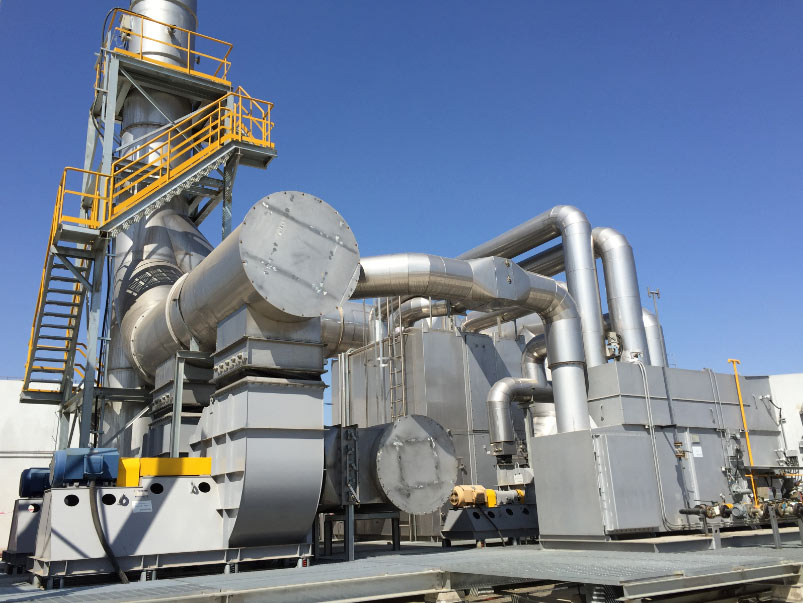

Flue gas treatment removes pollutants from the exhaust of boilers, kilns, furnaces and waste-to-energy plants before discharge. Depending on the fuel and process, the treatment train addresses particulate, VOCs and odors, acid gases, and other regulated pollutants using a combination of proven technologies.
Typical flue gas treatment train
- Particulate removal – a baghouse or cyclone pre-separator captures dust from combustion exhaust;
- VOC and odor control – a thermal oxidizer or RTO destroys volatile organic compounds and odors;
- Adsorption polishing – activated carbon removes residual organics, dioxins and odor;
- Acid gas control – scrubbers or dry injection systems handle SO2, HCl and other acid gases (supplied with partners where required);
- NOx control – combustion controls or catalytic reduction systems address nitrogen oxides (supplied with partners where required).
Flue gas treatment applications
- Boilers and industrial furnaces;
- Rotary kilns in cement and lime production;
- Waste-to-energy and incineration plants;
- Dryers, roasters and process heaters;
- Chemical and metallurgical processes.
Frequently asked questions
What is flue gas treatment?
Flue gas treatment removes pollutants such as dust, VOCs, acid gases and heavy metals from combustion exhaust before it is released to atmosphere.
What is in a flue gas cleaning system?
A typical system combines particulate collection (baghouse), VOC and odor oxidation (thermal oxidizer), activated carbon polishing, and acid gas or NOx control stages as required by the fuel and emission limits.
How do you treat flue gas from a boiler?
Boiler flue gas is typically dedusted with a baghouse or cyclone, followed by activated carbon and, where VOCs or odors are present, a thermal oxidizer.
What is flue gas purification?
Flue gas purification is the combined removal of particulate and gaseous pollutants to meet emission limits, using filtration, adsorption and destruction technologies.
How is flue gas treated in waste-to-energy plants?
Waste-to-energy plants use a multi-stage train: particulate removal, acid gas scrubbing, activated carbon for dioxins and mercury, and NOx control, engineered to the local emission standard.
What is the difference between flue gas treatment and air pollution control?
Flue gas treatment is air pollution control applied specifically to combustion exhaust streams, typically covering multiple pollutants in one train.
Can thermal oxidation treat flue gas?
Yes, thermal oxidation destroys VOCs and odors in flue gas, and is commonly combined with a baghouse and activated carbon for complete treatment.
What is the cost of a flue gas treatment system?
Cost depends on flue gas flow, pollutant loading, technology combination and emission targets. Send your fuel and flue gas data for a preliminary budget estimate.
Do you supply complete flue gas treatment systems?
PollutionCtrl supplies baghouses, thermal oxidizers, RTO and activated carbon equipment for flue gas treatment, and can coordinate complementary scrubber and NOx control stages with partners for complete systems.
Request a project evaluation
Send your fuel type, flue gas flow, pollutant concentrations and emission target for a flue gas treatment recommendation.