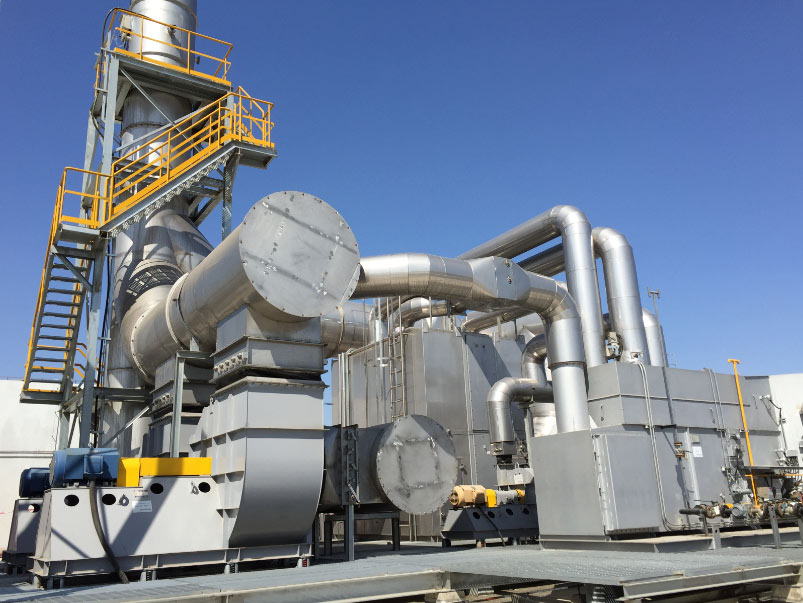


Project Overview
County-scale kitchen waste treatment site processing 40 t/d. Odor area: receiving bay and crushing/sorting room. Design air volume: 7,800 m3/h.
Odor Components
Mercaptans, organic acids, mixed VOCs, with traces of oil mist droplets
Operating Challenges
Exhaust contains oil mist; direct entry into the plasma unit would coke the electrodes and create a safety hazard.
Treatment Process
Negative-pressure sealed collection → scrubber tower for oil removal and dehumidifying → low-temperature plasma deodorizer → activated carbon adsorber
Main Equipment
Explosion-proof induced draft fan, oil-removal scrubber tower, low-temperature plasma unit, activated carbon adsorber
Treatment Results
Kitchen-waste sour/rotten odor effectively treated; equipment shows no frequent scaling or clogging.
Operating Cost
0.50–0.59 CNY / 1,000 m3 of exhaust gas
Technical Highlights
Mandatory design rule: upstream spray removes oil mist to guarantee long-term stable plasma operation – the project’s safety design red line.
This project uses a Low-Temperature Plasma combined process. Learn more about the technology on our Low-Temperature Plasma equipment page. For a similar design, contact us at info@pollutionctrl.com / WhatsApp +86 19833770783.
Why oil mist is a safety issue, not just a fouling issue
Kitchen waste handling releases oil mist along with the odour. In a low-temperature plasma unit the discharge sits on the electrode surface: oil deposits there, the deposit carbonises, and a conductive carbon path can form. That is a fire and short-circuit risk, not simply a loss of performance. Oil removal before the plasma stage is therefore a safety requirement.
The role of each stage
- Negative-pressure sealed collection — keeps the receiving bay and sorting room under suction so odour does not migrate into the site.
- Oil-removal scrubber — removes oil mist and dehumidifies, protecting the electrodes.
- Low-temperature plasma — oxidises mercaptans and organic acids that cause the sour, rotten note.
- Activated carbon — polishes the residual odour to the boundary limit.
Why the fan is explosion-proof
Kitchen waste gas can contain methane and other flammable components at low concentration. Where the gas may enter a flammable range, the fan and electrical equipment in the gas path are specified to the applicable explosion-protection standard, and the system is designed against the dust and gas hazard assessment for the site.
What to specify for a similar kitchen waste plant
- Throughput and the operating hours of the receiving and sorting areas.
- Odour component list, including oil mist concentration.
- Gas temperature and humidity at the extraction point.
- Whether methane is expected, which drives the electrical classification.
- Boundary odour target and the nearest receptor distance.
- Access for scrubber and lamp maintenance, since oil service is frequent.
Frequently asked questions
Can the oil be removed by a filter instead of a scrubber?
A filter can remove mist, but it loads quickly and becomes a maintenance burden. A scrubber removes oil continuously and also cools and humidifies the gas, which the plasma stage needs.
What happens if oil reaches the plasma unit?
Performance falls first, then the electrodes coke. In the worst case the carbonised deposit creates a conductive path, which is why the scrubber is treated as a protective stage rather than an optional one.