
Project Overview
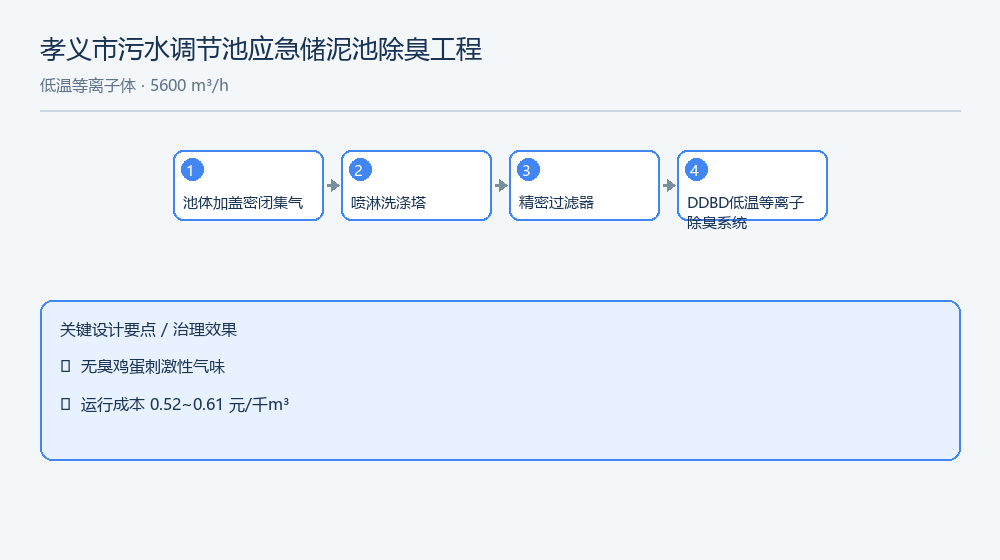
Odor control for the regulation tank and emergency sludge holding tank of an industrial park enterprise WWTP. Design air volume: 5,600 m3/h.
Odor Components
Hydrogen sulfide, volatile sulfides and small-molecule organic acids
Operating Challenges
Very limited reserved space; retrofit project; exhaust is humid and emitted intermittently.
Treatment Process
Sealed tank cover collection → water scrubber tower → fine filter → low-temperature plasma deodorization system → elevated discharge
Main Equipment
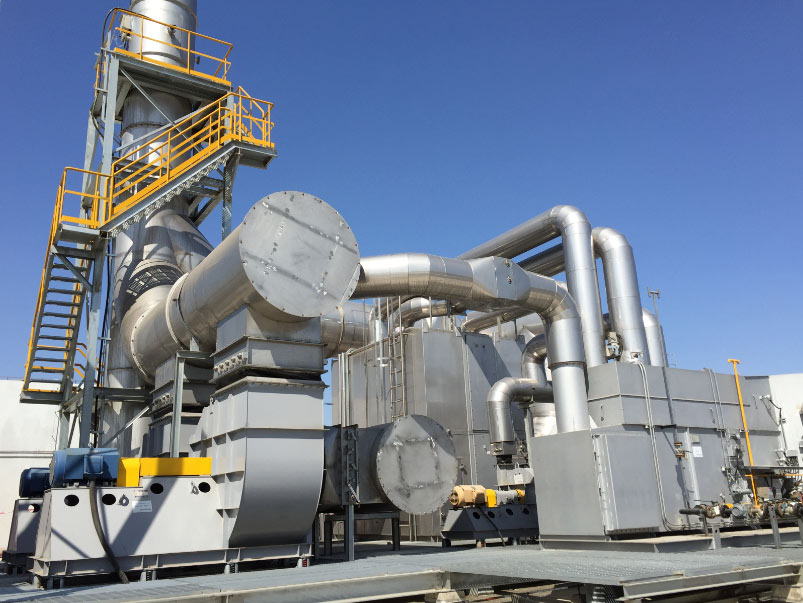
Corrosion-resistant fan, scrubber tower, fine filter, DBD low-temperature plasma unit
Treatment Results
No obvious rotten-egg odor around the tanks; stably meets environmental inspection requirements.
Operating Cost
0.52–0.61 CNY / 1,000 m3 of exhaust gas
Technical Highlights
Compact layout fits tight retrofit space; fine filter protects the plasma chamber under humid intermittent duty.
This project uses a Low-Temperature Plasma combined process. Learn more about the technology on our Low-Temperature Plasma equipment page. For a similar design, contact us at info@pollutionctrl.com / WhatsApp +86 19833770783.
Why a retrofit at a treatment plant is a space problem first
Regulation and emergency sludge holding tanks at an industrial park treatment plant are usually built before the odour requirement existed. The reserved space is what it is, and the system has to fit into it. That constraint drives the configuration more than the chemistry does: a compact skid with a small footprint is selected because a biofilter or a large thermal unit cannot be accommodated.
Why the sequence is scrubber, filter, then plasma
- Scrubber — reduces hydrogen sulphide and conditions the humid gas.
- Fine filter — protects the plasma electrodes from carry-over, which is the most common cause of declining performance in retrofit installations.
- DBD plasma — oxidises the residual volatile sulphides and organic acids.
Why the exhaust is discharged at elevation
Where the treated gas still carries a residual odour note, an elevated discharge uses the atmosphere as a final buffer. That is a legitimate part of the design, but it depends on there being no sensitive receptor close enough for the plume to reach at ground level — which is why the receptor distance has to be part of the design basis.
What to specify for a similar retrofit
- Available footprint and the access route for installation.
- Tank volume, filling pattern and the resulting emission peaks.
- H2S and organic sulphur concentration, including the emergency holding tank which can be the worst case.
- Gas humidity and temperature at the extraction point.
- Nearest receptor distance and the boundary odour target.
- Whether the plant operates unattended, which drives remote monitoring requirements.
Frequently asked questions
Why is the emergency holding tank often the design case?
Because it can hold sludge for longer and at higher strength than the normal flow, so its headspace concentration is higher. Designing only on the normal regulation tank under-sizes the system for the worst day.
Can the system be expanded later?
That should be decided at the layout stage. Leaving space and a spare electrical capacity for a second stage is much cheaper than retrofitting one into an occupied plant room.