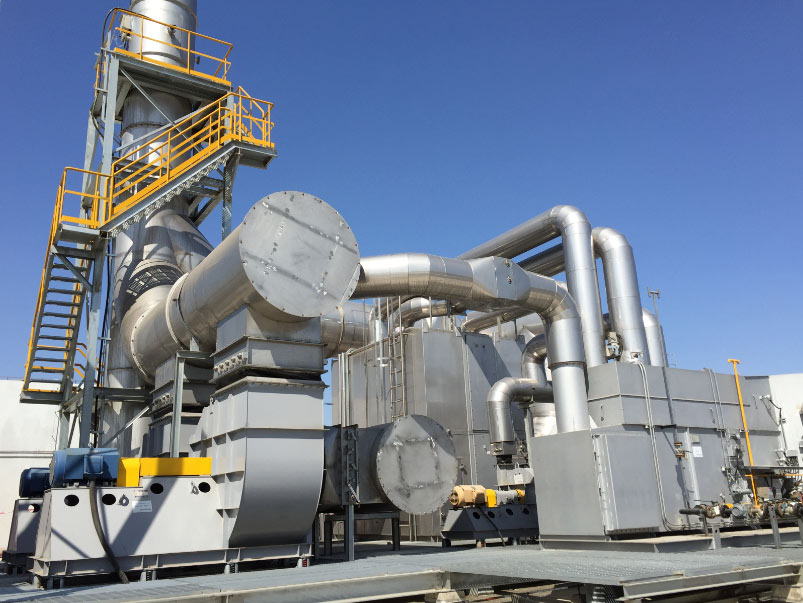


Project Overview
Odor control for the sludge section of a county WWTP treating 65 t/d of sludge (80% moisture). Areas: sludge silo and small dewatering room. Design air volume: 7,200 m3/h.
Odor Components
High-concentration hydrogen sulfide, organic amines and thioethers; highly corrosive
Operating Challenges
Enclosed indoor space; exhaust carries fine sludge dust that tends to contaminate purification equipment electrodes.
Treatment Process
Sealed collection from silo and dewatering room → primary filter dedusting → water scrubber tower → low-temperature plasma deodorizer → activated carbon adsorber
Main Equipment
Corrosion-resistant induced draft fan, scrubber tower, DBD low-temperature plasma unit, dust filter, activated carbon adsorber
Treatment Results
Irritating odor in the room markedly reduced; operators no longer need heavy-duty respirators at all times.
Operating Cost
0.51–0.60 CNY / 1,000 m3 of exhaust gas
Technical Highlights
Key design point: multi-stage upstream filtration prevents dust entering the plasma chamber and causing electrode fouling or short-circuit.
This project uses a Low-Temperature Plasma combined process. Learn more about the technology on our Low-Temperature Plasma equipment page. For a similar design, contact us at info@pollutionctrl.com / WhatsApp +86 19833770783.
Why the sludge off-gas needs dedusting before the plasma stage
Sludge at 80% moisture produces an off-gas that carries fine sludge particles. In a low-temperature plasma unit the discharge electrodes are the sensitive component: dust deposits on them, the discharge becomes uneven, and performance falls before any alarm indicates a fault. A primary filter ahead of the plasma stage is therefore a reliability measure, not an optional extra.
Why a scrubber sits between the filter and the plasma unit
- Hydrogen sulphide load — high-concentration H2S from sludge handling is corrosive and odorous; a water scrubber reduces the load that the plasma stage has to handle.
- Humidity control — the gas is saturated; the scrubber also acts as a conditioning stage, and the material selection downstream has to assume a wet, acidic environment.
- Corrosion — the combination of H2S and moisture attacks carbon steel, so the fan, ducting and housing are specified in corrosion-resistant materials.
Why activated carbon follows the plasma stage
Odour limits at a treatment plant boundary are low and the load varies with sludge delivery. The carbon adsorber absorbs excursions that the plasma stage passes through, and it is what makes a boundary odour guarantee achievable rather than a best-effort statement.
What to specify for a similar sludge facility
- Sludge throughput and moisture content, which set the odour load.
- H2S and organic sulphur concentration, including peaks during sludge delivery.
- Dust loading and particle characteristics.
- Gas temperature and relative humidity.
- Boundary odour limit and how compliance is measured.
- Material specification for wet H2S service.
Frequently asked questions
Why not a biofilter for sludge odour?
Biofilters need a steady load and a large footprint, and they are sensitive to cold weather. Where the flow is enclosed and the space is constrained, a compact physical-chemical route is more predictable.
Why is the plasma stage not sufficient on its own?
Because the inlet load varies and the outlet limit is low. A single stage has no reserve for peaks; the carbon polishing stage provides that reserve.