
Project Overview
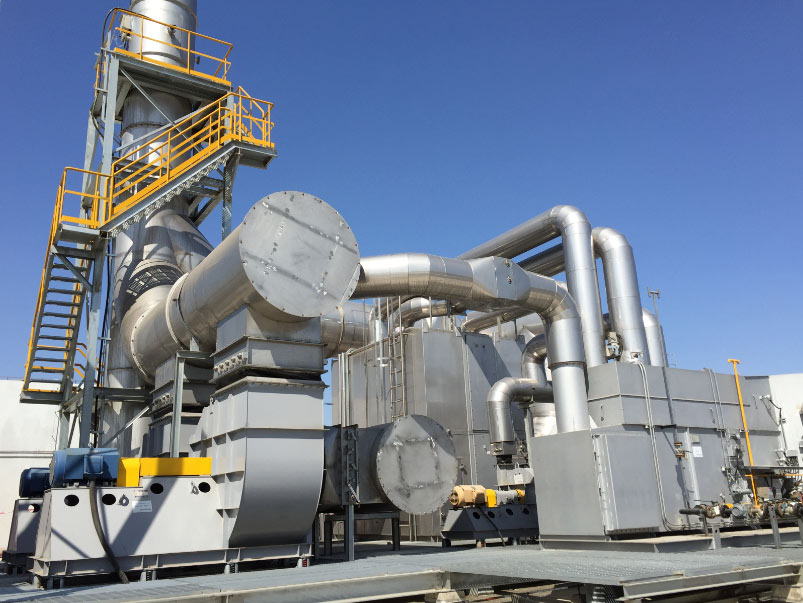
Odor treatment for the grinding and cooking sections of a feed processing plant. Design air volume: 11,000 m3/h.
Odor Components
Amines from protein decomposition, volatile fatty acids and traces of VOC
Operating Challenges
Exhaust carries fine feed dust; production starts and stops intermittently; limited installation space in the workshop.
Treatment Process
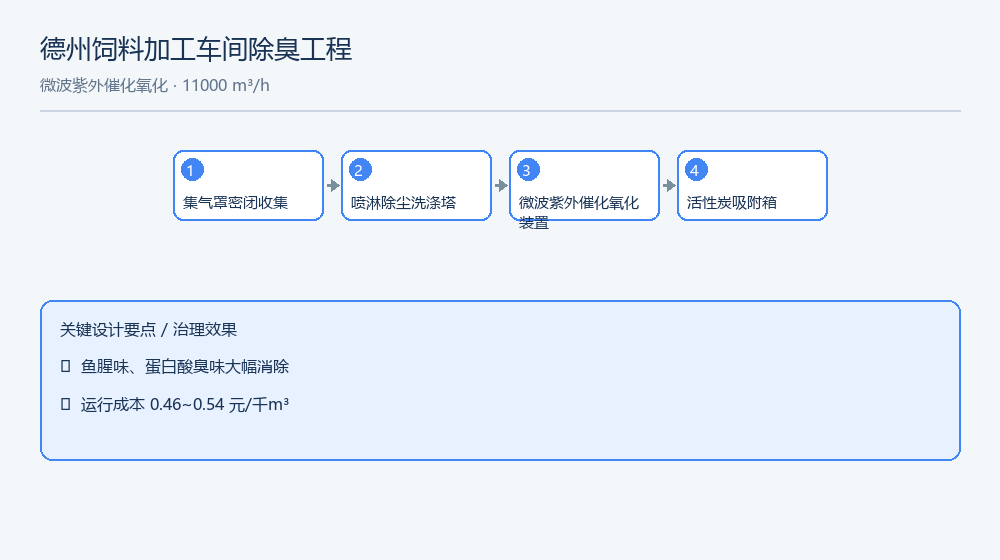
Hood sealed collection → spray dedusting scrubber → MW-UV catalytic oxidation unit → activated carbon adsorber for compliant discharge
Main Equipment
Centrifugal corrosion-resistant fan, spray scrubber tower, MW-UV unit, activated carbon adsorber
Treatment Results
Fishy and protein-acid odor in the workshop largely eliminated; working environment for operators improved.
Operating Cost
0.46–0.54 CNY / 1,000 m3 of exhaust gas
Technical Highlights
Spray dedusting upstream protects UV lamps; adapts to load fluctuation from intermittent production.
This project uses a Microwave UV Oxidation combined process. Learn more about the technology on our Microwave UV Oxidation equipment page. For a similar design, contact us at info@pollutionctrl.com / WhatsApp +86 19833770783.
Why feed mill odour needs dedusting first
Grinding and cooking sections release fine feed dust along with the odour. In a compact workshop the collector has to sit close to the process, so every stage upstream of the UV unit also protects the unit from dust that would settle on the lamp sleeves. A spray dedusting scrubber is used here for that dual purpose: it removes particulate and it conditions the gas.
Why the odour is dominated by amines and fatty acids
Protein decomposition produces amines, and fat breakdown produces volatile fatty acids. These are not the same compounds as sewage hydrogen sulphide, and they respond differently to oxidation: the amine fraction is readily oxidised, while the fatty acid fraction is what the carbon polishing stage is there to catch.
Why the installation space decided the configuration
- Compact footprint — a multi-stage skid fits inside a workshop where a biofilter would not.
- Intermittent operation — production starts and stops, so the system has to handle cycling without a long biological recovery period.
- Attended site — lamp and scrubber maintenance can be scheduled during production breaks.
What to specify for a similar food or feed plant
- Air volume per extraction point and whether sections run simultaneously.
- Odour component profile, dust loading and gas temperature.
- Available floor area and ceiling height for the equipment skid.
- Operating pattern, including the number of starts per day.
- Boundary odour target and the measurement method.
Frequently asked questions
Why include an activated carbon stage after UV?
Because the fatty acid fraction is not fully destroyed in a single oxidation pass, and the outlet limit is low. Carbon provides the margin that makes the guarantee achievable.
Can the same system handle a change of product line?
To a degree. A different product changes the odour profile, so the carbon replacement interval and possibly the scrubber chemistry should be reviewed when the product mix changes.