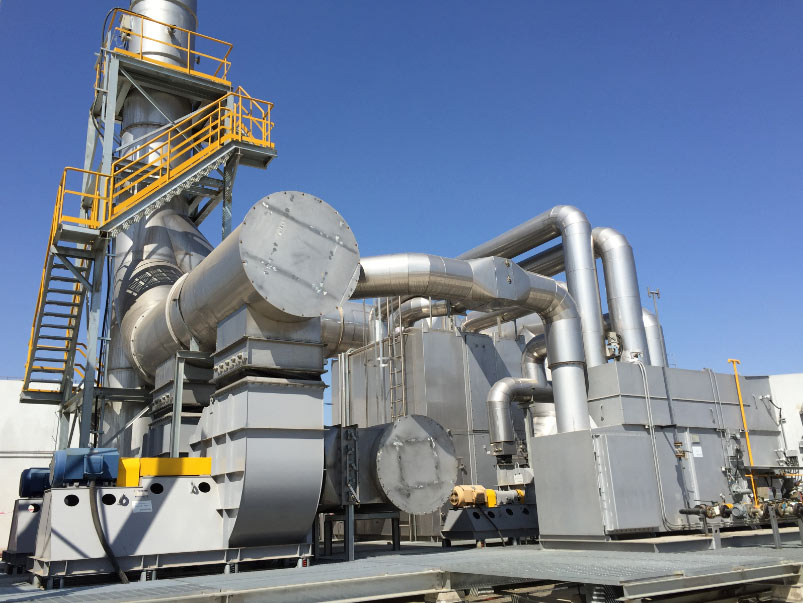

Adsorption + absorption combines activated-carbon capture with gas-liquid mass transfer to recover or control hydrocarbon vapor from tank farms, gasoline loading, solvent storage and process vents. The arrangement can smooth concentration peaks, recover selected hydrocarbons and polish the final gas when the vapor is compatible with the selected absorbent.
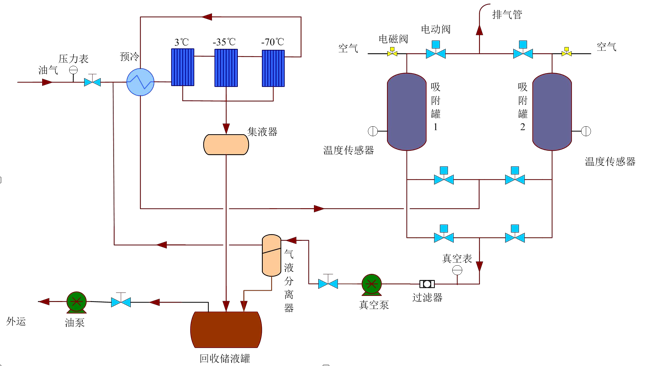
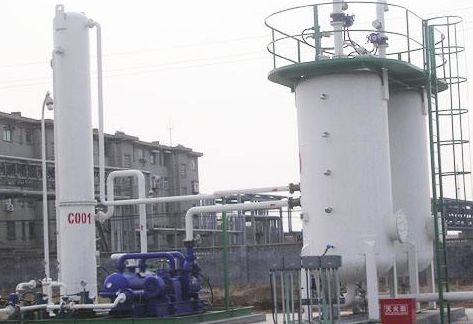
Process configuration
- Vapor collection: source vapor enters a controlled header with pressure measurement, liquid separation and safe isolation.
- Adsorption: activated-carbon beds capture hydrocarbon components while the beds operate in alternating adsorption and regeneration cycles.
- Absorption: the concentrated or conditioned vapor contacts a compatible absorbent in a packed or structured tower.
- Absorbent circulation: the rich absorbent is managed, regenerated or routed to the approved product system; the lean absorbent returns to service.
- Tail-gas control: residual gas is monitored and, if necessary, sent to polishing adsorption, catalytic oxidation or another approved treatment stage.
When to consider this VRU
- Hydrocarbon vapor has recoverable value but the stream varies in concentration or flow.
- Gas-liquid contact can selectively absorb the target components.
- Activated-carbon polishing is useful for controlling residual vapor and peak loading.
- The site can safely manage absorbent circulation, regeneration and recovered product routing.
Engineering and safety requirements
| Area | Project review |
|---|---|
| Adsorbent protection | Check water, aerosols, dust, heavy hydrocarbons, polymerizable materials and adsorption heat. |
| Absorbent selection | Confirm solubility, selectivity, vapor pressure, corrosion, compatibility and regeneration method. |
| Flow control | Design around minimum, normal and peak vapor flow, simultaneous loading and tank pressure limits. |
| Combustion safety | Monitor LEL, oxygen, temperature and pressure; coordinate bypass, emergency isolation and ignition-source control. |
| Maintenance | Track bed temperature, pressure drop, absorber differential pressure, liquid level and outlet concentration. |
Data required for selection
Provide the hydrocarbon list, concentration range, flow range, pressure, temperature, humidity, oxygen, liquid carryover, loading or tank schedule, recovery destination, emission target and utilities. Absorbent and activated-carbon selection must be confirmed against the actual gas composition.
Request an adsorption + absorption review
Share the available process data for a preliminary comparison with condensation + adsorption, direct recovery or oxidation.
Related: condensation + adsorption VRU · tank farm and truck loading design · VRU troubleshooting.