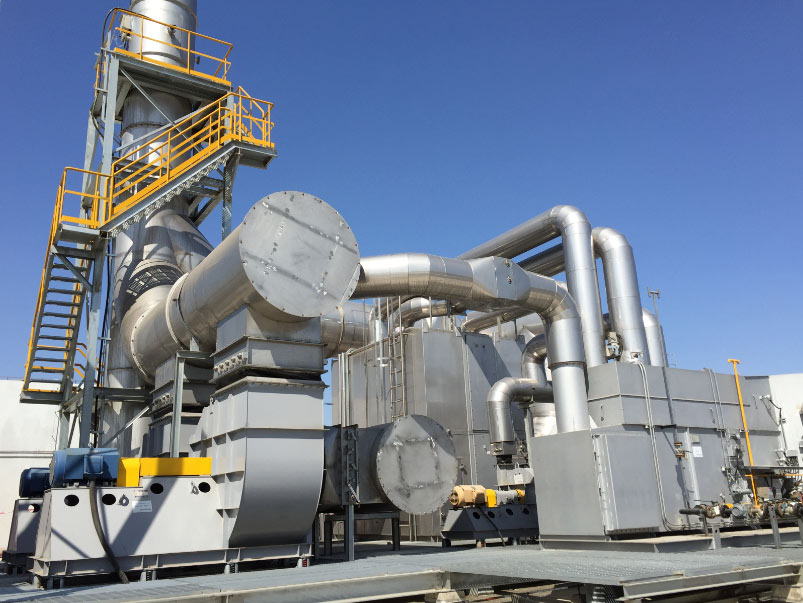

A regenerative catalytic oxidizer (RCO) combines a catalyst bed with regenerative ceramic heat recovery: the catalyst oxidizes VOCs and HAPs at a lower temperature (typically 300-450 C), while the ceramic beds store and reuse heat from the clean gas. This configuration achieves high thermal recovery with low fuel consumption for medium-to-high airflow, continuous duty applications.
How a regenerative catalytic oxidizer works
- Preheat – VOC-laden exhaust passes through a hot ceramic bed and is preheated.
- Catalytic oxidation – The preheated stream passes over the catalyst bed, where organic compounds oxidize at 300-450 C.
- Heat recovery – Clean hot gas transfers heat to a second ceramic bed before leaving the system.
- Reverse or rotate – Switching valves or a rotary distributor reverse the flow so heat recovery continues.
RCO vs catalytic oxidizer vs recuperative catalytic oxidizer
| Configuration | Best suited for | Key difference |
|---|---|---|
| Regenerative catalytic oxidizer (RCO) | Medium-to-high airflow, continuous duty | Ceramic-bed heat recovery, high thermal efficiency, low fuel use |
| Recuperative catalytic oxidizer | Lower to medium airflow, intermittent duty | Fixed heat exchanger, simpler footprint |
| Catalytic oxidizer (CO) | Lower airflow, stable catalyst-compatible gas | Low-temperature oxidation with optional heat recovery |
Typical technical specifications
| Parameter | Typical value |
|---|---|
| Catalyst-bed temperature | 300-450 C* |
| Destruction removal efficiency | 99%+* |
| Heat recovery | Regenerative ceramic beds |
| Airflow | Medium to high |
| Control system | PLC/HMI with interlocks |
*Actual performance depends on waste-gas composition, operating conditions and final system design.
Typical applications
- Surface coating and automotive painting;
- Chemical and pharmaceutical production;
- Printing and packaging solvent exhaust;
- Large airflow with continuous or near-continuous duty.
Frequently asked questions
What is a regenerative catalytic oxidizer?
A regenerative catalytic oxidizer (RCO) combines a catalyst bed with regenerative ceramic heat recovery, oxidizing VOCs at low temperature while recovering up to high levels of thermal energy to minimize fuel use.
What is the difference between an RCO and a catalytic oxidizer?
An RCO adds regenerative ceramic-bed heat recovery to the catalyst system, suits larger airflow and continuous duty, and achieves lower fuel consumption; a catalytic oxidizer is often selected for lower airflow or intermittent duty.
What is the difference between an RCO and a recuperative catalytic oxidizer?
An RCO uses ceramic beds with higher thermal recovery; a recuperative catalytic oxidizer uses a fixed heat exchanger and suits lower to medium airflow with a simpler footprint.
What temperature does an RCO operate at?
The catalyst bed typically operates at 300-450 C, lower than a thermal oxidizer, which reduces fuel consumption in suitable applications.
What can damage the catalyst in an RCO?
Dust, oil mist, sulfur, halogens, silicon compounds and some metals can reduce catalyst activity, so pretreatment may be required.
How much does a regenerative catalytic oxidizer cost?
Cost depends on airflow, VOC concentration, catalyst loading, ceramic media, configuration and scope. Send your process parameters for a preliminary budget estimate.
When is an RCO the right choice?
When airflow is medium to high, duty is continuous, and the gas is catalyst-compatible, an RCO offers low-temperature oxidation with high thermal recovery and low operating cost.
Do you supply RCO systems?
Yes. PollutionCtrl designs and supplies RCO systems with custom catalyst selection, ceramic media, controls and lifecycle catalyst management.
Request a project evaluation
Send the process conditions – airflow, VOC composition and concentration, operating hours and emission target – for an RCO recommendation and budget estimate.
{ “@context”: “https://schema.org”, “@graph”: [ { “@type”: “Product”, “name”: “Regenerative Catalytic Oxidizer (RCO)”, “description”: “Regenerative catalytic oxidizer combining catalyst oxidation at 300-450 C with ceramic-bed heat recovery for medium-to-high airflow VOC control.”, “brand”: {“@type”: “Brand”, “name”: “PollutionCtrl”}, “url”: “https://pollutionctrl.com/regenerative-catalytic-oxidizer/” }, { “@type”: “FAQPage”, “mainEntity”: [ {“@type”: “Question”, “name”: “What is a regenerative catalytic oxidizer?”, “acceptedAnswer”: {“@type”: “Answer”, “text”: “A regenerative catalytic oxidizer (RCO) combines a catalyst bed with regenerative ceramic heat recovery, oxidizing VOCs at low temperature while recovering high levels of thermal energy to minimize fuel use.”}}, {“@type”: “Question”, “name”: “What is the difference between an RCO and a catalytic oxidizer?”, “acceptedAnswer”: {“@type”: “Answer”, “text”: “An RCO adds regenerative ceramic-bed heat recovery to the catalyst system, suits larger airflow and continuous duty, and achieves lower fuel consumption; a catalytic oxidizer is often selected for lower airflow or intermittent duty.”}}, {“@type”: “Question”, “name”: “What is the difference between an RCO and a recuperative catalytic oxidizer?”, “acceptedAnswer”: {“@type”: “Answer”, “text”: “An RCO uses ceramic beds with higher thermal recovery; a recuperative catalytic oxidizer uses a fixed heat exchanger and suits lower to medium airflow with a simpler footprint.”}}, {“@type”: “Question”, “name”: “What temperature does an RCO operate at?”, “acceptedAnswer”: {“@type”: “Answer”, “text”: “The catalyst bed typically operates at 300-450 C, lower than a thermal oxidizer, which reduces fuel consumption in suitable applications.”}}, {“@type”: “Question”, “name”: “What can damage the catalyst in an RCO?”, “acceptedAnswer”: {“@type”: “Answer”, “text”: “Dust, oil mist, sulfur, halogens, silicon compounds and some metals can reduce catalyst activity, so pretreatment may be required.”}}, {“@type”: “Question”, “name”: “How much does a regenerative catalytic oxidizer cost?”, “acceptedAnswer”: {“@type”: “Answer”, “text”: “Cost depends on airflow, VOC concentration, catalyst loading, ceramic media, configuration and scope. Send your process parameters for a preliminary budget estimate.”}}, {“@type”: “Question”, “name”: “When is an RCO the right choice?”, “acceptedAnswer”: {“@type”: “Answer”, “text”: “When airflow is medium to high, duty is continuous, and the gas is catalyst-compatible, an RCO offers low-temperature oxidation with high thermal recovery and low operating cost.”}}, {“@type”: “Question”, “name”: “Do you supply RCO systems?”, “acceptedAnswer”: {“@type”: “Answer”, “text”: “Yes. PollutionCtrl designs and supplies RCO systems with custom catalyst selection, ceramic media, controls and lifecycle catalyst management.”}} ] } ] }What is a regenerative catalytic oxidizer (RCO)?
An RCO destroys volatile organic compounds by passing the exhaust stream through a catalyst bed at roughly 300 to 500 degrees Celsius, with ceramic media on either side recovering heat from the clean gas to preheat the incoming gas. The catalyst lets the oxidation happen at a much lower temperature than thermal oxidation alone, which is where the fuel saving comes from.
The two regenerative beds alternate between heating the incoming gas and being reheated by the outgoing clean gas, so the unit is self-sustaining above a certain solvent concentration. Below that concentration, supplementary fuel is needed.
RCO versus RTO versus CO: how to choose
| Dimension | RCO | RTO | Recuperative CO |
|---|---|---|---|
| Oxidation temperature | About 300–500 °C | About 760–850 °C | About 300–500 °C |
| Heat recovery | Ceramic media, typically above 90% | Ceramic media, typically above 95% | Metallic recuperator, typically 50–70% |
| Fuel use at low concentration | Lowest | Higher | Highest |
| Catalyst risk | Poisoning and masking possible | None | Poisoning and masking possible |
| Destruction efficiency | Typically 95–99% | Typically 99% and above | Typically 95–99% |
| Sensitivity to particulates | High — can mask the catalyst | Lower, but still needs care | High |
| Capital cost at low flow | Higher than CO | Higher than RCO | Lowest |
The decision usually turns on three questions: is the stream chemically compatible with a catalyst, is the concentration low enough that fuel matters, and is continuous compliance required.
When an RCO is the right choice
- Low VOC concentration where an RTO would need continuous supplementary fuel.
- High heat recovery requirement combined with a modest temperature rise limit.
- Clean gas — no significant particulate, no known catalyst poisons, or effective pretreatment upstream.
- Continuous operation, where the fuel saving pays back the catalyst replacement cost over the service interval.
When an RCO is the wrong choice
- Streams containing catalyst poisons — sulphur compounds, halogens, phosphorus, heavy metals and silicones deactivate or mask the catalyst. On those streams an RTO is the safer specification.
- High particulate loading — dust blinds the catalyst surface and the pressure drop rises until the unit must be stopped.
- Very high concentration — the fuel saving that justifies the catalyst disappears, and the catalyst becomes an unnecessary risk.
- Intermittent operation — the thermal mass has to be brought up to temperature for each start, which erodes the operating saving.
Catalyst types and what deactivates them
Two catalyst families dominate: precious metal (platinum or palladium on a washcoat) for general VOC service, and base metal oxide for streams where precious metal would be poisoned by specific compounds. Selection is a chemical question about the stream, not a price question.
- Sulphur and halogens — form compounds that block active sites or attack the washcoat.
- Silicones — oxidise to silica, which coats the catalyst irreversibly.
- Phosphorus and heavy metals — accumulate on the surface and cannot be regenerated in situ.
- Particulate and aerosols — physically mask the surface; a filter or scrubber upstream is part of the design, not an option.
What to specify when requesting an RCO quotation
- Exhaust flow rate at normal conditions, and the expected range of operation.
- VOC species and concentration, including any halogenated or sulphur-bearing compounds.
- Particulate loading and whether upstream filtration exists.
- Required destruction or removal efficiency and the applicable emission limit.
- Operating hours per year and the expected duty cycle.
- Available plot area, utilities and the electrical supply voltage.
- The required documentation and any certification for the destination market.
Frequently asked questions
Can an RCO be converted from an RTO?
Sometimes. The housing and heat exchange media can often be reused, but the catalyst volume, the temperature control philosophy and the auxiliary burner sizing all change. It is an engineering evaluation rather than a parts swap.
How long does an RCO catalyst last?
Service life depends on the stream chemistry and on how well the pretreatment works. It is quoted as an expected interval with replacement cost per unit volume, and it should be part of the total cost of ownership calculation from the start.
Does an RCO handle odour as well as VOC?
It can, provided the odorant compounds are oxidisable at the catalyst operating temperature and are not present at concentrations that poison the catalyst. Odour removal should be verified by testing rather than assumed from a VOC specification.