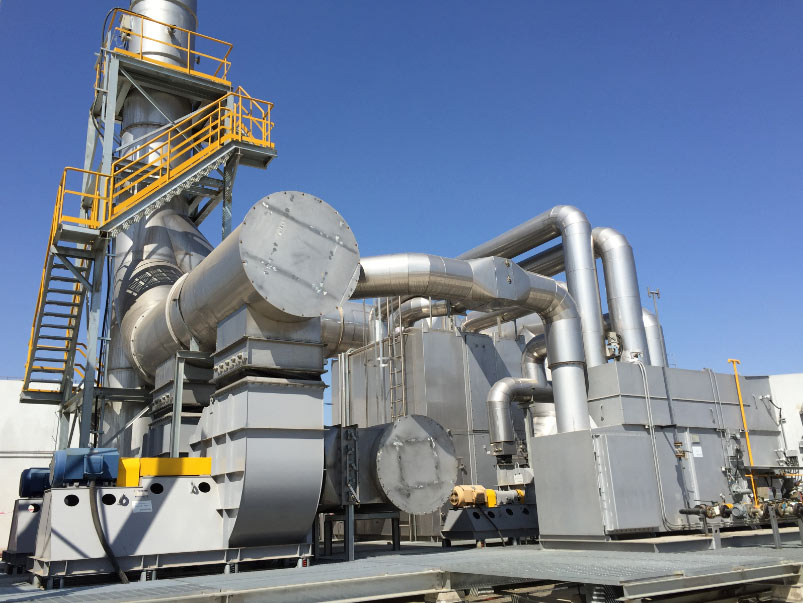

Heat recovery preheats incoming VOC exhaust with clean hot outlet gas, reducing fuel or electric-heating demand. The exchanger design affects operating cost, pressure drop, fouling and maintenance.
Why this component matters
A recuperative heat exchanger is valuable only when the gas stream can pass through it without rapid fouling or corrosion. Temperature, condensation and cleaning access matter as much as nominal efficiency.
| Airflow | Total, minimum and maximum operating airflow. Include simultaneous-use assumptions for multiple emission points. |
|---|---|
| VOC composition | Known solvents, average and peak concentration, calorific value if available, and any changing product recipes. |
| Contaminants | Dust, oil mist, resin aerosol, silicone, sulfur, phosphorus, halogens, heavy metals or catalyst-poisoning compounds. |
| Gas conditions | Normal and peak temperature, humidity, oxygen level, pressure and condensation risk. |
| Compliance target | Required outlet concentration, destruction efficiency, monitoring method and project location. |
What should be reviewed before final selection?
Recovery efficiency
Higher heat recovery lowers heater demand but can increase exchanger size, cost and pressure drop.
Fouling control
Paint mist, resin aerosol, dust or condensables can block passages. Pretreatment and access doors should be planned.
Material selection
Stainless steel grade, insulation and expansion details depend on temperature, moisture and corrosive compounds.
Pressure drop
Exchanger resistance affects fan power and process-room pressure stability.
Condensation risk
Cold spots may create corrosion or sticky deposits if solvent or water vapor condenses.
Secondary heat use
Where useful, recovered heat can support process air or hot water after a project-specific energy balance.
Catalytic Oxidizer Heat Exchanger and Energy Recovery questions
What heat recovery is typical?
It depends on exchanger type, flow, temperature and fouling allowance. Claims should be verified against the full system heat balance.
Can the heat exchanger be cleaned?
Access doors, removable sections or cleaning ports can be designed when fouling risk is expected.
When is RCO better than recuperative CO?
RCO may be evaluated for larger continuous flows where regenerative heat recovery is more economical.
Send VOC data for catalytic oxidizer sizing
Share airflow, VOC composition, concentration range, temperature, humidity, dust or mist content, operating schedule and required emission limit. We will review whether a catalytic oxidizer, RCO, RTO, zeolite rotor or carbon system is the better fit.