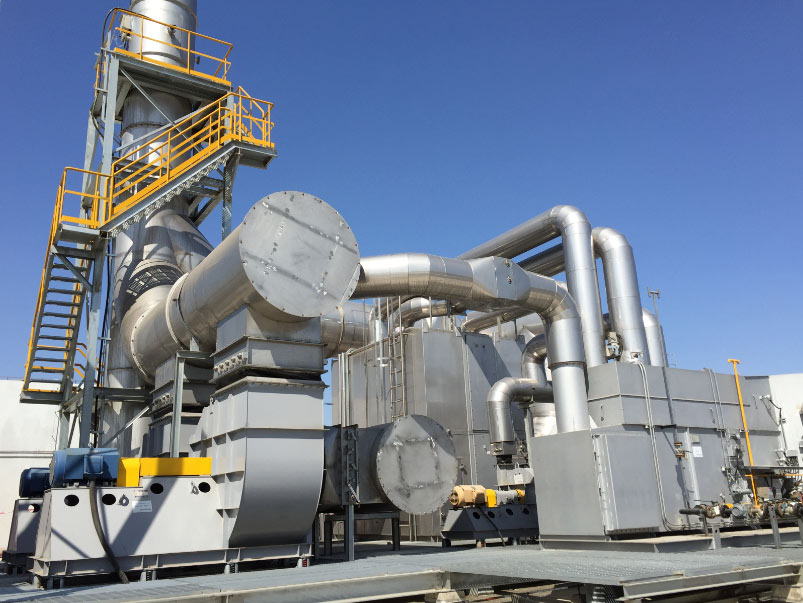

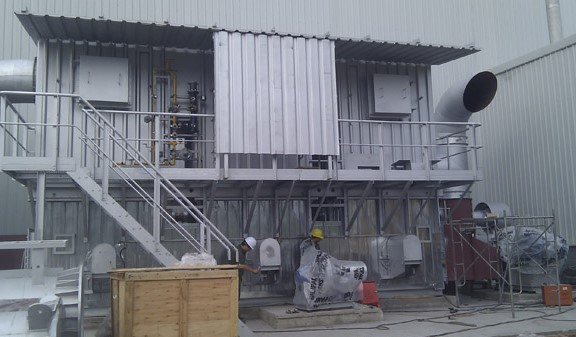

Case 3: RTO with Waste Heat Recovery for Phthalic Anhydride Tail Gas (Xinbao Coal Chemical)
Project Overview
This is a tail gas treatment project for a 40kt/a phthalic anhydride production plant. The flue gas contains phthalic anhydride, maleic anhydride, benzoic acid, naphthoquinone, sulfur dioxide and other substances, with complex components and acidic media. The system needs to realize VOC purification and waste heat recovery simultaneously to maximize economic benefits.
Core Parameters
- Design gas treatment capacity: 75,000 Nm³/h
- Combustion temperature: 850℃
- Annual operating hours: 8,000
Process Solution
Integrated process: Desulfurization Tower + Three-Chamber RTO + Waste Heat Boiler
Process Flow: Production Tail Gas → Desulfurization Tower → Mist Eliminator → RTO Incinerator → Waste Heat Boiler → Chimney Discharge
Pre-desulfurization: Wet desulfurization tower removes acidic gas such as SO₂ to prevent corrosion on high-temperature equipment.
High-temperature Incineration: Organic pollutants are fully oxidized and decomposed inside RTO, with VOC removal efficiency ≥ 99%.
Waste Heat Utilization: High-temperature flue gas enters the heat pipe boiler to produce saturated steam for energy recovery.
Main Equipment
Desulfurization tower & circulating pump, three-chamber RTO, ceramic regenerator, pneumatic poppet dampers, 8t/h heat pipe waste heat boiler, explosion-proof fans, electrical & instrument assemblies.
Operation Performance
- Emission: VOC, NOₓ and particulate matter all reach industrial emission standards, no peculiar odor.
- Energy Benefit: The boiler produces 8.8 tons of saturated steam per hour. The annual income from waste heat far exceeds operating costs, realizing waste-to-energy.
- Equipment Durability: Pre-desulfurization reduces acid corrosion; the outer shell temperature of RTO is controlled below 65℃.
- Maintenance: Modular design, convenient inspection and replacement of components.
Technical Highlights
- Integrated design of desulfurization, incineration and waste recovery, suitable for acidic organic waste gas from coal chemical industry.
- Stable operation with small pressure fluctuation during valve switching.
- Equipped with FM/IRI certified burner and flame monitoring devices for multi-level safety protection.
Why desulfurisation comes before the RTO
Tail gas from phthalic anhydride production carries sulfur dioxide alongside the organic compounds. If that gas reaches the RTO directly, the sulfur converts further in the combustion chamber, the acid dew point of the exhaust rises, and the heat exchange media and the downstream boiler become exposed to acid condensation. Putting a desulfurisation tower upstream protects the RTO and the waste heat boiler, and it changes the material selection for everything downstream.
Why a three-chamber RTO at 75,000 Nm³/h
- Continuous destruction — with three chambers, one is always in purge while the other two exchange heat, so the unit does not need to interrupt treatment to cycle.
- Higher destruction efficiency — the purge step stops untreated gas from passing straight through during changeover, which is what allows a 99%+ guarantee on a large unit.
- Thermal stability at scale — at this flow the ceramic mass is large and the unit holds temperature through load changes, which matters when the upstream plant swings.
Why recover heat rather than just destroy
At 850 °C and 75,000 Nm³/h, the exhaust carries a substantial heat flow. A waste heat boiler downstream converts that into steam for the process, which is what turns an abatement cost into a partial credit. The economics of the whole project usually depend on this recovery, so the boiler duty should be specified together with the RTO, not added afterwards.
What to specify for a similar chemical tail gas
- Gas composition including acid gases and sulfur species, and the resulting acid dew point.
- Design flow and the variation expected from the production plant.
- Combustion temperature required for the specific compounds — some aromatics need higher temperatures than others.
- Required destruction efficiency and the measurement method for compliance.
- Heat recovery target and the steam or hot water demand it will serve.
- Material specification for the wet, acidic sections.
Frequently asked questions
Why not use a catalytic oxidiser on this stream?
Catalyst poisons. Sulfur compounds and heavy-metal contaminants deactivate the catalyst, and the economics of catalyst replacement would overwhelm the fuel saving. Thermal oxidation is the robust choice for a dirty, sulfur-bearing stream.
Why 850 °C rather than a lower combustion temperature?
The combination of aromatic compounds requires a higher temperature and sufficient residence time to reach the destruction target. The temperature is set by the hardest-to-destroy compound in the stream, not by the average.